Basis DSP
Basis DSP is a comprehensive media automation and intelligence platform that provides programmatic advertising solutions, offering advanced campaign management, audience targeting, and performance analytics for digital marketing professionals.

Power end-to-end data operations for your Basis DSP API with Nexla. Our bi-directional Basis DSP connector is purpose-built for Basis DSP, making it simple to ingest data, sync it across systems, and deliver it anywhere — all with no coding required. Nexla turns API-sourced data into ready-to-use, reusable data products and makes it easy to send data to Basis DSP or any other destination. With comprehensive monitoring, lineage tracking, and access controls, Nexla keeps your Basis DSP workflows fast, secure, and fully governed.
Features
Type: API
- Seamless API Integration: Connect to any endpoint as source or destination without coding, with automatic data product creation
- Visual Composition & Chaining: Build complex integrations using visual templates, chain API calls, and compose workflows with data validation and filtering
- API Proxy: Expose curated slices of your data securely with a secure and customizable API proxy that validates and transforms data on the fly
- Request optimization with intelligent batching, retry, and caching to minimize API calls and costs
Prerequisites
Before creating a Basis DSP credential in Nexla, you need to obtain OAuth 2.0 client credentials (Client ID and Client Secret) from Basis DSP. Basis DSP uses OAuth 2.0 with client credentials flow for secure API access.
Basis DSP requires OAuth 2.0 client credentials for API access. These credentials are typically provided by Basis DSP through email or your Basis DSP account settings.
-
Contact Basis DSP: Reach out to Basis DSP support or your account representative to request API access and OAuth 2.0 client credentials. Basis DSP will provide you with a Client ID and Client Secret via email or through your account portal.
-
Obtain Client Credentials: Once you receive the Basis API email, you will have:
- Client ID: A unique identifier for your OAuth application
- Client Secret: A secret key used to authenticate your application
- Access Scope: The scope of access granted to your application (typically
STATSfor statistics access)
-
Review Access Scope: Understand the access scope provided with your credentials. The default scope is typically
STATS, which provides access to statistics and reporting data. Different scopes may provide access to different API endpoints and data. -
Copy Credentials: Copy your Client ID and Client Secret immediately after receiving them. Keep these credentials secure, as they provide access to your Basis DSP account data.
Basis DSP OAuth 2.0 client credentials provide programmatic access to your Basis DSP account. Keep your Client ID and Client Secret secure and do not share them publicly or commit them to version control systems. The credentials use the OAuth 2.0 client credentials flow, which exchanges the Client ID and Client Secret for an access token. For detailed information about Basis DSP API authentication, see the Basis DSP API documentation.
For additional information about Basis DSP API authentication and credential management, see the Basis DSP API documentation.
Authenticate
Credentials required
| Field | Required | Secret | Description |
|---|---|---|---|
| Client ID | Yes | No | The Basis Client ID received from a Basis API email |
| Client Secret | Yes | Yes | Basis DSP Client Secret for Token URL |
| Access Scope | Yes | No | Basis DSP Access Scope |
Create a credential in Nexla
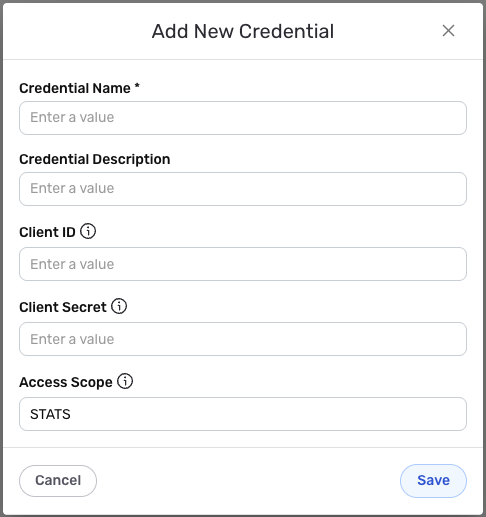
- After selecting the data source/destination type, click the Add Credential tile to open the Add New Credential overlay.
New Credential Overlay – Basis DSP
-
Enter a name for the credential in the Credential Name field and a short, meaningful description in the Credential Description field.
-
Enter your Basis DSP Client ID in the Client ID field. This should be the Client ID received from Basis DSP in the Basis API email. The Client ID is used together with the Client Secret to obtain an OAuth 2.0 access token.
-
Enter your Basis DSP Client Secret in the Client Secret field. This should be the Client Secret received from Basis DSP. The Client Secret is used together with the Client ID to authenticate and obtain an OAuth 2.0 access token.
The Client ID and Client Secret are used for OAuth 2.0 client credentials flow authentication. The credentials are exchanged for an access token using the token endpoint (
https://api.sitescout.com/oauth/token). The access token is then used in theAuthorization: Bearer {token}header for all API requests. Keep your Client Secret secure and do not share it publicly or commit it to version control systems. For detailed information about Basis DSP API authentication, see the Basis DSP API documentation. -
Enter the access scope in the Access Scope field. This should be the scope of access granted to your application (e.g.,
STATSfor statistics access). The default value isSTATSif not specified. The scope determines which API endpoints and data you can access.The access scope determines the level of access your application has to the Basis DSP API. The default scope is
STATS, which provides access to statistics and reporting data. Different scopes may provide access to different API endpoints. Ensure the scope matches the access level granted by Basis DSP for your application. -
Click the Save button at the bottom of the overlay. The newly added credential will now appear in a tile on the Authenticate screen during data source/destination creation.
Use as a data source
To create a new data flow, navigate to the Integrate section, and click the New Data Flow button. Select the desired flow type, then select the Basis DSP connector tile and the credential that will be used to connect to the Basis DSP instance, and click Next; or, create a new Basis DSP credential for use in this flow.
Endpoint templates
Nexla provides pre-built templates that can be used to rapidly configure data sources to ingest data from common Basis DSP endpoints. Select the endpoint from which this source will fetch data from the Endpoint pulldown menu. Available endpoint templates are listed in the expandable boxes below. Click on an endpoint to see more information about it and how to configure your data source for this endpoint.
Once the selected endpoint template has been configured, click the Test button to the right of the endpoint selection menu to retrieve a sample of the data that will be fetched. Sample data will be displayed in the Endpoint Test Result panel on the right, allowing you to verify that the source is configured correctly before saving.
Manual configuration
Basis DSP data sources can also be manually configured to ingest data from any valid Basis DSP API endpoint, including endpoints not covered by the pre-built templates, chained API calls that fetch data from multiple endpoints, or custom request parameters. Select the Advanced tab at the top of the configuration screen, and follow the instructions in Connect to Any API to configure the API method, endpoint URL, path to data, metadata, and request headers.
The Basis DSP API base URL is https://api.sitescout.com, and endpoints follow the pattern https://api.sitescout.com/{api_path} (e.g., /advertisers/{advertiserId}, /advertisers/{advertiserId}/campaigns). Responses return an array at the root level, so the path to data is entered as $[*]. Basis DSP API requests require OAuth 2.0 authentication with a Bearer token, and the Authorization: Bearer {token} header is automatically included in requests using your credential configuration.
Once all of the relevant settings have been configured, click the Create button in the upper right corner of the screen to save and create the new Basis DSP data source. Nexla will now begin ingesting data from the configured endpoint and will organize any data that it finds into one or more Nexsets.