Jina AI Embeddings
Jina AI Embeddings is a high-performance embedding service that converts text into numerical vector representations, capturing semantic meanings for applications like semantic search, dense retrieval, and similarity matching. The Jina AI Embeddings connector enables you to generate embeddings from text using Jina AI's embedding models, allowing you to convert textual data into vector representations for use in search systems, recommendation engines, and AI-powered applications. This connector is particularly useful for applications that need to perform semantic search, build recommendation systems, analyze text similarity, or prepare data for vector databases.

Power end-to-end data operations for your Jina AI Embeddings API with Nexla. Our bi-directional Jina AI Embeddings connector is purpose-built for Jina AI Embeddings, making it simple to ingest data, sync it across systems, and deliver it anywhere — all with no coding required. Nexla turns API-sourced data into ready-to-use, reusable data products and makes it easy to send data to Jina AI Embeddings or any other destination. With comprehensive monitoring, lineage tracking, and access controls, Nexla keeps your Jina AI Embeddings workflows fast, secure, and fully governed.
Features
Type: API
- Seamless API Integration: Connect to any endpoint as source or destination without coding, with automatic data product creation
- Visual Composition & Chaining: Build complex integrations using visual templates, chain API calls, and compose workflows with data validation and filtering
- API Proxy: Expose curated slices of your data securely with a secure and customizable API proxy that validates and transforms data on the fly
- Request optimization with intelligent batching, retry, and caching to minimize API calls and costs
Prerequisites
Before creating a Jina AI Embeddings credential, you'll need to obtain an API key from your Jina AI account. Jina AI provides API keys for programmatic access to their embedding services through the API dashboard.
To obtain a Jina AI API key:
-
Log in to your Jina AI account at
https://jina.aior create an account if you don't have one. -
Navigate to the API dashboard at
https://jina.ai/api-dashboard/or access it from your Jina AI account settings. -
In the API dashboard, locate the section for API key management. This is typically found in your account settings or a dedicated API/Developer section.
-
Click Create API Key or Generate New Key to create a new API key for your application.
-
Copy the API key immediately after generation, as it may only be displayed once for security purposes. Store it securely, as you'll need it to authenticate API requests.
-
Note the base URL for the Jina AI API (typically
https://api.jina.ai) and the API version you'll be using (typicallyv1for the current Jina AI API version).
For detailed information about Jina AI API authentication and API key management, refer to the Jina AI Embeddings Documentation and Jina AI API Dashboard.
Authenticate
Credentials required
Authenticate using your Jina AI API key
| Field | Required | Secret | Description |
|---|---|---|---|
| Jina AI API Key | Yes | Yes | Your API key from https://jina.ai/api-dashboard/ |
| Base URL | Yes | No | The base URL for the Jina AI API. |
| API Version | Yes | No | Parameter for defining the API version for Jina API requests |
| API Version | Yes | No | Embeddings payload to test a connection |
Create a credential in Nexla
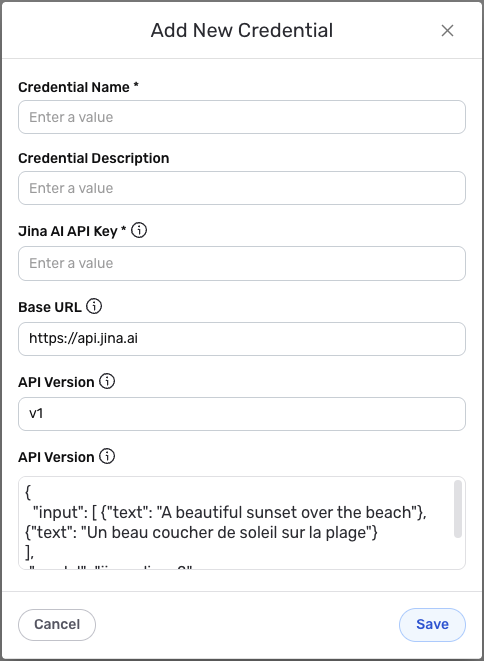
- To create a new Jina AI Embeddings credential, after selecting the data source/destination type, click the Add Credential tile to open the Add New Credential overlay.
New Credential Overlay – Jina AI Embeddings
-
Enter a name for the credential in the Credential Name field and a short, meaningful description in the Credential Description field.
-
In the Jina AI API Key field, enter the API key that you obtained from your Jina AI API dashboard. This is the secret API key used to authenticate requests to the Jina AI Embeddings API.
The API key is sensitive information and should be kept secure. If you've lost your API key, you'll need to generate a new one in your Jina AI API dashboard. API keys are used in the Authorization header as a Bearer token for all API requests.
-
In the Base URL field, enter the base URL for the Jina AI API. The default value is
https://api.jina.ai, which is the standard base URL for Jina AI's embedding API. You typically won't need to change this unless you're using a custom endpoint. -
In the API Version field, enter the API version you want to use. The default value is
v1, which is the current version of the Jina AI Embeddings API. You can specify a different version if your organization uses a specific API version. -
Once all of the relevant fields have been completed, click the Save button at the bottom of the overlay to save the configured credential. The newly added credential will now appear in a tile on the Authenticate screen during data source/destination creation.
Use as a data source
To create a new data flow, navigate to the Integrate section, and click the New Data Flow button. Select the Jina AI Embeddings connector tile, then select the credential that will be used to connect to the Jina AI Embeddings API, and click Next; or, create a new Jina AI Embeddings credential for use in this flow.
Endpoint templates
Nexla provides pre-built templates that can be used to rapidly configure data sources to ingest data from common Jina AI Embeddings API endpoints. Select the endpoint from which this source will fetch data from the Endpoint pulldown menu. Available endpoint templates are listed in the expandable boxes below.
Once the selected endpoint template has been configured, click the Test button to the right of the endpoint selection menu to retrieve a sample of the data that will be fetched. Sample data will be displayed in the Endpoint Test Result panel on the right, allowing you to verify that the source is configured correctly before saving.
Manual configuration
Jina AI Embeddings data sources can also be manually configured to ingest data from any valid Jina AI Embeddings API endpoint, including endpoints not covered by the pre-built templates, chained API calls, or custom request parameters. Select the Advanced tab at the top of the configuration screen, and follow the instructions in Connect to Any API to configure the API method, endpoint URL, date/time and lookup macros, path to data, metadata, and request headers.
Jina AI Embeddings API endpoints typically follow the pattern https://api.jina.ai/v1/embeddings, and most endpoints use the POST method to submit text for embedding.
Jina AI Embeddings API responses return an array of embedding objects under a top-level data property, so enter $.data[*] as the path to data for these responses.
You do not need to include an Authorization header—it is handled automatically by Nexla based on your credential configuration.
Once all of the relevant settings have been configured, click the Create button in the upper right corner of the screen to save and create the new Jina AI Embeddings data source. Nexla will now begin ingesting data from the configured endpoint and will organize any data that it finds into one or more Nexsets.