The Finnhub connector enables you to ingest real-time and historical financial market data into Nexla, including stock quotes, candlestick data, company fundamentals, insider transactions, earnings data, forex rates, cryptocurrency data, ETF holdings, economic indicators, and market news. Follow the instructions below to create a new data flow that ingests data from a Finnhub source in Nexla.
Create a New Data Flow
-
To create a new data flow, navigate to the Integrate section, and click the New Data Flow button. Then, select the desired flow type from the list, and click the Create button.
-
Select the Finnhub connector tile from the list of available connectors. Then, select the credential that will be used to connect to the Finnhub instance, and click Next; or, create a new Finnhub credential for use in this flow.
-
In Nexla, Finnhub data sources can be created using pre-built endpoint templates, which expedite source setup for common Finnhub API endpoints. Each template is designed specifically for the corresponding Finnhub endpoint, making source configuration easy and efficient.
• To configure this source using a template, follow the instructions in Configure Using a Template.
Finnhub sources can also be configured manually, allowing you to ingest data from Finnhub endpoints not included in the pre-built templates or apply further customizations to exactly suit your needs.
• To configure this source manually, follow the instructions in Configure Manually.
Nexla provides pre-built templates that can be used to rapidly configure data sources to ingest data from common Finnhub API endpoints. Each template is designed specifically for the corresponding Finnhub endpoint, making data source setup easy and efficient.
Endpoint Settings
- Select the endpoint from which this source will fetch data from the Endpoint pulldown menu. Available endpoint templates are listed in the expandable boxes below. Click on an endpoint to see more information about it and how to configure your data source for this endpoint.
Basic Financial Report
Returns reported financial statements for a company, including balance sheet, income statement, and cash flow statement data. Use this endpoint to ingest structured financial statement data for fundamental analysis or financial modeling.
- This endpoint retrieves all available reported financial statements for the company associated with the credentials. No additional parameters are required — select this endpoint and the data will be fetched automatically.
- The response data path is
$.data[*], meaning Nexla will treat each reported financial period as a separate record in the resulting Nexset.
Insider Sentiment
Returns aggregate insider sentiment metrics for a company, indicating aggregate buying and selling trends among company insiders over time. Use this endpoint to monitor insider sentiment as part of investment research or market signal pipelines.
- This endpoint retrieves aggregate insider sentiment data automatically. No additional parameters are required — select this endpoint and the data will be fetched for all available periods.
- The response data path is
$.data[*], meaning Nexla will treat each sentiment period as a separate record.
Get Quote
Retrieves real-time stock quote data for a specified stock symbol, including the current price, open, high, low, previous close, and price change. Use this endpoint to ingest live price data for individual equities.
Get Company Profile
Retrieves general company information for a specific company, including name, country, currency, exchange, industry, market capitalization, and logo URL. Use this endpoint to enrich your datasets with company metadata or build company reference tables.
Get Company News
Retrieves recent news articles for a specific company filtered by date range. Use this endpoint to ingest company-specific news for sentiment analysis, event detection, or monitoring pipelines.
- Enter the stock ticker symbol in the Symbol field (e.g.,
AAPL). This field is required. - Enter the start date of the news date range in the From field, formatted as
YYYY-MM-DD (e.g., 2024-01-01). This field is required. - Enter the end date of the news date range in the To field, formatted as
YYYY-MM-DD (e.g., 2024-01-31). This field is required. - The response returns an array of news article objects. The data path is
$[*], meaning Nexla will treat each article as a separate record.
Get Company Earnings
Retrieves historical quarterly earnings surprises and EPS (earnings per share) data for a specified company. Use this endpoint to build earnings history datasets or track EPS trends over time.
- Enter the stock ticker symbol in the Symbol field (e.g.,
AAPL). This field is required. - Optionally, enter a maximum number of records to return in the Limit field. When left blank, Finnhub returns all available historical earnings records for the company.
- The response returns an array of quarterly earnings objects. The data path is
$[*], meaning each earnings period is treated as a separate record.
Get Insider Transactions
Retrieves insider buy and sell transactions reported to the SEC for a specified stock symbol, with optional date range filtering. Use this endpoint to monitor insider trading activity as part of compliance, research, or investment signal workflows.
- Enter the stock ticker symbol in the Symbol field (e.g.,
AAPL). This field is required. - Optionally, enter a start date in the From field, formatted as
YYYY-MM-DD, to filter transactions from a specific date onward. - Optionally, enter an end date in the To field, formatted as
YYYY-MM-DD, to filter transactions up to a specific date. - The response data path is
$.data[*], meaning Nexla will treat each individual insider transaction as a separate record.
Get Market News
Retrieves general market news articles across multiple categories, including general market news, forex, crypto, and merger and acquisition news. Use this endpoint to build market news feeds or power financial sentiment analysis pipelines.
Get Stock Candlestick Data
Returns OHLCV (open, high, low, close, volume) candlestick data for a stock symbol over a specified time range and resolution. Use this endpoint to build historical price datasets for technical analysis, charting, or quantitative modeling.
Get Basic Financial Metrics
Returns key financial metrics for a company, including 52-week high and low prices, P/E ratio, EPS, market capitalization, and other valuation and performance indicators. Use this endpoint to build company screening datasets or enrich financial dashboards.
Get Earnings Calendar
Returns historical and upcoming earnings release dates, EPS estimates, and actual EPS results for companies across a date range. Use this endpoint to build earnings event calendars, track estimate revisions, or power event-driven trading pipelines.
- Optionally, enter the start date of the earnings calendar range in the Start Date field, formatted as
YYYY-MM-DD. - Optionally, enter the end date of the earnings calendar range in the End Date field, formatted as
YYYY-MM-DD. - Optionally, enter a stock ticker symbol in the Stock Symbol field to filter earnings events for a single company.
- Optionally, set the Include International field to
true to include international (non-US) stocks in the results, or false (default) to return only US-listed companies. - The response data path is
$.earningsCalendar[*], meaning each earnings event is treated as a separate record.
Search Stock Symbols
Searches for stock symbols and company names matching a query string. Use this endpoint to build symbol lookup tools, validate ticker symbols, or populate reference datasets with symbol and company name mappings.
- Optionally, enter a search query string in the Search Query field. This can be a partial company name or ticker symbol (e.g.,
Apple or AAP). - Optionally, enter an exchange code in the Exchange field to filter results to a specific exchange (e.g.,
US for US exchanges, L for London Stock Exchange). - The response data path is
$.result[*], meaning each matching symbol result is treated as a separate record.
Get Price Target Consensus
Retrieves analyst price target consensus data for a stock, including the high, low, mean, and median price targets from analyst coverage. Use this endpoint to incorporate sell-side analyst targets into investment research or screening workflows.
- Optionally, enter the stock ticker symbol in the Stock Symbol field (e.g.,
AAPL). - The response returns a single JSON object containing the consensus price target fields. The data path is
$.
Get Company Peers
Returns a list of peer company ticker symbols for a given stock, based on the company's country of domicile and GICS (Global Industry Classification Standard) sub-industry classification. Use this endpoint to build peer comparison datasets or populate sector analysis workflows.
- Optionally, enter the stock ticker symbol in the Stock Symbol field (e.g.,
AAPL). - The response returns an array of peer ticker symbol strings. The data path is
$[*], meaning each peer symbol is treated as a separate record.
Peer groupings are based on GICS sub-industry classification and may include both domestic and international peers. For more details, see the Finnhub Company Peers documentation.
Get EPS Consensus Estimates
Retrieves earnings per share (EPS) consensus estimates for a company, filterable by frequency (annual or quarterly). Use this endpoint to track forward-looking EPS estimates for fundamental analysis or earnings forecast pipelines.
Get Fund and Institutional Ownership
Returns a list of fund and institutional investors holding shares in a company, sorted by shares held in descending order. Use this endpoint to analyze institutional ownership concentration, track changes in fund positions, or build ownership dashboards.
- Optionally, enter the stock ticker symbol in the Stock Symbol field (e.g.,
AAPL). - Optionally, enter the maximum number of ownership records to return in the Result Limit field. When left blank, Finnhub returns all available ownership records.
- The response data path is
$.data[*], meaning each institutional holder is treated as a separate record.
Get IPO Calendar
Retrieves upcoming and recent IPO (Initial Public Offering) events, including the expected date, exchange, price range, and number of shares offered. Use this endpoint to build IPO tracking pipelines or monitor new listings for investment research.
- Optionally, enter a start date in the Start Date field, formatted as
YYYY-MM-DD, to filter IPO events from a specific date onward. - Optionally, enter an end date in the End Date field, formatted as
YYYY-MM-DD, to filter IPO events up to a specific date. - The response data path is
$.ipoCalendar[*], meaning each IPO event is treated as a separate record.
Get Forex Candlestick Data
Returns OHLCV candlestick data for a forex currency pair over a specified time range and resolution. Use this endpoint to ingest historical foreign exchange price data for currency analysis, algorithmic trading, or reporting.
Get Crypto Candlestick Data
Returns OHLCV candlestick data for a cryptocurrency symbol over a specified time range and resolution. Use this endpoint to ingest historical crypto price data for trading analysis, portfolio monitoring, or backtesting.
List Crypto Symbols
Returns the list of all available cryptocurrency symbols for a given exchange. Use this endpoint to discover tradable crypto pairs on a specific exchange, or to build a reference dataset of supported symbols before configuring candlestick or price data sources.
- Optionally, enter the exchange name in the Exchange field (e.g.,
BINANCE, COINBASE). Use the List Crypto Exchanges endpoint to retrieve the full list of supported exchange names. - The response returns an array of symbol objects. The data path is
$[*], meaning each symbol entry is treated as a separate record.
List Forex Symbols
Returns the list of all available forex symbols for a given exchange. Use this endpoint to discover currency pairs supported on a specific forex exchange before configuring forex candlestick or rate data sources.
- Optionally, enter the exchange name in the Exchange field (e.g.,
OANDA, FXCM). Use the Retrieve Forex Rates endpoint to discover available exchange and currency codes. - The response returns an array of symbol objects. The data path is
$[*], meaning each symbol entry is treated as a separate record.
Retrieve Economic Data
Retrieves a time-series of economic indicator data by economic code (e.g., GDP, CPI, unemployment rate). Use this endpoint to ingest macroeconomic data for economic analysis, forecasting models, or enriching market datasets with macroeconomic context.
Retrieve ETF Holdings
Retrieves the holdings and constituent weights for an ETF (Exchange-Traded Fund). Use this endpoint to analyze ETF composition, track position changes over time, or build ETF transparency dashboards.
- Optionally, enter the ETF ticker symbol in the Symbol field (e.g.,
SPY for the SPDR S&P 500 ETF or QQQ for the Invesco QQQ Trust). - The response data path is
$.holdings[*], meaning each individual holding is treated as a separate record.
Retrieve ETF Profile
Retrieves profile and metadata for an ETF, including the fund name, description, asset class, expense ratio, and total assets under management. Use this endpoint to build ETF reference data or enrich ETF holding datasets with fund-level metadata.
- Optionally, enter the ETF ticker symbol in the Symbol field (e.g.,
SPY). - The response returns a single JSON object containing the ETF profile fields. The data path is
$.
Retrieve Forex Rates
Retrieves all supported forex exchange rates for a specified base currency. Use this endpoint to ingest current exchange rate data for currency conversion pipelines, financial reporting, or multi-currency data normalization.
- Optionally, enter the base currency code in the Base field using the standard ISO 4217 three-letter currency code (e.g.,
USD for US Dollar, EUR for Euro, GBP for British Pound). - The response returns a JSON object containing exchange rates for all supported currencies relative to the base currency. The data path is
$.
Retrieve Technical Indicators
Retrieves aggregate technical indicator values for a stock symbol and resolution over a configurable time range. Use this endpoint to incorporate computed technical signals (such as moving averages, RSI, or MACD) directly into Nexla data flows for quantitative analysis or trading signal pipelines.
- Enter the stock ticker symbol in the Symbol field (e.g.,
AAPL). This field is required. Enter the time resolution in the Resolution field. This field is required. Supported values are:
1, 5, 15, 30, 60 — Intraday in minutesD — Daily, W — Weekly, M — Monthly
- Enter the start of the data range in the From (UNIX Timestamp) field as a Unix timestamp in seconds (e.g.,
1609459200 for January 1, 2021). This field is required. - Enter the end of the data range in the To (UNIX Timestamp) field as a Unix timestamp in seconds. This field is required.
Enter the technical indicator name in the Indicator field. This field is required. Common indicators include:
sma — Simple Moving Averageema — Exponential Moving Averagersi — Relative Strength Indexmacd — Moving Average Convergence Divergenceadx — Average Directional Index
- The response returns a JSON object. The data path is
$.
Retrieve Stock Dividends
Retrieves historical dividend data for a stock symbol over a specified date range, including dividend amounts, declaration dates, payment dates, and record dates. Use this endpoint to build dividend history datasets for income analysis, portfolio yield calculations, or total return modeling.
- Optionally, enter the stock ticker symbol in the Symbol field (e.g.,
AAPL). - Enter the start date of the dividend history range in the From Date field, formatted as
YYYY-MM-DD. This field is required. - Enter the end date of the dividend history range in the To Date field, formatted as
YYYY-MM-DD. This field is required. - The response returns an array of dividend event objects. The data path is
$[*], meaning each dividend event is treated as a separate record.
List Crypto Exchanges
Returns the list of all supported cryptocurrency exchanges available through the Finnhub API. Use this endpoint to discover which exchanges you can use when configuring cryptocurrency candlestick or symbol data sources.
- No additional parameters are required for this endpoint. Select it from the endpoint menu, and Nexla will automatically fetch the complete list of supported exchanges.
- The response returns a JSON object. The data path is
$.
List Economic Codes
Returns the complete catalog of all available economic data codes, including country, category, and description for each indicator. Use this endpoint to discover the correct code to use with the Retrieve Economic Data endpoint.
- No additional parameters are required for this endpoint. Select it from the endpoint menu, and Nexla will automatically fetch the full economic code catalog.
- The response returns a JSON object. The data path is
$.
Get Index Constituents
Returns the current list of constituent ticker symbols for a major stock index, such as the S&P 500, NASDAQ 100, or Dow Jones Industrial Average. Use this endpoint to build index membership datasets, track index composition changes, or populate universe-of-securities filters for screening workflows.
Endpoint Testing
Once the selected endpoint template has been configured, Nexla can retrieve a sample of the data that will be fetched according to the current settings. This allows users to verify that the source is configured correctly before saving.
-
To test the current endpoint configuration, click the Test button to the right of the endpoint selection menu. Sample data will be fetched & displayed in the Endpoint Test Result panel on the right.
-
If the sample data is not as expected, review the selected endpoint and associated settings, and make any necessary adjustments. Then, click the Test button again, and check the sample data to ensure that the correct information is displayed.
Finnhub data sources can be manually configured to ingest data from any valid Finnhub API endpoint. Manual configuration provides maximum flexibility for accessing endpoints not covered by pre-built templates or when you need custom API configurations.
With manual configuration, you can also create more complex Finnhub sources, such as sources that use chained API calls to fetch data from multiple endpoints, or sources that require custom date range parameters or additional query string values.
API Method
-
To manually configure this source, select the Advanced tab at the top of the configuration screen.
-
Select the API method that will be used for calls to the Finnhub API from the Method pulldown menu. Finnhub's API endpoints use GET for all data retrieval operations.
API Endpoint URL
- Enter the URL of the Finnhub API endpoint from which this source will fetch data in the Set API URL field. All Finnhub API endpoints use the base URL
https://finnhub.io/api/v1/ followed by the endpoint path and any query parameters.
The Finnhub API key is automatically included in requests via the credential configured for this source — you do not need to append it manually to the URL. For the complete list of Finnhub endpoints and their URL formats, see the Finnhub API documentation.
Date/Time Macros (API URL)
Optional
Optionally, the API URL can be customized using macros—all macros added to the API URL will be converted into values when Nexla executes the API call. Macros are dynamic placeholders that allow you to create flexible API endpoints that can adapt to different time periods or data requirements.
Date/time macros are particularly useful for Finnhub endpoints that accept date range parameters (such as from and to), allowing you to create rolling data ingestion windows without manually updating the URL. Many Finnhub endpoints accept dates in YYYY-MM-DD format.
-
To add a macro, type { at the appropriate position in the API URL (within the Set API URL field), and select the desired macro from the dropdown list.
{now} – The current datetime{now-1} – The datetime one time unit before the current datetime{now+1} – The datetime one time unit after the current datetimecustom – Datetime macros can reference any number of time units before or after the current datetime—for example, enter (now-4) to indicate the datetime four time units before the current datetime
-
Select the format that will be applied to datetime macros from the Date Format for Date/Time Macro pulldown menu. This format will be applied to the base datetime value of the macro—i.e., the value of {now} in {now-1}.
-
Select the datetime unit that will be used to perform mathematical operations in the included macro(s) from the Time Unit for Operations pulldown menu—for example, for the macro {now-1}, when Day is selected, {now-1} will be converted to the datetime one day before the current datetime.
Lookup-Based Macros (API URL)
Optional
Column values from existing lookups can also be included as macros in the API URL. Lookup-based macros allow you to reference data from previously configured data sources or lookups, enabling dynamic API endpoints that can adapt based on existing data.
Lookup-based macros are useful for Finnhub sources when you need to dynamically supply stock symbols, exchange codes, or other parameter values from an existing Nexla dataset rather than entering them statically.
-
To include a lookup column value macro, select the relevant lookup from the Add Lookups to Supported Macros pulldown menu.
-
Type { at the appropriate position in the API URL, and select the lookup column-based macro from the dropdown list. Lookup-based macros are automatically populated into the macro list when a lookup is selected in the Add Lookups to Supported Macros pulldown menu.
If only a subset of the data that will be returned by API endpoint is needed, you can designate the part(s) of the response that should be included in the Nexset(s) produced from this source by specifying the path to the relevant data within the response. This is particularly useful when API responses contain metadata, pagination information, or other data that you don't need for your analysis.
For example, when a request call is used to fetch a list of items, the API will typically return an array of records, along with metadata, in the response. By entering the path to the relevant data, you can configure Nexla to treat each element of the returned array as a record.
Path to Data is essential when Finnhub API responses have nested structures. Many Finnhub endpoints return data nested inside a top-level object (e.g., $.data[*], $.earningsCalendar[*], $.constituents[*]) rather than as a top-level array.
Autogenerate Path Suggestions
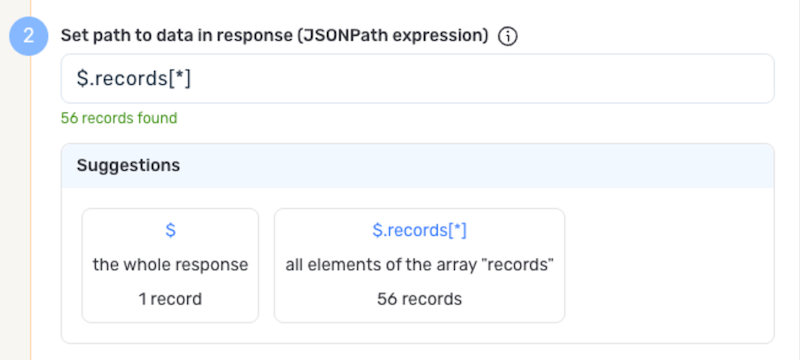
Nexla can also autogenerate data path suggestions based on the response from the API endpoint. These suggested paths can be used as-is or modified to exactly suit your needs.
-
To use this feature, click the Test button next to the Set API URL field to fetch a sample response from the API endpoint. Suggested data paths generated based on the content & format of the response will be displayed in the Suggestions box below the Set Path to Data in Response field.
-
Click on a suggestion to automatically populate the Set Path to Data in Response field with the corresponding path. The populated path can be modified directly within the field if further customization is needed.
If metadata is included in the response but is located outside of the defined path to relevant data, you can configure Nexla to include this data as common metadata in each record. This is useful when you want to preserve important contextual information that applies to all records but isn't part of the main data array.
For example, when a request call is used to fetch a list of items, the API response will typically include an array of records along with metadata such as total count, pagination information, or request timestamps. In this case, if you have specified the path to the relevant data but metadata of interest is located in a different part of the response, you can specify a path to this metadata to include it with each record in the generated Nexset(s).
Metadata paths are particularly useful for preserving Finnhub API response context like total counts, API call timestamps, or summary statistics that apply to all records in the response.
-
If Nexla should include any additional request headers in API calls to this source, enter the headers & corresponding values as comma-separated pairs in the Request Headers field (e.g., header1:value1,header2:value2). Additional headers are often required for API versioning, content type specifications, or custom authentication requirements.
You do not need to include the X-Finnhub-Token authentication header here — it is automatically included by Nexla based on the credential configured for this source. Common headers like Authorization and Content-Type are handled automatically.
Endpoint Testing
After configuring all settings for the selected endpoint, Nexla can retrieve a sample of the data that will be fetched according to the current configuration. This allows users to verify that the source is configured correctly before saving.
-
To test the current endpoint configuration, click the Test button to the right of the endpoint selection menu. Sample data will be fetched & displayed in the Endpoint Test Result panel on the right.
-
If the sample data is not as expected, review the selected endpoint and associated settings, and make any necessary adjustments. Then, click the Test button again, and check the sample data to ensure that the correct information is displayed.
Save & Activate the Source
- Once all of the relevant steps in the above sections have been completed, click the Create button in the upper right corner of the screen to save and create the new Finnhub data source. Nexla will now begin ingesting data from the configured endpoint and will organize any data that it finds into one or more Nexsets.