
Faker API Data Source

The Faker API connector enables you to ingest realistic, randomly generated fake data into Nexla data flows. Each endpoint returns structured JSON records that are immediately usable for testing pipelines, seeding development databases, building UI prototypes, and validating downstream transformations—all without any authentication or registration.

The Faker API connector enables you to ingest realistic fake data across a wide range of categories—persons, addresses, companies, users, products, books, credit cards, images, places, and custom-defined fields. Follow the instructions below to create a new data flow that ingests data from a Faker API source in Nexla.
faker_api.png

Faker API

Create a New Data Flow

  1. To create a new data flow, navigate to the Integrate section, and click the New Data Flow button. Then, select the desired flow type from the list, and click the Create button.

  2. Select the Faker API connector tile from the list of available connectors. Then, select the credential that will be used to connect to the Faker API instance, and click Next; or, create a new Faker API credential for use in this flow.

  3. In Nexla, Faker API data sources can be created using pre-built endpoint templates, which expedite source setup for common Faker API endpoints. Each template is designed specifically for the corresponding Faker API resource, making source configuration easy and efficient.
    • To configure this source using a template, follow the instructions in Configure Using a Template.

    Faker API sources can also be configured manually, allowing you to ingest data from any valid Faker API endpoint or apply custom configurations.
    • To configure this source manually, follow the instructions in Configure Manually.

Configure Using a Template

Nexla provides pre-built templates that can be used to rapidly configure data sources to ingest data from common Faker API endpoints. Each template corresponds to a specific Faker API resource, making data source setup easy and efficient.

Endpoint Settings

  • Select the endpoint from which this source will fetch data from the Endpoint pulldown menu. Available endpoint templates are listed in the expandable boxes below. Click on an endpoint to see more information about it and how to configure your data source for that endpoint.

List Persons

Retrieves fake person records including first name, last name, email address, phone number, gender, date of birth, and a nested address object. Use this endpoint to generate test user profiles, populate demographic datasets, or validate pipelines that process personal identity data.

  • Enter the number of person records to retrieve in the Quantity field. Accepted values are 1–1000. The default is 10.

  • Optionally, select a locale from the Locale dropdown to control the language and regional formatting of generated names, addresses, and other locale-sensitive fields. The default is en_US. Available locales include:

    • English (US) — en_US
    • English (UK) — en_GB
    • French (France) — fr_FR
    • German (Germany) — de_DE
    • Spanish (Spain) — es_ES
    • Italian (Italy) — it_IT
    • Japanese — ja_JP
    • Chinese (Simplified) — zh_CN
    • Portuguese (Brazil) — pt_BR
    • Russian — ru_RU
  • Optionally, enter an integer in the Seed field to produce reproducible results. When a seed value is provided, the same request will always return the same set of records. Leave this field empty to generate different random data on each run.
  • Optionally, select a value from the Gender dropdown to filter results to a specific gender. Available options are:

    • Any (default) — Returns a mix of genders.
    • Male — Returns only male person records.
    • Female — Returns only female person records.
    • Other — Returns person records with a non-binary gender designation.
  • Optionally, enter a date in YYYY-MM-DD format in the Birthday Start field to restrict results to persons born on or after the specified date.
  • Optionally, enter a date in YYYY-MM-DD format in the Birthday End field to restrict results to persons born on or before the specified date. Use Birthday Start and Birthday End together to produce records within a specific age range.

Each person record returned by this endpoint includes a nested address object. Nexla will automatically flatten or preserve this nested structure based on your Nexset schema settings.

List Addresses

Retrieves fake address records including street name, street address, city, ZIP/postal code, state, and country. Use this endpoint to generate test shipping or billing address datasets, validate address-parsing pipelines, or populate location fields in development databases.

  • Enter the number of address records to retrieve in the Quantity field. Accepted values are 1–1000. The default is 10.
  • Optionally, select a locale from the Locale dropdown to control the language and regional formatting of the generated addresses. The default is en_US.
  • Optionally, enter an integer in the Seed field to produce reproducible results. Leave this field empty to generate different random data on each run.
  • Optionally, enter an ISO 3166-1 alpha-2 country code in the Country Code field (for example, US, FR, or DE) to restrict all generated addresses to that specific country. Leave this field empty to receive addresses from a mix of countries.

List Companies

Retrieves fake company records including company name, email address, VAT number, phone number, country, and a nested address. Use this endpoint to generate test B2B datasets, populate company lookup tables, or test pipelines that process organizational data.

  • Enter the number of company records to retrieve in the Quantity field. Accepted values are 1–1000. The default is 10.
  • Optionally, select a locale from the Locale dropdown to control the regional formatting of company names and other locale-sensitive fields. The default is en_US.
  • Optionally, enter an integer in the Seed field to produce reproducible results. Leave this field empty to generate different random data on each run.

List Users

Retrieves fake user account records including username, email address, hashed password, IP address, MAC address, website URL, and registration timestamp. Use this endpoint to test user authentication flows, populate user tables in development databases, or validate pipelines that handle account data.

  • Enter the number of user records to retrieve in the Quantity field. Accepted values are 1–1000. The default is 10.
  • Optionally, select a locale from the Locale dropdown to control locale-sensitive field values. The default is en_US.
  • Optionally, enter an integer in the Seed field to produce reproducible results. Leave this field empty to generate different random data on each run.

Password values returned by this endpoint are randomly generated strings and are not real credentials. They are provided solely as test data to simulate the shape of a user record.

List Products

Retrieves fake product records including product name, EAN barcode, description, stock quantity, price, and category identifiers. Use this endpoint to populate product catalogs in development environments, test e-commerce pipelines, or build demo storefronts.

  • Enter the number of product records to retrieve in the Quantity field. Accepted values are 1–1000. The default is 10.
  • Optionally, select a locale from the Locale dropdown. The default is en_US.
  • Optionally, enter an integer in the Seed field to produce reproducible results. Leave this field empty to generate different random data on each run.
  • Optionally, enter a tax percentage integer in the Tax Percentage field (for example, 10 or 20) to include a calculated tax amount in each product record. Leave this field empty to omit tax information.
  • Optionally, select the format in which category identifiers are returned from the Categories Type dropdown. Available options are:

    • UUID (default) — Returns category identifiers as UUID strings.
    • Integer — Returns category identifiers as integers.
    • String — Returns category identifiers as human-readable strings.
  • Optionally, enter an integer in the Categories Per Product field to control how many category identifiers are included per product record. The default is 1.
  • Optionally, enter a decimal value in the Minimum Price field to set a lower bound on generated product prices.
  • Optionally, enter a decimal value in the Maximum Price field to set an upper bound on generated product prices. Use Minimum Price and Maximum Price together to generate products within a realistic price range for your use case.

List Books

Retrieves fake book records including title, author name, genre, description, ISBN, publisher name, and publication date. Use this endpoint to populate library or catalog datasets, build demo content applications, or test pipelines that process bibliographic data.

  • Enter the number of book records to retrieve in the Quantity field. Accepted values are 1–1000. The default is 10.
  • Optionally, select a locale from the Locale dropdown to influence the language of generated titles and author names. The default is en_US.
  • Optionally, enter an integer in the Seed field to produce reproducible results. Leave this field empty to generate different random data on each run.

List Credit Cards

Retrieves fake credit card records including card type (e.g., Visa, MasterCard), card number, expiration date, and owner name. Use this endpoint to test payment form validation, populate mock payment records, or build demos that simulate financial transactions.

  • Enter the number of credit card records to retrieve in the Quantity field. Accepted values are 1–1000. The default is 10.
  • Optionally, select a locale from the Locale dropdown. The default is en_US.
  • Optionally, enter an integer in the Seed field to produce reproducible results. Leave this field empty to generate different random data on each run.
For Testing Purposes Only

Credit card numbers returned by this endpoint are randomly generated and are not valid for any real financial transaction. Never use this data in production systems or present it as real payment information.

List Images

Retrieves fake image metadata including a URL, title, and description. Image URLs link to actual placeholder images hosted by the Faker API service. Use this endpoint to populate image fields in development environments, test media rendering pipelines, or build UI prototypes with realistic placeholder assets.

  • Enter the number of image records to retrieve in the Quantity field. Accepted values are 1–1000. The default is 10.
  • Optionally, select a locale from the Locale dropdown. The default is en_US.
  • Optionally, enter an integer in the Seed field to produce reproducible results. Leave this field empty to generate different image URLs on each run.
  • Optionally, select an image type from the Image Type dropdown. Available options are:

    • Any (default) — Returns general-purpose placeholder image URLs.
    • Pokemon — Returns Pokémon image URLs, useful for distinct, colorful placeholder images in UI testing.
  • Optionally, enter a pixel value in the Image Width field to set the width of the placeholder images. The default is 640 pixels.
  • Optionally, enter a pixel value in the Image Height field to set the height of the placeholder images. The default is 480 pixels.

List Places

Retrieves fake geographic place records including city name, state/region, country, and latitude/longitude coordinates. Use this endpoint to generate test geolocation datasets, populate location fields in development databases, or test mapping and spatial analytics pipelines.

  • Enter the number of place records to retrieve in the Quantity field. Accepted values are 1–1000. The default is 10.
  • Optionally, select a locale from the Locale dropdown to influence the language and regional formatting of place names. The default is en_US.
  • Optionally, enter an integer in the Seed field to produce reproducible results. Leave this field empty to generate different random places on each run.

List Texts

Retrieves fake text content as an array of character strings. Use this endpoint to generate filler content for UI mockups, populate text fields in development databases, or test pipelines that process unstructured text data.

  • Enter the number of text records to retrieve in the Quantity field. Accepted values are 1–1000. The default is 10.
  • Optionally, select a locale from the Locale dropdown to control the language of generated text. The default is en_US.
  • Optionally, enter an integer in the Seed field to produce reproducible results. Leave this field empty to generate different random text on each run.
  • Optionally, enter an integer in the Characters field to set the maximum number of characters in each generated text string. The default is 200 characters.

List Custom Fields

Retrieves fake records with a fully custom schema defined by you. Instead of using a fixed resource type, this endpoint lets you specify exactly which fields to include and what type of fake data each field should contain. Use this endpoint when none of the pre-built resource templates match your target data shape, or when you need a highly specific combination of field types.

  • Enter the number of custom records to retrieve in the Quantity field. Accepted values are 1–1000. The default is 10.
  • Optionally, select a locale from the Locale dropdown. The default is en_US.
  • Optionally, enter an integer in the Seed field to produce reproducible results. Leave this field empty to generate different random data on each run.
  • Enter your custom field definitions in the Custom Field Definitions field as a URL-encoded query string, where each key is the output field name you want in the response and each value is the Faker API field type that will generate the data. For example:

    • name=firstName&email=freeEmail — Returns records with a name field (first name) and an email field (free-provider email address).
    • phone=phoneNumber&zip=postcode&city=city — Returns records with phone, ZIP code, and city fields.

Common field type values include: firstName, lastName, freeEmail, companyEmail, phoneNumber, postcode, city, streetAddress, country, url, userName, paragraph, sentence, currencyCode, ip, and iban. For a complete list of supported field types, refer to the official Faker API documentation.

Endpoint Testing

Once the selected endpoint template has been configured, Nexla can retrieve a sample of the data that will be fetched according to the current settings. This allows users to verify that the source is configured correctly before saving.

  • To test the current endpoint configuration, click the Test button to the right of the endpoint selection menu. Sample data will be fetched & displayed in the Endpoint Test Result panel on the right.

  • If the sample data is not as expected, review the selected endpoint and associated settings, and make any necessary adjustments. Then, click the Test button again, and check the sample data to ensure that the correct information is displayed.

Configure Manually

Faker API data sources can be manually configured to ingest data from any valid Faker API endpoint. Manual configuration provides maximum flexibility for accessing endpoints not covered by the pre-built templates or when you need to construct custom query parameters beyond what the templates expose.

With manual configuration, you can also build more advanced Faker API sources—for example, sources that combine multiple query parameters, use dynamic date macros in URLs, or chain calls to multiple endpoints.

API Method

  1. To manually configure this source, select the Advanced tab at the top of the configuration screen.

  2. Select the API method from the Method pulldown menu. All Faker API endpoints use GET requests.

API Endpoint URL

  1. Enter the full URL of the Faker API endpoint in the Set API URL field. The base URL for the latest API version is https://fakerapi.it/api/v2, and each resource is accessed by appending the resource name as a path segment. For example:

    • https://fakerapi.it/api/v2/persons — Retrieves person records.
    • https://fakerapi.it/api/v2/addresses — Retrieves address records.
    • https://fakerapi.it/api/v2/companies — Retrieves company records.
    • https://fakerapi.it/api/v2/users — Retrieves user records.
    • https://fakerapi.it/api/v2/products — Retrieves product records.
    • https://fakerapi.it/api/v2/books — Retrieves book records.
    • https://fakerapi.it/api/v2/credit_cards — Retrieves credit card records.
    • https://fakerapi.it/api/v2/images — Retrieves image records.
    • https://fakerapi.it/api/v2/places — Retrieves place records.
    • https://fakerapi.it/api/v2/texts — Retrieves text records.
    • https://fakerapi.it/api/v2/custom — Retrieves custom-schema records.

    Append query parameters directly to the URL to control the output. All Faker API parameter names are prefixed with an underscore. For example: https://fakerapi.it/api/v2/persons?_quantity=50&_locale=fr_FR&_gender=female.

Faker API supports the following common query parameters on all endpoints: _quantity (1–1000, default 10), _locale (locale code, default en_US), and _seed (integer for reproducible results). Individual endpoints may also support additional parameters—refer to the Faker API documentation for the full parameter list for each resource.

Date/Time Macros (API URL)

Optional

Optionally, the API URL can be customized using macros—all macros added to the API URL will be converted into values when Nexla executes the API call. Macros are dynamic placeholders that allow you to create flexible API endpoints that can adapt to different time periods or data requirements.

Date/time macros are most useful when combined with Faker API's _birthday_start and _birthday_end parameters on the List Persons endpoint, allowing you to dynamically scope generated records to persons born within a rolling date window relative to the current date.

  1. To add a macro, type { at the appropriate position in the API URL (within the Set API URL field), and select the desired macro from the dropdown list.

    • {now} – The current datetime
    • {now-1} – The datetime one time unit before the current datetime
    • {now+1} – The datetime one time unit after the current datetime
    • custom – Datetime macros can reference any number of time units before or after the current datetime—for example, enter (now-4) to indicate the datetime four time units before the current datetime
  2. Select the format that will be applied to datetime macros from the Date Format for Date/Time Macro pulldown menu. This format will be applied to the base datetime value of the macro—i.e., the value of {now} in {now-1}.

  3. Select the datetime unit that will be used to perform mathematical operations in the included macro(s) from the Time Unit for Operations pulldown menu—for example, for the macro {now-1}, when Day is selected, {now-1} will be converted to the datetime one day before the current datetime.

Lookup-Based Macros (API URL)

Optional

Column values from existing lookups can also be included as macros in the API URL. Lookup-based macros allow you to reference data from previously configured data sources or lookups, enabling dynamic API endpoints that adapt based on existing data.

  1. To include a lookup column value macro, select the relevant lookup from the Add Lookups to Supported Macros pulldown menu.

  2. Type { at the appropriate position in the API URL, and select the lookup column-based macro from the dropdown list. Lookup-based macros are automatically populated into the macro list when a lookup is selected in the Add Lookups to Supported Macros pulldown menu.

Path to Data

Optional

If only a subset of the data returned by the API endpoint is needed, you can designate which part of the response should be included in the Nexsets produced from this source. This is particularly useful when the Faker API response contains wrapper metadata alongside the records you need.

Faker API wraps all resource records inside a data array in the response body, alongside a total count and a code field. To have Nexla treat each element of the data array as an individual record, specify the path to that array.

For all Faker API endpoints, the path to the data records in the response is $.data[*]. Entering this value in the Set Path to Data in Response field ensures that Nexla correctly identifies each object in the array as a separate record.

  • To specify which data should be treated as relevant in responses from this source, enter the path to the relevant data in the Set Path to Data in Response field.

    • For responses in JSON format, enter the JSON path that points to the object or array that should be treated as relevant data. For Faker API, this is $.data[*].
    Path to Data Example:

    For a request to https://fakerapi.it/api/v2/persons, the response contains a top-level data array with the person records. Enter $.data[*] as the path to correctly parse each person object as a separate record.

Autogenerate Path Suggestions

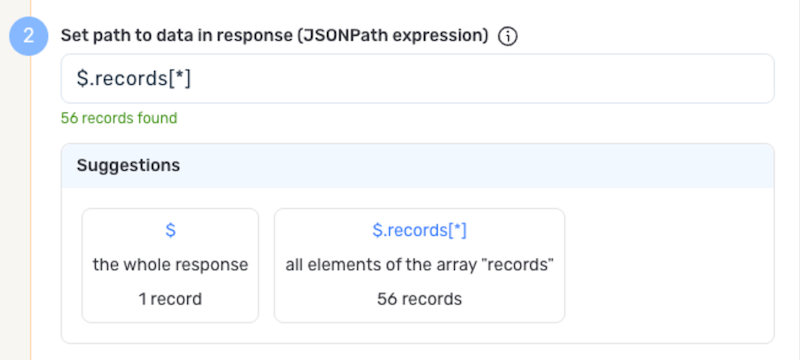
Nexla can also autogenerate data path suggestions based on the response from the API endpoint. These suggested paths can be used as-is or modified to exactly suit your needs.

  • To use this feature, click the Test button next to the Set API URL field to fetch a sample response from the API endpoint. Suggested data paths generated based on the content & format of the response will be displayed in the Suggestions box below the Set Path to Data in Response field.

  • Click on a suggestion to automatically populate the Set Path to Data in Response field with the corresponding path. The populated path can be modified directly within the field if further customization is needed.
    PathSuggestions.png

Metadata

If metadata is included in the response but is located outside of the defined path to relevant data, you can configure Nexla to include this data as common metadata in each record.

For Faker API responses, the top-level total and code fields are examples of metadata that exist outside the $.data[*] path. If you want to preserve this context alongside each record, specify the path to the metadata in the Path to Metadata in Response field.

  • To specify the location of metadata that should be included with each record, enter the path to the relevant metadata in the Path to Metadata in Response field.

    • For responses in JSON format, enter the JSON path to the object or array that contains the metadata.

Request Headers

Optional
  • If Nexla should include any additional request headers in API calls to this source, enter the headers & corresponding values as comma-separated pairs in the Request Headers field (for example, header1:value1,header2:value2).

    Faker API does not require any authentication headers—all endpoints are publicly accessible without tokens or credentials. You only need to add request headers if your network environment requires specific proxy or routing headers.

Endpoint Testing

After configuring all settings for the selected endpoint, Nexla can retrieve a sample of the data that will be fetched according to the current configuration. This allows users to verify that the source is configured correctly before saving.

  • To test the current endpoint configuration, click the Test button to the right of the endpoint selection menu. Sample data will be fetched & displayed in the Endpoint Test Result panel on the right.

  • If the sample data is not as expected, review the selected endpoint and associated settings, and make any necessary adjustments. Then, click the Test button again, and check the sample data to ensure that the correct information is displayed.

Save & Activate the Source

  1. Once all of the relevant steps in the above sections have been completed, click the Create button in the upper right corner of the screen to save and create the new Faker API data source. Nexla will now begin ingesting data from the configured endpoint and will organize any data that it finds into one or more Nexsets.