The Factorial connector enables you to ingest HR data from your Factorial workspace into Nexla data flows. Use this connector to bring employee records, attendance data, time-off information, team structures, and more into your analytics pipelines and data integrations. Follow the instructions below to create a new data flow that ingests data from a Factorial source in Nexla.
Create a New Data Flow
-
To create a new data flow, navigate to the Integrate section, and click the New Data Flow button. Then, select the desired flow type from the list, and click the Create button.
-
Select the Factorial connector tile from the list of available connectors. Then, select the credential that will be used to connect to the Factorial instance, and click Next; or, create a new Factorial credential for use in this flow.
-
In Nexla, Factorial data sources can be created using pre-built endpoint templates, which expedite source setup for common Factorial endpoints. Each template is designed specifically for the corresponding Factorial API endpoint, making source configuration easy and efficient.
• To configure this source using a template, follow the instructions in Configure Using a Template.
Factorial sources can also be configured manually, allowing you to ingest data from Factorial endpoints not included in the pre-built templates or apply further customizations to exactly suit your needs.
• To configure this source manually, follow the instructions in Configure Manually.
Nexla provides pre-built templates that can be used to rapidly configure data sources to ingest data from common Factorial endpoints. Each template is designed specifically for the corresponding Factorial API endpoint, making data source setup easy and efficient.
Endpoint Settings
- Select the endpoint from which this source will fetch data from the Endpoint pulldown menu. Available endpoint templates are listed in the expandable boxes below. Click on an endpoint to see more information about it and how to configure your data source for this endpoint.
List Tasks
Retrieves a paginated list of all tasks in your Factorial organization. Use this endpoint to pull task data for workforce management reporting or to integrate task assignments into downstream systems.
- No additional parameters are required for this endpoint. Nexla will automatically paginate through all available tasks, fetching up to 100 records per page until all tasks have been retrieved.
- The endpoint returns task metadata including task IDs, names, assignees, and status information for all tasks configured in your organization.
List Work Schedules
Retrieves a paginated list of all work schedules configured in your Factorial organization. Use this endpoint to extract scheduling templates for workforce planning analysis or to synchronize schedule definitions with external systems.
- No additional parameters are required. Nexla will automatically paginate through all available work schedules, fetching up to 100 records per page.
- Work schedules define the expected working hours, days, and patterns assigned to employees or groups within your organization.
List Teams
Retrieves a paginated list of all teams in your Factorial organization. Use this endpoint to synchronize team structures with HR analytics tools or to build organizational hierarchy reports.
- No additional parameters are required. Nexla will automatically paginate through all available teams, fetching up to 100 records per page.
- The response includes team IDs, names, and associated metadata for every team defined in your workspace.
To retrieve the employees assigned to each team, use the List Team Memberships endpoint in combination with this endpoint.
List Team Memberships
Retrieves a paginated list of all team memberships, showing which employees belong to which teams. Use this endpoint to analyze team composition, build org charts, or audit team assignments.
- No additional parameters are required. Nexla will automatically paginate through all membership records, fetching up to 100 records per page.
- Each membership record links an employee ID to a team ID, enabling joins with data from the List Employees and List Teams endpoints.
List Time Off Allowances
Retrieves a paginated list of all time off allowances configured for employees. Use this endpoint to audit leave entitlements, report on allowance utilization, or synchronize leave balances with payroll systems.
- No additional parameters are required. Nexla will automatically paginate through all allowance records, fetching up to 100 records per page.
- Allowances define the number of leave days or hours each employee is entitled to, organized by leave type and policy.
List Blocked Periods
Retrieves a paginated list of all blocked periods—date ranges during which employees cannot submit time off requests. Use this endpoint to identify scheduling constraints or to synchronize blackout dates with workforce planning tools.
- No additional parameters are required. Nexla will automatically paginate through all blocked period records, fetching up to 100 records per page.
- Each blocked period record includes the start and end dates of the restriction and any associated policy or leave type constraints.
List Time Off Requests
Retrieves a paginated list of all time off (leave) requests submitted by employees. Use this endpoint to track leave patterns, monitor pending approvals, or feed leave data into payroll and HR analytics workflows.
- No additional parameters are required. Nexla will automatically paginate through all leave records, fetching up to 100 records per page.
- Each record includes the employee ID, leave type, requested dates, and approval status (pending, approved, or rejected).
List Leave Types
Returns a paginated list of all leave types configured in your Factorial system, such as vacation, sick leave, or parental leave. Use this endpoint to retrieve the reference data needed to interpret leave request and allowance records.
- No additional parameters are required. Nexla will automatically paginate through all leave type records, fetching up to 100 records per page.
- Leave type IDs returned by this endpoint can be used to cross-reference records from the List Time Off Requests and List Time Off Allowances endpoints.
List Timeoff Policies
Returns a paginated list of all time off policies configured in your Factorial organization. Policies define the rules governing how leave types are accrued, approved, and tracked for different employee groups.
- No additional parameters are required. Nexla will automatically paginate through all policy records, fetching up to 100 records per page.
- Policy records include accrual rules, carryover settings, and the leave types governed by each policy.
List Legal Entities
Returns a paginated list of all legal entities configured in your Factorial company. Use this endpoint to retrieve the company structure needed for multi-entity reporting or to support payroll integrations that require legal entity information.
- No additional parameters are required. Nexla will automatically paginate through all legal entity records, fetching up to 100 records per page.
- Legal entities represent distinct legal organizations (such as subsidiaries or regional offices) within your company structure.
List Contract Versions
Returns a paginated list of all contract versions in your Factorial system. Contract versions capture changes to an employee's employment terms over time—such as salary adjustments, role changes, or schedule modifications.
- No additional parameters are required. Nexla will automatically paginate through all contract version records, fetching up to 100 records per page.
- Each contract version record is linked to an employee and reflects the terms in effect during a specific date range.
List Employees
Returns a paginated list of all employees in your Factorial organization. This is one of the most commonly used endpoints, providing core workforce data for HR analytics, headcount reporting, and integration with downstream systems.
- No additional parameters are required. Nexla will automatically paginate through all employee records, fetching up to 100 records per page.
- Each employee record includes personal details, employment status, job information, and organizational assignments such as team and location.
To retrieve the full details for a single employee record, use the Get Employee endpoint with a specific employee ID.
Get Employee
Retrieves a single employee record by its unique ID. Use this endpoint when you need detailed information about a specific employee or when building a flow that processes individual employee records.
List Cost Centers
Returns a paginated list of cost centers used for financial tracking and organizational reporting within your Factorial workspace. Use this endpoint to retrieve cost center reference data for payroll integrations or financial analytics.
- No additional parameters are required. Nexla will automatically paginate through all cost center records, fetching up to 100 records per page.
- Cost center records include identifiers and names that can be used to categorize employee expenses and payroll costs.
List Company Holidays
Returns a paginated list of company-wide holidays and non-working days configured in your Factorial workspace. Use this endpoint to synchronize holiday calendars with scheduling, payroll, or workforce planning systems.
- No additional parameters are required. Nexla will automatically paginate through all holiday records, fetching up to 100 records per page.
- Holiday records include the date, name, and any regional or policy-based scoping applied to the holiday.
List Locations
Returns a paginated list of office locations and work sites registered in your Factorial organization. Use this endpoint to retrieve location reference data for employee reporting or to synchronize workspace locations with other business systems.
- No additional parameters are required. Nexla will automatically paginate through all location records, fetching up to 100 records per page.
- Location records include the location name, address, and any associated configuration details.
List Work Areas
Returns a paginated list of work areas or departments within locations in your Factorial workspace. Work areas are subdivisions of physical locations and can be used to organize employees by functional area within a site.
- No additional parameters are required. Nexla will automatically paginate through all work area records, fetching up to 100 records per page.
- Work area records include the work area name, associated location ID, and any related configuration.
List Shifts
Returns a paginated list of work shifts configured in the Factorial shift management system. Use this endpoint to retrieve shift definitions for scheduling analysis or to synchronize shift templates with workforce management tools.
- No additional parameters are required. Nexla will automatically paginate through all shift records, fetching up to 100 records per page.
- Shift records describe the planned working periods, including start and end times, and any recurrence rules associated with each shift.
List Attendance Shifts
Retrieves a paginated list of attendance shifts—individual clock-in and clock-out events recorded for employees. Use this endpoint to analyze actual worked hours, audit attendance records, or feed time data into payroll processes.
- No additional parameters are required for basic retrieval. Nexla will automatically paginate through all attendance shift records, fetching up to 100 records per page.
- Each attendance shift record captures the employee ID, clock-in time, clock-out time, and the duration of the shift. The Factorial API also supports filtering by
employee_ids[], start_on, and end_on parameters for more targeted data retrieval when configuring manually.
List Open Shifts
Retrieves a real-time list of employees who are currently clocked in. Use this endpoint to monitor live attendance status or to trigger real-time workflows based on employee check-in events.
- No additional parameters are required. This endpoint does not use pagination—it returns all currently open shifts in a single response.
- Each open shift record identifies the employee and the time at which they clocked in. The Factorial API supports filtering by
employee_ids[] to narrow results to specific employees when configuring manually.
Because this endpoint reflects real-time status, the results will change as employees clock in and out. Schedule this data flow to run at regular intervals to capture point-in-time snapshots of attendance status.
List Estimated Times
Retrieves planned hours per employee per date, enabling variance reporting between scheduled and actual worked hours. Use this endpoint to compare expected attendance against actual clock-in data for productivity and compliance reporting.
- No additional parameters are required. This endpoint returns all estimated time records in a single response without pagination.
- Estimated time records include the employee ID, the target date, and the planned number of hours for that day based on the employee's assigned work schedule.
List Worked Times
Retrieves aggregated worked hours per employee per period—suitable for use as payroll input or for generating time-worked summaries. Use this endpoint when you need consolidated time totals rather than individual clock-in/out events.
- No additional parameters are required. This endpoint returns all worked time records in a single response without pagination.
- Each record summarizes the total hours worked by an employee during a given period, aggregated from the underlying attendance shift records.
List Overtime Requests
Retrieves a paginated list of overtime approval requests submitted by employees. Use this endpoint to monitor overtime activity, track approval status, or feed overtime data into payroll processing workflows.
- No additional parameters are required. Nexla will automatically paginate through all overtime request records, fetching up to 100 records per page.
- Each overtime request record includes the employee ID, the requested overtime period, the number of hours, and the current approval status.
List Documents
Retrieves a paginated list of document metadata records stored in Factorial. Use this endpoint to audit the document library, track document uploads by employee, or synchronize document metadata with external document management systems.
- No additional parameters are required. Nexla will automatically paginate through all document records, fetching up to 100 records per page.
- This endpoint returns document metadata only—it does not return the binary file contents. Each record includes the document name, associated employee, folder, upload date, and other metadata fields.
List Document Folders
Retrieves the document folder hierarchy used to organize documents in Factorial. Use this endpoint to understand the folder structure before synchronizing documents or to reproduce the same folder hierarchy in an external system.
- No additional parameters are required. Nexla will automatically paginate through all folder records, fetching up to 100 records per page.
- Each folder record includes the folder ID, name, parent folder ID (for nested folders), and associated metadata.
Endpoint Testing
Once the selected endpoint template has been configured, Nexla can retrieve a sample of the data that will be fetched according to the current settings. This allows users to verify that the source is configured correctly before saving.
-
To test the current endpoint configuration, click the Test button to the right of the endpoint selection menu. Sample data will be fetched & displayed in the Endpoint Test Result panel on the right.
-
If the sample data is not as expected, review the selected endpoint and associated settings, and make any necessary adjustments. Then, click the Test button again, and check the sample data to ensure that the correct information is displayed.
Factorial data sources can be manually configured to ingest data from any valid Factorial API endpoint. Manual configuration provides maximum flexibility for accessing endpoints not covered by pre-built templates or when you need custom API configurations, such as applying query parameter filters to narrow results by date range, employee group, or other criteria.
With manual configuration, you can also create more complex Factorial sources, such as sources that use chained API calls to fetch data from multiple endpoints or sources that require custom request parameters.
API Method
-
To manually configure this source, select the Advanced tab at the top of the configuration screen.
-
Select the API method that will be used for calls to the Factorial API from the Method pulldown menu. The most common methods are:
- GET: For retrieving data from the API
- POST: For sending data to the API or triggering actions
- PUT: For updating existing data
- PATCH: For partial updates to existing data
- DELETE: For removing data
API Endpoint URL
-
Enter the URL of the Factorial API endpoint from which this source will fetch data in the Set API URL field. This should be the complete URL including the protocol (https://) and the versioned path segment.
Factorial API URLs follow the pattern https://api.factorialhr.com/api/{version}/resources/{resource_path}, where {version} is the date-based API version (for example, 2026-04-01) configured in your credential and {resource_path} is the path to the specific resource. The full API reference is available at https://apidoc.factorialhr.com/reference.
Ensure the API endpoint URL is correct and accessible with your current credentials. You can test the endpoint using the Test button after configuring the URL.
Date/Time Macros (API URL)
Optional
Optionally, the API URL can be customized using macros—all macros added to the API URL will be converted into values when Nexla executes the API call. Macros are dynamic placeholders that allow you to create flexible API endpoints that can adapt to different time periods or data requirements.
Date/time macros are particularly useful for Factorial attendance and time-off endpoints that support start_on and end_on query parameters, enabling incremental data ingestion based on the current date.
-
To add a macro, type { at the appropriate position in the API URL (within the Set API URL field), and select the desired macro from the dropdown list.
{now} – The current datetime{now-1} – The datetime one time unit before the current datetime{now+1} – The datetime one time unit after the current datetimecustom – Datetime macros can reference any number of time units before or after the current datetime—for example, enter (now-4) to indicate the datetime four time units before the current datetime
-
Select the format that will be applied to datetime macros from the Date Format for Date/Time Macro pulldown menu. This format will be applied to the base datetime value of the macro—i.e., the value of {now} in {now-1}.
-
Select the datetime unit that will be used to perform mathematical operations in the included macro(s) from the Time Unit for Operations pulldown menu—for example, for the macro {now-1}, when Day is selected, {now-1} will be converted to the datetime one day before the current datetime.
Lookup-Based Macros (API URL)
Optional
Column values from existing lookups can also be included as macros in the API URL. Lookup-based macros allow you to reference data from previously configured data sources or lookups, enabling dynamic API endpoints that can adapt based on existing data.
Lookup-based macros are useful for Factorial endpoints that require an ID in the URL path, such as retrieving data scoped to a specific employee, team, or legal entity whose ID is stored in another Nexla data source.
-
To include a lookup column value macro, select the relevant lookup from the Add Lookups to Supported Macros pulldown menu.
-
Type { at the appropriate position in the API URL, and select the lookup column-based macro from the dropdown list. Lookup-based macros are automatically populated into the macro list when a lookup is selected in the Add Lookups to Supported Macros pulldown menu.
If only a subset of the data that will be returned by the API endpoint is needed, you can designate the part(s) of the response that should be included in the Nexset(s) produced from this source by specifying the path to the relevant data within the response.
For most Factorial list endpoints, the actual records are contained within a data array in the JSON response. Specifying the correct JSON path ensures that Nexla treats each element in the array as an individual record rather than treating the entire response as a single record.
Path to Data is essential when working with Factorial API responses, as most list endpoints return records nested within a data array alongside pagination metadata. Without specifying the correct path, Nexla may not parse the response into usable records.
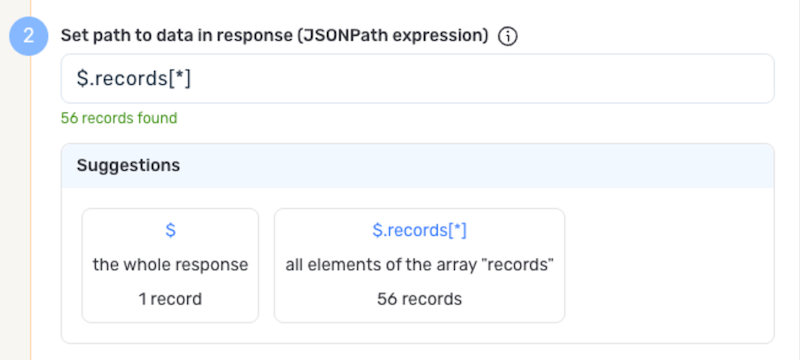
Autogenerate Path Suggestions
Nexla can also autogenerate data path suggestions based on the response from the API endpoint. These suggested paths can be used as-is or modified to exactly suit your needs.
-
To use this feature, click the Test button next to the Set API URL field to fetch a sample response from the API endpoint. Suggested data paths generated based on the content & format of the response will be displayed in the Suggestions box below the Set Path to Data in Response field.
-
Click on a suggestion to automatically populate the Set Path to Data in Response field with the corresponding path. The populated path can be modified directly within the field if further customization is needed.
If metadata is included in the response but is located outside of the defined path to relevant data, you can configure Nexla to include this data as common metadata in each record. Factorial API responses commonly include pagination metadata (such as total record count and current page number) alongside the data array. If this contextual information should be preserved with each record, specify its path using this setting.
Metadata paths are particularly useful for preserving API response context like request IDs, timestamps, or summary statistics that apply to all records in the response.
-
If Nexla should include any additional request headers in API calls to this source, enter the headers & corresponding values as comma-separated pairs in the Request Headers field (e.g., header1:value1,header2:value2). Additional headers are occasionally required for API versioning overrides or content type specifications.
You do not need to include the X-API-KEY authentication header or the Accept: application/json header in this field—these are automatically included by Nexla based on your Factorial credential configuration.
Endpoint Testing
After configuring all settings for the selected endpoint, Nexla can retrieve a sample of the data that will be fetched according to the current configuration. This allows users to verify that the source is configured correctly before saving.
-
To test the current endpoint configuration, click the Test button to the right of the endpoint selection menu. Sample data will be fetched & displayed in the Endpoint Test Result panel on the right.
-
If the sample data is not as expected, review the selected endpoint and associated settings, and make any necessary adjustments. Then, click the Test button again, and check the sample data to ensure that the correct information is displayed.
Save & Activate the Source
- Once all of the relevant steps in the above sections have been completed, click the Create button in the upper right corner of the screen to save and create the new Factorial data source. Nexla will now begin ingesting data from the configured endpoint and will organize any data that it finds into one or more Nexsets.