
e-conomic Data Source

The e-conomic connector enables you to ingest financial data from your e-conomic account, including accounts, customers, invoices, orders, products, journals, subscriptions, dimensions, and general-ledger entries. Follow the instructions below to create a new data flow that ingests data from an e-conomic source in Nexla.
e_conomic_api.png

e-conomic

Create a New Data Flow

  1. To create a new data flow, navigate to the Integrate section, and click the New Data Flow button. Then, select the desired flow type from the list, and click the Create button.

  2. Select the e-conomic connector tile from the list of available connectors. Then, select the credential that will be used to connect to the e-conomic account, and click Next; or, create a new e-conomic credential for use in this flow.

  3. In Nexla, e-conomic data sources can be created using pre-built endpoint templates, which expedite source setup for common e-conomic API endpoints. Each template is designed specifically for the corresponding e-conomic endpoint, making source configuration easy and efficient.
    • To configure this source using a template, follow the instructions in Configure Using a Template.

    e-conomic sources can also be configured manually, allowing you to ingest data from e-conomic endpoints not included in the pre-built templates or apply further customizations to exactly suit your needs.
    • To configure this source manually, follow the instructions in Configure Manually.

Configure Using a Template

Nexla provides pre-built templates that can be used to rapidly configure data sources to ingest data from common e-conomic endpoints. Each template is designed specifically for the corresponding e-conomic REST API endpoint, making data source setup easy and efficient.

Endpoint Settings

  • Select the endpoint from which this source will fetch data from the Endpoint pulldown menu. Available endpoint templates are listed in the expandable boxes below. Click on an endpoint to see more information about it and how to configure your data source for this endpoint.

List Accounts

Returns the complete list of accounts defined in the e-conomic chart of accounts for your agreement. Use this endpoint to export your account structure for reporting, reconciliation, or synchronisation with an external system.

  • No additional parameters are required. Select the List Accounts template and Nexla will automatically call the GET /accounts endpoint and paginate through all available accounts.
  • The endpoint returns one account record per item in the response collection. Each record includes the account number, account name, account type, balance, and related metadata.

Additional reference information for the Accounts endpoint is available in the e-conomic REST API Swagger documentation.

List Customers

Returns the complete list of customers registered in your e-conomic account. Use this endpoint to export customer master data for CRM synchronisation, analytics, or external reporting.

  • No additional parameters are required. Select the List Customers template and Nexla will automatically paginate through all customer records using the GET /customers endpoint.
  • Each record includes customer number, name, address, VAT zone, currency, payment terms, and links to related resources such as contacts and invoices.

Additional reference information for the Customers endpoint is available in the e-conomic REST API Swagger documentation.

List Journals

Returns the list of journals defined in your e-conomic agreement. Journals in e-conomic are bookkeeping registers used to post vouchers and accounting transactions. Use this endpoint to retrieve journal definitions for reference when creating journal vouchers or auditing your accounting structure.

  • No additional parameters are required. Select the List Journals template and Nexla will automatically call the GET /journals endpoint and paginate through all available journals.
  • Each record includes the journal number, name, voucher number range settings, and convenience links to voucher and entry collections.

Additional reference information for the Journals endpoint is available in the e-conomic REST API Swagger documentation.

List Products

Returns all products available in the e-conomic product catalogue for your agreement. Use this endpoint to export product data for inventory management, pricing analysis, or synchronisation with an e-commerce or ERP system.

  • No additional parameters are required. Select the List Products template and Nexla will automatically paginate through all product records using the GET /products endpoint.
  • Each record includes the product number, name, sales price, cost price, unit of measure, and stock information where applicable.

List Draft Invoices

Retrieves all draft invoices in your e-conomic account. Draft invoices are work-in-progress invoices that have not yet been booked and are not legally binding. Use this endpoint to monitor invoices awaiting review or approval before they are finalised.

  • No additional parameters are required. Select the List Draft Invoices template and Nexla will automatically paginate through all draft invoices using the GET /invoices/drafts endpoint.
  • Each record includes invoice number, customer reference, invoice lines, amounts, currency, due date, and current status within the drafting workflow.

List Booked Invoices

Retrieves all booked (finalised) invoices in your e-conomic account. Booked invoices have been formally recorded in the accounting system and are legally binding documents. Use this endpoint to export completed invoice records for revenue analysis, accounts-receivable reporting, or data warehousing.

  • No additional parameters are required. Select the List Booked Invoices template and Nexla will automatically paginate through all booked invoices using the GET /invoices/booked endpoint.
  • Each record includes booked invoice number, date, customer details, line items, gross and net amounts, VAT amounts, and payment status.

List Paid Invoices

Retrieves all invoices that have been fully paid in your e-conomic account. Use this endpoint to track completed payment activity and generate cash-flow or accounts-receivable reports.

  • No additional parameters are required. Select the List Paid Invoices template and Nexla will automatically paginate through all paid invoices using the GET /invoices/paid endpoint.
  • Each record includes booked invoice details along with the recorded payment date and amount.

List Overdue Invoices

Retrieves all invoices that have passed their due date without full payment. Use this endpoint to monitor outstanding debt, prioritise collections activity, or trigger automated follow-up workflows in Nexla.

  • No additional parameters are required. Select the List Overdue Invoices template and Nexla will automatically paginate through all overdue invoices using the GET /invoices/overdue endpoint.
  • Each record includes the invoice details, due date, and outstanding balance, enabling downstream alerts or debt-collection workflows.

List Unpaid Invoices

Retrieves all booked invoices that have not yet been fully paid, regardless of whether they are overdue. This is a broader set than overdue invoices and is useful for accounts-receivable reporting and cash-flow forecasting.

  • No additional parameters are required. Select the List Unpaid Invoices template and Nexla will automatically paginate through all unpaid invoices using the GET /invoices/unpaid endpoint.
  • Each record includes invoice details, outstanding balance, due date, and payment status information.

List Not Due Invoices

Retrieves all booked invoices that are not yet past their due date. Use this endpoint to plan upcoming payment expectations and forecast short-term cash inflows.

  • No additional parameters are required. Select the List Not Due Invoices template and Nexla will automatically paginate through all not-due invoices using the GET /invoices/not-due endpoint.
  • Each record includes invoice details, due date, and outstanding balance.

Get Invoice Totals

Retrieves summary totals aggregated across all invoices in the account. Use this endpoint for high-level financial dashboards that display total invoiced amounts, total outstanding balances, and aggregate payment status.

  • No additional parameters are required. Select the Get Invoice Totals template and Nexla will call the GET /invoices/totals endpoint and return the summary object as a single record.
  • The response is a single JSON object (not a paginated list) containing aggregate amounts grouped by invoice status (paid, unpaid, overdue, not due).

Because this endpoint returns a summary object rather than a collection, Nexla is configured to treat the entire response as a single record. This endpoint is well-suited for use in scheduled dashboard refresh flows.

List Sent Invoices

Retrieves all invoices that have been sent to customers. Use this endpoint to track invoice delivery activity and confirm which customers have been billed.

  • No additional parameters are required. Select the List Sent Invoices template and Nexla will automatically paginate through all sent invoices using the GET /invoices/sent endpoint.
  • Each record includes invoice details along with delivery metadata such as the date and method by which the invoice was sent.

List Draft Orders

Returns all draft orders in the e-conomic system. Draft orders are sales orders that are still being prepared and have not yet been sent to customers. Use this endpoint to monitor orders in progress or synchronise order pipeline data with an external system.

  • No additional parameters are required. Select the List Draft Orders template and Nexla will automatically paginate through all draft orders using the GET /orders/drafts endpoint.
  • Each record includes order number, customer reference, order lines, amounts, and current order status.

List Sent Orders

Returns all sent orders in the e-conomic system. Sent orders have been transmitted to customers but may not yet have been converted into invoices. Use this endpoint to track order fulfilment status and reconcile order data with shipping or ERP systems.

  • No additional parameters are required. Select the List Sent Orders template and Nexla will automatically paginate through all sent orders using the GET /orders/sent endpoint.
  • Each record includes order details along with the date the order was sent.

List Archived Orders

Returns all archived orders in the e-conomic system. Archived orders are historical orders that have been closed or converted, providing a complete record of past sales order activity. Use this endpoint for historical reporting or data archiving workflows.

  • No additional parameters are required. Select the List Archived Orders template and Nexla will automatically paginate through all archived orders using the GET /orders/archived endpoint.
  • Each record includes the full order details captured at the time of archiving.

List Booked Entries

Returns the immutable list of all booked (posted) general-ledger entries in your e-conomic account. Booked entries form the permanent audit trail produced when invoices and journal vouchers are posted. Use this endpoint for accounting reconciliation, audit reporting, or feeding a data warehouse with the full general-ledger history.

  • No additional parameters are required. Select the List Booked Entries template and Nexla will automatically paginate through all booked general-ledger entries using the GET /entries/booked endpoint.
  • Each record includes entry number, account number and name, voucher number, amount (debit/credit), booking date, and the journal from which the entry originated.

Booked entries are immutable — once created, they cannot be modified or deleted. This endpoint is therefore an authoritative source for audit and compliance reporting. Additional reference information is available in the e-conomic Booked Entries API documentation.

List Subscriptions

Returns all subscriptions (recurring billing plans) configured in the e-conomic account. Use this endpoint to track recurring revenue, monitor subscription lifecycle, or synchronise subscription data with a SaaS billing or CRM platform.

  • No additional parameters are required. Select the List Subscriptions template and Nexla will automatically paginate through all subscription records using the GET /subscriptions endpoint.
  • Each record includes subscription details such as billing interval, associated customer, and subscription status.

List Dimensions

Returns all dimension and cost-centre definitions used in your e-conomic account. Dimensions allow organisations to tag accounting transactions with departmental, project, or cost-centre codes, enabling more granular financial analysis. Use this endpoint to export dimension definitions for use in reporting or to enrich general-ledger data with cost-centre context.

  • No additional parameters are required. Select the List Dimensions template and Nexla will automatically paginate through all dimension records using the GET /dimensions endpoint.
  • Each record includes the dimension number, name, and any associated member values.

Endpoint Testing

Once the selected endpoint template has been configured, Nexla can retrieve a sample of the data that will be fetched according to the current settings. This allows users to verify that the source is configured correctly before saving.

  • To test the current endpoint configuration, click the Test button to the right of the endpoint selection menu. Sample data will be fetched and displayed in the Endpoint Test Result panel on the right.

  • If the sample data is not as expected, review the selected endpoint and associated settings, and make any necessary adjustments. Then, click the Test button again, and check the sample data to ensure that the correct information is displayed.

Configure Manually

e-conomic data sources can be manually configured to ingest data from any valid e-conomic REST API endpoint. Manual configuration provides maximum flexibility for accessing endpoints not covered by pre-built templates, using custom filters or query parameters, or chaining multiple API calls together.

The e-conomic REST API base URL is https://restapi.e-conomic.com. All endpoints are accessed relative to this base, and all responses are returned in JSON format. Full reference documentation is available at https://restdocs.e-conomic.com.

API Method

  1. To manually configure this source, select the Advanced tab at the top of the configuration screen.

  2. Select the API method that will be used for calls to the e-conomic API from the Method pulldown menu. For data retrieval from e-conomic, the appropriate method is:

    • GET: For retrieving data from any e-conomic endpoint.

API Endpoint URL

  1. Enter the URL of the e-conomic REST API endpoint from which this source will fetch data in the Set API URL field. This should be the complete URL including the protocol (https://) and any required path segments.

The e-conomic REST API base URL is https://restapi.e-conomic.com. For example, to retrieve a list of suppliers, enter https://restapi.e-conomic.com/suppliers. A full list of available endpoints is documented in the e-conomic REST API documentation.

Date/Time Macros (API URL)

Optional

Optionally, the API URL can be customised using macros—all macros added to the API URL will be converted into values when Nexla executes the API call. Macros are dynamic placeholders that allow you to create flexible API endpoints that adapt to different time periods or data requirements.

Date/time macros are particularly useful when querying e-conomic endpoints that accept date filter parameters, such as filtering invoices by booking date or filtering entries by a date range.

  1. To add a macro, type { at the appropriate position in the API URL (within the Set API URL field), and select the desired macro from the dropdown list.

    • {now} – The current datetime
    • {now-1} – The datetime one time unit before the current datetime
    • {now+1} – The datetime one time unit after the current datetime
    • custom – Datetime macros can reference any number of time units before or after the current datetime—for example, enter (now-4) to indicate the datetime four time units before the current datetime
  2. Select the format that will be applied to datetime macros from the Date Format for Date/Time Macro pulldown menu. The e-conomic API uses yyyy-MM-dd date format for most date parameters.

  3. Select the datetime unit that will be used to perform mathematical operations in the included macro(s) from the Time Unit for Operations pulldown menu—for example, for the macro {now-1}, when Day is selected, {now-1} will be converted to the datetime one day before the current datetime.

Lookup-Based Macros (API URL)

Optional

Column values from existing lookups can also be included as macros in the API URL. Lookup-based macros allow you to reference data from previously configured data sources or lookups, enabling dynamic API endpoints that adapt based on existing data.

Lookup-based macros are useful for e-conomic endpoints that require a specific identifier, such as a journal number when retrieving vouchers for a particular journal (e.g., https://restapi.e-conomic.com/journals/{journalNumber}/vouchers).

  1. To include a lookup column value macro, select the relevant lookup from the Add Lookups to Supported Macros pulldown menu.

  2. Type { at the appropriate position in the API URL, and select the lookup column-based macro from the dropdown list. Lookup-based macros are automatically populated into the macro list when a lookup is selected in the Add Lookups to Supported Macros pulldown menu.

Path to Data

Optional

If only a subset of the data returned by the API endpoint is needed, you can designate the part of the response that should be included in the Nexsets produced from this source by specifying the path to the relevant data. This is important for e-conomic API responses, which typically wrap paginated results in a collection array alongside pagination metadata.

For example, when calling GET /customers, the e-conomic API returns a JSON object with a collection array containing the customer records, along with metaData and pagination objects. By specifying $.collection[*] as the data path, Nexla will extract each customer record as an individual row.

For most e-conomic list endpoints, the path to the relevant data is $.collection[*]. For summary endpoints that return a single object (such as GET /invoices/totals), use $ to treat the entire response object as a single record.

  • To specify which data should be treated as relevant in responses from this source, enter the path to the relevant data in the Set Path to Data in Response field.

    • For responses in JSON format, enter the JSON path that points to the object or array that should be treated as relevant data. JSON paths use dot notation (e.g., $.collection[*] to access the collection array).
    Path to Data Example:

    For a standard e-conomic list endpoint response, set the path to $.collection[*] to extract each item in the collection as a separate record.

Autogenerate Path Suggestions

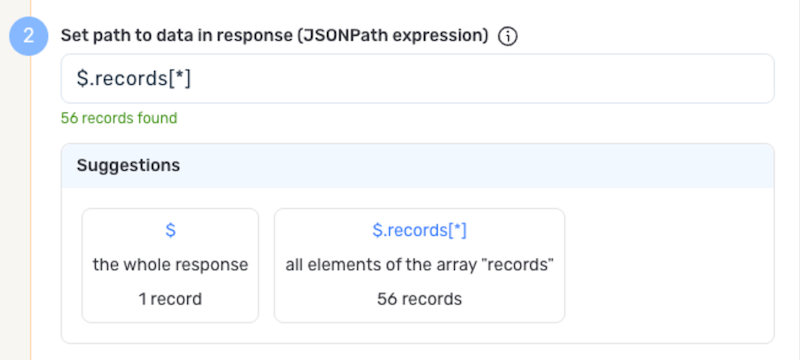
Nexla can also autogenerate data path suggestions based on the response from the API endpoint. These suggested paths can be used as-is or modified to exactly suit your needs.

  • To use this feature, click the Test button next to the Set API URL field to fetch a sample response from the API endpoint. Suggested data paths generated based on the content and format of the response will be displayed in the Suggestions box below the Set Path to Data in Response field.

  • Click on a suggestion to automatically populate the Set Path to Data in Response field with the corresponding path. The populated path can be modified directly within the field if further customisation is needed.
    PathSuggestions.png

Metadata

If metadata is included in the response but is located outside of the defined path to relevant data, you can configure Nexla to include this data as common metadata in each record.

For example, the e-conomic API returns metaData and pagination objects alongside the collection array. If pagination metadata such as total result count is needed for downstream processing, you can specify a path to that metadata to include it alongside each record.

Metadata paths are particularly useful for preserving e-conomic response context such as total record counts or page sizes that apply to all records in the response.

  • To specify the location of metadata that should be included with each record, enter the path to the relevant metadata in the Path to Metadata in Response field using JSON path notation.

Request Headers

Optional
  • If Nexla should include any additional request headers in API calls to this source, enter the headers and corresponding values as comma-separated pairs in the Request Headers field (e.g., header1:value1,header2:value2).

    You do not need to include the X-AppSecretToken or X-AgreementGrantToken authentication headers in this field — these are automatically injected by Nexla from the selected e-conomic credential.

Endpoint Testing

After configuring all settings for the selected endpoint, Nexla can retrieve a sample of the data that will be fetched according to the current configuration. This allows users to verify that the source is configured correctly before saving.

  • To test the current endpoint configuration, click the Test button to the right of the endpoint selection menu. Sample data will be fetched and displayed in the Endpoint Test Result panel on the right.

  • If the sample data is not as expected, review the selected endpoint and associated settings, and make any necessary adjustments. Then, click the Test button again, and check the sample data to ensure that the correct information is displayed.

Save & Activate the Source

  1. Once all of the relevant steps in the above sections have been completed, click the Create button in the upper right corner of the screen to save and create the new e-conomic data source. Nexla will now begin ingesting data from the configured endpoint and will organise any data that it finds into one or more Nexsets.