The Dixa connector enables you to ingest conversation data, message exports, analytics metrics, agent and team rosters, end-user profiles, queue configurations, tags, webhooks, and organisation details from Dixa into Nexla. Follow the instructions below to create a new data flow that ingests data from a Dixa source in Nexla.
Create a New Data Flow
-
To create a new data flow, navigate to the Integrate section, and click the New Data Flow button. Then, select the desired flow type from the list, and click the Create button.
-
Select the Dixa connector tile from the list of available connectors. Then, select the credential that will be used to connect to the Dixa instance, and click Next; or, create a new Dixa credential for use in this flow.
-
In Nexla, Dixa data sources can be created using pre-built endpoint templates, which expedite source setup for common Dixa API endpoints. Each template is designed specifically for the corresponding Dixa endpoint, making source configuration easy and efficient.
• To configure this source using a template, follow the instructions in Configure Using a Template.
Dixa sources can also be configured manually, allowing you to ingest data from Dixa endpoints not included in the pre-built templates or apply further customisations to exactly suit your needs.
• To configure this source manually, follow the instructions in Configure Manually.
Nexla provides pre-built templates that can be used to rapidly configure data sources to ingest data from common Dixa endpoints. Each template is designed specifically for the corresponding Dixa endpoint, making data source setup easy and efficient.
Endpoint Settings
- Select the endpoint from which this source will fetch data from the Endpoint pulldown menu. Available endpoint templates are listed in the expandable boxes below. Click on an endpoint to see more information about it and how to configure your data source for this endpoint.
Export Conversations
Bulk-export conversation records from the Dixa Exports API for a specified date range. This endpoint is the primary path for warehousing complete conversation histories, including wrapup notes and custom attributes. Use this endpoint when you need a full snapshot of all conversations within a time window for reporting, compliance, or data warehouse ingestion.
- This endpoint uses the Dixa Exports API host (
https://exports.dixa.io/v1/conversation_export) and accepts date-range parameters to scope the export. No additional configuration parameters are required beyond selecting the template — Nexla handles the date windowing automatically using the configured schedule. - The response is a JSON array where each element represents a single conversation record. Nexla maps each element as an individual record in the resulting Nexset.
- Queries are subject to Dixa's time-range limit of 31 days per request. When running recurring flows, configure your Nexla schedule so that each run covers a window of 31 days or fewer to remain within this limit.
Export Messages
Bulk-export message records from the Dixa Exports API for a specified date range. This endpoint is complementary to Export Conversations and returns the individual messages associated with conversations, making it suitable for message-level analytics, sentiment analysis pipelines, and full-text search indexing.
- This endpoint uses the Dixa Exports API host (
https://exports.dixa.io/v1/message_export) and returns a JSON array of message records. Each element in the array represents a single message and is mapped to an individual record in the resulting Nexset. - Queries are subject to the same 31-day time-range limit that applies to the Export Conversations endpoint. Schedule recurring flows to stay within this window.
- Internal notes are not included in the message export. To retrieve internal conversation notes, use the List Conversation Notes or Export Conversations endpoint instead.
Get Conversation
Retrieve the full detail of a single conversation by its ID, including wrapup notes, custom attributes, and all associated metadata. Use this endpoint when you need complete, record-level detail for a specific conversation — for example, when enriching a downstream CRM record or verifying a support interaction.
List Conversations
Search and list conversations using Dixa's search endpoint with optional filters. This endpoint is well-suited for enumerating conversations for bulk processing, change detection, and incremental sync workflows where you need to discover conversations matching specific criteria rather than exporting a full time-range snapshot.
- No additional template parameters are required. The endpoint returns conversation summary records from
https://dev.dixa.io/v1/search/conversations. The response data is extracted from the $.data[*] path, with each element mapped to an individual Nexset record. - For filtered searches, use the manual configuration option to pass query parameters such as status, channel type, or assigned agent directly in the API URL.
List Conversation Messages
List all messages within a specific conversation. Use this endpoint for real-time or incremental retrieval of messages per conversation — for example, when monitoring an ongoing support interaction or syncing individual conversation threads to an external system.
- Enter the unique identifier of the conversation whose messages you want to retrieve in the Conversation ID field. This is a required parameter. Conversation IDs can be obtained from the List Conversations or Export Conversations endpoints.
- The response data is extracted from the
$.data[*] path, with each message mapped to an individual Nexset record.
List Conversation Notes
Retrieve all internal notes attached to a specific conversation. Internal notes are visible only to agents and are commonly used to share context, escalation details, or follow-up instructions. Use this endpoint when syncing conversation notes to external knowledge bases, CRMs, or ticketing systems.
- Enter the unique identifier of the conversation whose notes you want to list in the Conversation ID field. This is a required parameter.
- The response data is extracted from the
$.data[*] path, with each note mapped to an individual Nexset record.
List Conversation Ratings
Retrieve CSAT (Customer Satisfaction) or NPS (Net Promoter Score) ratings submitted for a specific conversation. Use this endpoint to feed customer feedback data into analytics dashboards, quality assurance workflows, or CRM enrichment pipelines.
- Enter the unique identifier of the conversation whose ratings you want to retrieve in the Conversation ID field. This is a required parameter.
- The response data is extracted from the
$.data[*] path, with each rating record mapped to an individual Nexset record.
List Conversation Tags
List all tags currently applied to a specific conversation. Tags in Dixa are used to categorise conversations for routing, reporting, and quality assurance. Use this endpoint to enrich analytics pipelines with tag metadata or to audit conversation classification.
- Enter the unique identifier of the conversation whose tags you want to list in the Conversation ID field. This is a required parameter.
- The response data is extracted from the
$.data[*] path, with each tag record mapped to an individual Nexset record.
List Analytics Metrics
List all available analytics metric definitions from the Dixa Analytics API. This endpoint returns the catalogue of metric IDs and their definitions, which is required before querying actual metric values using the List Analytics Records or Query Analytics Metrics endpoints. Use this endpoint to discover which KPIs and contact-centre metrics are available in your Dixa organisation.
- No additional parameters are required. The endpoint returns metric definitions from
https://dev.dixa.io/v1/analytics/metrics. The response data is extracted from the $.data[*] path, with each metric definition mapped to an individual Nexset record.
List Analytics Records
Query raw analytics records (KPIs and contact-centre metrics) for a specified time window. This is the primary feed for BI and dashboard tools that need to display Dixa performance data. Use this endpoint for recurring metric exports to data warehouses, reporting databases, or BI platforms such as Tableau, Looker, or Power BI.
- No additional template parameters are required beyond selecting the endpoint. The response data is extracted from the
$.data[*] path, with each analytics record mapped to an individual Nexset record. - For filtered or aggregated metric queries, use the manual configuration option (Advanced tab) or the Query Analytics Records destination endpoint to pass a structured request body with specific filters and dimensions.
List Agents
List all agents in the Dixa organisation. Agent records include profile information, roles, and configuration details. Use this endpoint for reporting, workforce management exports, HR directory synchronisation, or auditing agent rosters.
- No additional parameters are required. The endpoint returns agent records from
https://dev.dixa.io/v1/agents. The response data is extracted from the $.data[*] path, with each agent mapped to an individual Nexset record.
Get Agent
Retrieve a single agent or administrator by their unique ID. Use this endpoint when you need complete profile details for a specific agent — for example, when enriching a workforce management record or verifying an agent's configuration before an automated action.
- Enter the unique identifier of the agent you want to retrieve in the Agent ID field. This is a required parameter. Agent IDs can be obtained from the List Agents endpoint.
- The response data is located at the
$.data path in the API response.
List Agents Presence
List the current presence and availability status of all agents. This endpoint is particularly useful for workforce management dashboards that need to display real-time agent availability, and for contact centre analytics that track agent utilisation across shifts.
- No additional parameters are required. The endpoint returns presence records from
https://dev.dixa.io/v1/agents/presence. The response data is extracted from the $.data[*] path, with each agent presence record mapped to an individual Nexset record.
List Queues
List all queues and their configuration details. Queues in Dixa define routing rules for incoming conversations. Use this endpoint for queue-based analytics, routing-rule synchronisation, or provisioning automation workflows.
- No additional parameters are required. The endpoint returns queue records from
https://dev.dixa.io/v1/queues. The response data is extracted from the $.data[*] path, with each queue mapped to an individual Nexset record.
Get Queue
Retrieve a single queue's configuration by its unique ID. Use this endpoint when you need detailed routing settings for a specific queue — for example, before making automated configuration changes.
- Enter the unique identifier of the queue you want to retrieve in the Queue ID field. This is a required parameter. Queue IDs can be obtained from the List Queues endpoint.
- The response data is located at the
$.data path in the API response.
List Queue Members
List all agents currently assigned to a specific queue. Use this endpoint for workforce management exports, access audits, or to verify queue membership as part of a provisioning workflow.
- Enter the unique identifier of the queue whose members you want to list in the Queue ID field. This is a required parameter. Queue IDs can be obtained from the List Queues endpoint.
- The response data is extracted from the
$.data[*] path, with each queue member mapped to an individual Nexset record.
List Teams
List all teams in the Dixa organisation. Teams group agents and link to queues to organise routing and reporting. Use this endpoint for team-level analytics, directory synchronisation, or HR system integrations.
- No additional parameters are required. The endpoint returns team records from
https://dev.dixa.io/v1/teams. The response data is extracted from the $.data[*] path, with each team mapped to an individual Nexset record.
Get Team
Retrieve a single team by its unique ID. Use this endpoint when you need complete team details — for example, before making automated membership or configuration changes.
- Enter the unique identifier of the team you want to retrieve in the Team ID field. This is a required parameter. Team IDs can be obtained from the List Teams endpoint.
- The response data is located at the
$.data path in the API response.
List Team Members
List all agents and administrators that are members of a specific team. Use this endpoint for team-membership synchronisation workflows, access audits, or when building reports that break down performance by team composition.
- Enter the unique identifier of the team whose members you want to list in the Team ID field. This is a required parameter. Team IDs can be obtained from the List Teams endpoint.
- The response data is extracted from the
$.data[*] path, with each team member mapped to an individual Nexset record.
List End Users
List all end users (customers) in the Dixa organisation. End users are the customers who contact your support team. Use this endpoint for data synchronisation workflows, customer data audits, and CRM-style integrations where you need a full export of your customer roster.
- No additional parameters are required. The endpoint returns end user records from
https://dev.dixa.io/v1/endusers. The response data is extracted from the $.data[*] path, with each end user mapped to an individual Nexset record.
Get End User
Retrieve a single end user's profile and metadata by their unique ID. Use this endpoint when you need complete customer profile details for a specific end user — for example, when building a customer-360 view in a downstream CRM or analytics system.
- Enter the unique identifier of the end user you want to retrieve in the User ID field. This is a required parameter. User IDs can be obtained from the List End Users endpoint or from a Dixa conversation record's end user reference.
- The response data is located at the
$.data path in the API response.
List End User Conversations
List all conversations associated with a specific end user. This is the primary customer-360 read path in Dixa — use it to retrieve the full conversation history for a given customer when enriching CRM records, building support portals, or generating per-customer analytics.
- Enter the unique identifier of the end user whose conversations you want to list in the User ID field. This is a required parameter. User IDs can be obtained from the List End Users or Get End User endpoints.
- The response data is extracted from the
$.data[*] path, with each conversation mapped to an individual Nexset record.
List Tags
List all conversation tags defined in the Dixa organisation. Tags are used to categorise and classify conversations for routing, reporting, and quality assurance. Use this endpoint to enrich analytics pipelines with tag metadata or to synchronise your Dixa tag catalogue with external systems.
- No additional parameters are required. The endpoint returns tag records from
https://dev.dixa.io/v1/tags. The response data is extracted from the $.data[*] path, with each tag mapped to an individual Nexset record.
List Webhooks
List all registered webhook subscriptions in the Dixa organisation. Use this endpoint to audit existing webhook registrations, verify webhook configurations, or support idempotent webhook registration workflows where you need to check whether a subscription already exists before creating a new one.
- No additional parameters are required. The endpoint returns webhook subscription records from
https://dev.dixa.io/v1/webhooks. The response data is extracted from the $.data[*] path, with each webhook subscription mapped to an individual Nexset record.
List Contact Endpoints
List all configured contact endpoints (email addresses, phone numbers, and other inbound channel identifiers) in the Dixa organisation. Contact endpoints represent the inbound channels through which customers can reach your support team. Use this endpoint to audit channel configuration or to synchronise channel metadata with external systems.
- No additional parameters are required. The endpoint returns contact endpoint records from
https://dev.dixa.io/v1/contact-endpoints. The response data is extracted from the $.data[*] path, with each contact endpoint mapped to an individual Nexset record.
Get Organization
Retrieve the current Dixa organisation's details, including name, locale, and account settings. Use this endpoint to obtain organisation metadata for auditing, reporting, or synchronising Dixa account information with external systems.
- No additional parameters are required. The endpoint returns organisation details from
https://dev.dixa.io/v1/organization. The response data is located at the $.data path in the API response.
Endpoint Testing
Once the selected endpoint template has been configured, Nexla can retrieve a sample of the data that will be fetched according to the current settings. This allows users to verify that the source is configured correctly before saving.
-
To test the current endpoint configuration, click the Test button to the right of the endpoint selection menu. Sample data will be fetched & displayed in the Endpoint Test Result panel on the right.
-
If the sample data is not as expected, review the selected endpoint and associated settings, and make any necessary adjustments. Then, click the Test button again, and check the sample data to ensure that the correct information is displayed.
Dixa data sources can be manually configured to ingest data from any valid Dixa API endpoint. Manual configuration provides maximum flexibility for accessing endpoints not covered by pre-built templates or when you need custom API configurations — for example, applying query parameter filters, using chained API calls, or accessing endpoints from the Dixa Integrations API.
With manual configuration, you can also create more complex Dixa sources that use lookup-based macros to pass dynamic values (such as conversation IDs or agent IDs) into the API URL.
API Method
-
To manually configure this source, select the Advanced tab at the top of the configuration screen.
-
Select the API method that will be used for calls to the Dixa API from the Method pulldown menu. The most common methods for Dixa data retrieval are:
- GET: For retrieving data from the Dixa API or Exports API (most read operations)
- POST: For querying analytics metrics or records using a request body with filters and dimensions
API Endpoint URL
- Enter the URL of the Dixa API endpoint from which this source will fetch data in the Set API URL field. The Dixa API uses two base URLs:
https://dev.dixa.io/v1/ — for the main Dixa API (conversations, agents, teams, queues, analytics, tags, webhooks, end users, organisation)https://exports.dixa.io/v1/ — for the Dixa Exports API (bulk conversation and message exports)
Ensure the API endpoint URL is correct and accessible with your current credentials. You can test the endpoint using the Test button after configuring the URL. Full API documentation is available at docs.dixa.io/openapi.
Date/Time Macros (API URL)
Optional
Optionally, the API URL can be customised using macros—all macros added to the API URL will be converted into values when Nexla executes the API call. Macros are dynamic placeholders that allow you to create flexible API endpoints that can adapt to different time periods or data requirements. This is particularly useful for the Dixa Exports API, which requires date range parameters.
Date/time macros are especially useful with the Dixa Exports API endpoints, which accept updated_after and updated_before query parameters. Use macros to configure rolling date windows for recurring export jobs.
-
To add a macro, type { at the appropriate position in the API URL (within the Set API URL field), and select the desired macro from the dropdown list.
{now} – The current datetime{now-1} – The datetime one time unit before the current datetime{now+1} – The datetime one time unit after the current datetimecustom – Datetime macros can reference any number of time units before or after the current datetime—for example, enter (now-4) to indicate the datetime four time units before the current datetime
-
Select the format that will be applied to datetime macros from the Date Format for Date/Time Macro pulldown menu. This format will be applied to the base datetime value of the macro—i.e., the value of {now} in {now-1}. The Dixa Exports API accepts dates in yyyy-MM-dd format.
-
Select the datetime unit that will be used to perform mathematical operations in the included macro(s) from the Time Unit for Operations pulldown menu—for example, for the macro {now-1}, when Day is selected, {now-1} will be converted to the datetime one day before the current datetime.
Lookup-Based Macros (API URL)
Optional
Column values from existing lookups can also be included as macros in the API URL. Lookup-based macros allow you to reference data from previously configured data sources or lookups, enabling dynamic API endpoints that can adapt based on existing data. This is useful for Dixa endpoints that require entity IDs (such as conversation IDs, agent IDs, or queue IDs) in the URL path.
Lookup-based macros are particularly valuable when chaining Dixa API calls — for example, using conversation IDs from an Export Conversations source as input to a Get Conversation or List Conversation Messages source.
-
To include a lookup column value macro, select the relevant lookup from the Add Lookups to Supported Macros pulldown menu.
-
Type { at the appropriate position in the API URL, and select the lookup column-based macro from the dropdown list. Lookup-based macros are automatically populated into the macro list when a lookup is selected in the Add Lookups to Supported Macros pulldown menu.
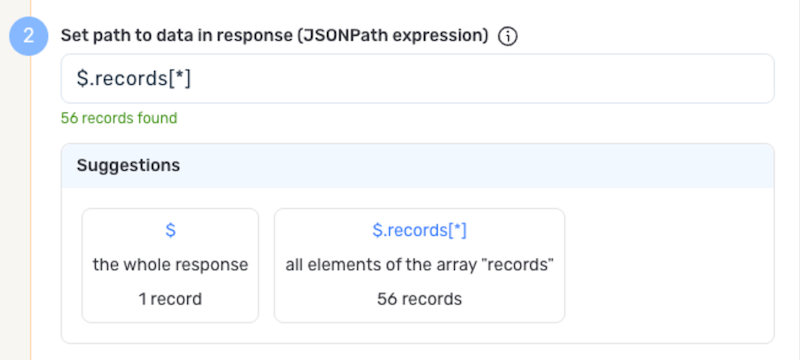
If only a subset of the data returned by the Dixa API endpoint is needed, you can designate the part(s) of the response that should be included in the Nexset(s) produced from this source by specifying the path to the relevant data within the response.
Most Dixa API responses follow one of two patterns:
- List responses: Return an object with a
data array (e.g., {"data": [...]}) — use $.data[*] to extract individual records.
- Single-record responses: Return an object with a
data property (e.g., {"data": {...}}) — use $.data to extract the record.
- Exports API responses: Return a top-level JSON array — use
$[*] to extract individual records.
Path to Data is essential when Dixa API responses contain pagination metadata or nested structures. Without specifying the correct path, Nexla may not be able to properly parse and organise your data into usable records.
Autogenerate Path Suggestions
Nexla can also autogenerate data path suggestions based on the response from the API endpoint. These suggested paths can be used as-is or modified to exactly suit your needs.
-
To use this feature, click the Test button next to the Set API URL field to fetch a sample response from the API endpoint. Suggested data paths generated based on the content & format of the response will be displayed in the Suggestions box below the Set Path to Data in Response field.
-
Click on a suggestion to automatically populate the Set Path to Data in Response field with the corresponding path. The populated path can be modified directly within the field if further customisation is needed.
If metadata is included in the Dixa API response but is located outside of the defined path to relevant data, you can configure Nexla to include this data as common metadata in each record. For example, Dixa list responses often include pagination metadata or request context alongside the data array — specifying a metadata path allows you to preserve this contextual information with each record.
-
If Nexla should include any additional request headers in API calls to this source, enter the headers & corresponding values as comma-separated pairs in the Request Headers field (e.g., header1:value1,header2:value2). This may be required for API versioning or content type specifications.
You do not need to include the Authorization header or any other headers already present in the Dixa credential. The API key configured in your credential is automatically applied to every request.
Endpoint Testing
After configuring all settings for the selected endpoint, Nexla can retrieve a sample of the data that will be fetched according to the current configuration. This allows users to verify that the source is configured correctly before saving.
-
To test the current endpoint configuration, click the Test button to the right of the endpoint selection menu. Sample data will be fetched & displayed in the Endpoint Test Result panel on the right.
-
If the sample data is not as expected, review the selected endpoint and associated settings, and make any necessary adjustments. Then, click the Test button again, and check the sample data to ensure that the correct information is displayed.
Save & Activate the Source
- Once all of the relevant steps in the above sections have been completed, click the Create button in the upper right corner of the screen to save and create the new Dixa data source. Nexla will now begin ingesting data from the configured endpoint and will organise any data that it finds into one or more Nexsets.