
Demandbase Data Source

The Demandbase connector enables you to ingest B2B company and contact intelligence, job status data, import job records, activity type definitions, credit usage metrics, and user administration data from the Demandbase B2B API directly into Nexla data flows. Follow the instructions below to create a new data flow that ingests data from a Demandbase source in Nexla.
demandbase_api.png

Demandbase

Create a New Data Flow

  1. To create a new data flow, navigate to the Integrate section, and click the New Data Flow button. Then, select the desired flow type from the list, and click the Create button.

  2. Select the Demandbase connector tile from the list of available connectors. Then, select the credential that will be used to connect to the Demandbase instance, and click Next; or, create a new Demandbase credential for use in this flow.

  3. In Nexla, Demandbase data sources can be created using pre-built endpoint templates, which expedite source setup for common Demandbase API endpoints. Each template is designed specifically for the corresponding Demandbase endpoint, making source configuration easy and efficient.
    • To configure this source using a template, follow the instructions in Configure Using a Template.

    Demandbase sources can also be configured manually, allowing you to ingest data from Demandbase endpoints not included in the pre-built templates or apply further customizations to exactly suit your needs.
    • To configure this source manually, follow the instructions in Configure Manually.

Configure Using a Template

Nexla provides pre-built templates that can be used to rapidly configure data sources to ingest data from common Demandbase API endpoints. Each template is designed specifically for the corresponding Demandbase endpoint, making data source setup easy and efficient.

Endpoint Settings

  • Select the endpoint from which this source will fetch data from the Endpoint pulldown menu. Available endpoint templates are listed in the expandable boxes below. Click on an endpoint to see more information about it and how to configure your data source for this endpoint.

Search Companies

Search the Demandbase company database using firmographic and location filters to retrieve a list of matching company profiles. Use this endpoint to build targeted account lists based on criteria such as industry, employee count, geography, or company name. Results include rich company profiles with firmographics, technographics, and corporate hierarchy data. This endpoint supports pagination and returns up to 100 results per page.

  • The following filter parameters are available to narrow your company search. All parameters are optional — leaving a filter empty returns results without restriction on that attribute:

    • Company Name: Enter a company name to filter results to companies whose name matches or contains this value.
    • Website Domain: Enter a domain (for example, acme.com) to filter to companies with that website domain.
    • City: Enter a city name to filter to companies headquartered in that city.
    • State: Enter a state or province name to filter to companies headquartered in that state or province.
    • Country: Enter a country name to filter to companies headquartered in that country.
    • Industries: Enter one or more industry classifications to filter to companies in those industries. Refer to the Demandbase B2B API reference for accepted industry values.
    • Min Employees: Enter a minimum employee count to filter to companies with at least this many employees.
    • Max Employees: Enter a maximum employee count to filter to companies with at most this many employees.
    • Sort By: Enter the field name by which results should be sorted.
    • Sort Order: Select asc for ascending order or desc for descending order. Defaults to asc.
  • Results Per Page: Enter the number of results to return per page. The maximum value is 100. Defaults to 100.
  • Page Number: Enter the starting page number for pagination. Defaults to 1. Nexla will automatically paginate through all available pages during ingestion.

This endpoint fetches paginated results and will automatically continue retrieving pages until no more data is returned. For large result sets, consider using filters to narrow results and reduce API credit consumption. See the Demandbase B2B API endpoint reference for additional details.

Search Contacts

Search the Demandbase contact database using name, title, job function, job level, email, or company filters to retrieve a list of matching contact profiles. Use this endpoint to build targeted prospect lists for outreach campaigns. Results include verified business emails, job titles, seniority levels, and associated company information. This endpoint supports pagination and returns up to 100 results per page.

  • The following filter parameters are available to narrow your contact search. All parameters are optional:

    • First Name: Enter a first name to filter to contacts whose first name matches this value.
    • Last Name: Enter a last name to filter to contacts whose last name matches this value.
    • Email: Enter an email address to filter to contacts with that email address.
    • Job Titles: Enter one or more job title values to filter to contacts with matching titles.
    • Job Levels: Enter one or more seniority level values (for example, VP, Director, Manager) to filter to contacts at those levels.
    • Job Functions: Enter one or more department or job function values (for example, Sales, Marketing, Engineering) to filter to contacts in those functions.
    • Company Name: Enter a company name to filter to contacts associated with that company.
    • Sort By: Enter the field name by which results should be sorted.
    • Sort Order: Select asc for ascending order or desc for descending order. Defaults to asc.
  • Results Per Page: Enter the number of results to return per page. The maximum value is 100. Defaults to 100.
  • Page Number: Enter the starting page number for pagination. Defaults to 1. Nexla will automatically paginate through all available pages during ingestion.

Demandbase contact data includes quality grades and verification status for email addresses. For complete information on available filter values and response fields, see the Demandbase B2B API endpoint reference.

Get Contact Details

Retrieve the full profile for a specific contact by their unique Demandbase Contact ID. Use this endpoint when you have a known contact ID — for example, from a previous search or from your CRM — and need to retrieve complete profile details including email, title, job function, seniority, and associated company information.

  • Contact ID (Required): Enter the unique Demandbase identifier for the contact whose profile you want to retrieve. Contact IDs can be obtained from the results of the Search Contacts endpoint or from your existing Demandbase data.

This endpoint returns a single contact record and does not paginate. Use the Search Contacts endpoint to discover contact IDs when they are not already known.

Get Company Details

Retrieve the full profile for a specific company by its unique Demandbase Company ID. Use this endpoint when you have a known company ID and need complete firmographic details including employee count, revenue, industry classification, technographics, corporate hierarchy, and intent data.

  • Company ID (Required): Enter the unique Demandbase identifier for the company whose profile you want to retrieve. Company IDs can be obtained from the results of the Search Companies endpoint or from your existing Demandbase data.

This endpoint returns a single company record and does not paginate. Use the Search Companies endpoint to discover company IDs when they are not already known.

Get Company News

Retrieve news articles associated with a specific company, filtered by news category. Use this endpoint to monitor real-time signals for target accounts — including M&A activity, leadership changes, funding rounds, product launches, and other business events that indicate buying intent or strategic shifts. This endpoint supports pagination.

  • Company ID (Required): Enter the unique Demandbase identifier for the company whose news you want to retrieve. Company IDs can be obtained from the Search Companies or Get Company Details endpoints.
  • News Categories: Optionally, enter one or more news category values to filter articles to specific event types (for example, funding, leadership, M&A). Refer to the Demandbase API reference for supported category values. Leave empty to retrieve all news categories.
  • Page Number: Enter the starting page number for pagination. Defaults to 1.
  • Per Page: Enter the number of articles to return per page. Defaults to 100.

Company news data is a powerful signal for identifying accounts that may be actively researching solutions or undergoing changes that create new buying opportunities. This endpoint fetches up to 50 pages of results.

Get Job Status

Check the status and progress of a bulk matching job previously submitted to Demandbase. Use this endpoint to monitor asynchronous bulk match jobs — for example, to determine when a large batch of company or contact records has been fully processed before retrieving results.

  • Job ID (Required): Enter the unique ID of the bulk match job whose status you want to check. Job IDs are returned by the Create Bulk Match Job destination endpoint when a job is submitted.

This endpoint returns a single status record for the specified job. Poll this endpoint periodically to monitor job progress for long-running bulk match operations.

Get Import Job Status

Retrieve the status and details of a specific data import job previously submitted to Demandbase. Use this endpoint to monitor the progress of import jobs — for example, to verify that account, contact, or activity records have been successfully ingested into Demandbase before proceeding with downstream workflows.

  • Job ID (Required): Enter the unique ID of the import job whose status you want to retrieve. Job IDs are returned by the Create Import Job destination endpoint when an import job is created.

The Demandbase Data Import API can process up to three million records per hour. For large imports, use this endpoint to monitor progress. For complete information on import job statuses, see the Demandbase Import API documentation.

List Import Jobs

Retrieve a list of all data import jobs for your Demandbase account. Use this endpoint for auditing, monitoring, or building dashboards that track the history and status of all import operations submitted to Demandbase from your organization.

  • This endpoint requires no additional configuration parameters. It returns all import jobs for the authenticated account automatically.

This endpoint returns summary information for all import jobs. To retrieve full details for a specific job, use the Get Import Job Status endpoint with the corresponding Job ID.

List Activity Types

Retrieve all activity type definitions configured for your Demandbase account. Activity types define the categories of engagement events (such as web visits, form submissions, or custom interactions) that can be imported into Demandbase. Use this endpoint to discover available activity types before submitting import data.

  • This endpoint requires no additional configuration parameters. It returns all activity types defined for the authenticated account automatically.

Activity types must be defined before activity data can be imported into Demandbase. Use the Create Activity Type or Update Activity Type destination endpoints to manage activity type definitions.

Get Activity Type

Retrieve the details for a specific activity type definition by its unique ID. Use this endpoint to inspect the schema and configuration of a particular activity type before submitting import data that references it.

  • Activity Type ID (Required): Enter the unique ID of the activity type you want to retrieve. Activity Type IDs can be obtained from the List Activity Types endpoint.

Get Credit Usage

Retrieve credit usage information for your Demandbase account. Use this endpoint to monitor API credit consumption — for example, to track usage against your plan limits, trigger alerts when usage approaches thresholds, or generate usage reports for billing and governance purposes.

  • This endpoint requires no additional configuration parameters. It returns credit usage data for the authenticated account automatically.

For complete information on Demandbase API credit usage and limits, see the Demandbase Credit Usage documentation.

List Users

Retrieve a list of all users in your Demandbase admin system. Use this endpoint for user directory synchronization, access auditing, or to retrieve user IDs needed for user-specific operations such as updates or deletions.

  • This endpoint requires no additional configuration parameters. It returns all users for the authenticated account automatically.

Access to user administration endpoints requires that your API Key Set includes Admin API permissions. Ensure the credential used for this source was created with Admin API access enabled. For complete information, see the Demandbase User Admin API documentation.

Get User

Retrieve the details for a specific user in the Demandbase admin system by their unique User ID. Use this endpoint to retrieve full profile and role information for an individual user.

  • User ID (Required): Enter the unique Demandbase identifier for the user you want to retrieve. User IDs can be obtained from the List Users endpoint.

Access to user administration endpoints requires Admin API permissions in your Demandbase API Key Set.

Endpoint Testing

Once the selected endpoint template has been configured, Nexla can retrieve a sample of the data that will be fetched according to the current settings. This allows users to verify that the source is configured correctly before saving.

  • To test the current endpoint configuration, click the Test button to the right of the endpoint selection menu. Sample data will be fetched & displayed in the Endpoint Test Result panel on the right.

  • If the sample data is not as expected, review the selected endpoint and associated settings, and make any necessary adjustments. Then, click the Test button again, and check the sample data to ensure that the correct information is displayed.

Configure Manually

Demandbase data sources can be manually configured to ingest data from any valid Demandbase API endpoint. Manual configuration provides maximum flexibility for accessing endpoints not covered by pre-built templates or when you need custom API configurations.

With manual configuration, you can also create more complex Demandbase sources, such as sources that use chained API calls to fetch data from multiple endpoints or sources that require custom request parameters beyond those exposed in the endpoint templates.

API Method

  1. To manually configure this source, select the Advanced tab at the top of the configuration screen.

  2. Select the API method that will be used for calls to the Demandbase API from the Method pulldown menu. The most common methods for Demandbase source endpoints are:

    • GET: For retrieving individual records, job status, credit usage, and list data.
    • POST: For search endpoints (Search Companies, Search Contacts) that accept filter criteria in the request body.

API Endpoint URL

  1. Enter the URL of the Demandbase API endpoint from which this source will fetch data in the Set API URL field. This should be the complete URL including the protocol (https://) and any required path parameters.

All Demandbase API endpoints begin with your account's base URL (default: https://uapi.demandbase.com) followed by the endpoint path. For example, the Search Companies endpoint URL is https://uapi.demandbase.com/data/b2b/v1/companies. Refer to the Demandbase B2B API endpoint reference for a complete list of available endpoint paths.

Date/Time Macros (API URL)

Optional

Optionally, the API URL can be customized using macros—all macros added to the API URL will be converted into values when Nexla executes the API call. Macros are dynamic placeholders that allow you to create flexible API endpoints that can adapt to different time periods or data requirements.

Date/time macros are particularly useful for Demandbase endpoints that support date-based filters, enabling you to create rolling time-window queries that automatically adjust with each flow run.

  1. To add a macro, type { at the appropriate position in the API URL (within the Set API URL field), and select the desired macro from the dropdown list.

    • {now} – The current datetime
    • {now-1} – The datetime one time unit before the current datetime
    • {now+1} – The datetime one time unit after the current datetime
    • custom – Datetime macros can reference any number of time units before or after the current datetime—for example, enter (now-4) to indicate the datetime four time units before the current datetime
  2. Select the format that will be applied to datetime macros from the Date Format for Date/Time Macro pulldown menu. This format will be applied to the base datetime value of the macro—i.e., the value of {now} in {now-1}. Demandbase date parameters use the format yyyy-MM-dd.

  3. Select the datetime unit that will be used to perform mathematical operations in the included macro(s) from the Time Unit for Operations pulldown menu—for example, for the macro {now-1}, when Day is selected, {now-1} will be converted to the datetime one day before the current datetime.

Lookup-Based Macros (API URL)

Optional

Column values from existing lookups can also be included as macros in the API URL. Lookup-based macros allow you to reference data from previously configured data sources or lookups, enabling dynamic API endpoints that can adapt based on existing data.

Lookup-based macros are useful when you need to pass IDs (such as Company IDs or Job IDs) from a previous Nexla source into a Demandbase endpoint URL — for example, to fetch company details for a list of IDs retrieved by an earlier search step.

  1. To include a lookup column value macro, select the relevant lookup from the Add Lookups to Supported Macros pulldown menu.

  2. Type { at the appropriate position in the API URL, and select the lookup column-based macro from the dropdown list. Lookup-based macros are automatically populated into the macro list when a lookup is selected in the Add Lookups to Supported Macros pulldown menu.

Path to Data

Optional

If only a subset of the data returned by the API endpoint is needed, you can designate the part(s) of the response that should be included in the Nexset(s) produced from this source by specifying the path to the relevant data within the response.

Demandbase API responses are in JSON format and typically wrap result data in a data property. For example, the Search Companies endpoint returns results under $.data[*], while the Get Company Details endpoint returns a single record at $.data. Specifying the correct path ensures that Nexla treats each element of the returned array as a record rather than treating the entire response envelope as a single record.

Path to Data is especially important for Demandbase endpoints that return paginated arrays (such as Search Companies and Search Contacts). Setting the path to $.data[*] ensures each company or contact record is treated as an individual row in your Nexset.

  • To specify which data should be treated as relevant in responses from this source, enter the path to the relevant data in the Set Path to Data in Response field using JSON path notation (e.g., $.data[*] to access an array of results within a data object).

    Path to Data Example:

    For the Search Companies endpoint, the response includes a top-level data array containing company records. Enter the path as $.data[*] to treat each element of that array as an individual record.

Autogenerate Path Suggestions

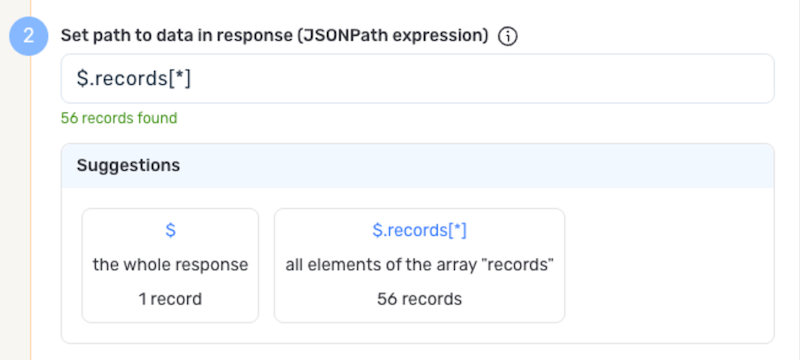
Nexla can also autogenerate data path suggestions based on the response from the API endpoint. These suggested paths can be used as-is or modified to exactly suit your needs.

  • To use this feature, click the Test button next to the Set API URL field to fetch a sample response from the API endpoint. Suggested data paths generated based on the content & format of the response will be displayed in the Suggestions box below the Set Path to Data in Response field.

  • Click on a suggestion to automatically populate the Set Path to Data in Response field with the corresponding path. The populated path can be modified directly within the field if further customization is needed.
    PathSuggestions.png

Metadata

If metadata is included in the response but is located outside of the defined path to relevant data, you can configure Nexla to include this data as common metadata in each record.

Demandbase API responses often include top-level metadata fields alongside the data array — such as total record counts or pagination information. If you want to preserve these fields alongside each ingested record, specify the path to the metadata in this field.

Metadata paths are particularly useful for preserving Demandbase API response context such as total result counts or request-level summary statistics that apply to all records in the response.

  • To specify the location of metadata that should be included with each record, enter the JSON path to the relevant metadata in the Path to Metadata in Response field.

Request Headers

Optional
  • If Nexla should include any additional request headers in API calls to this source, enter the headers & corresponding values as comma-separated pairs in the Request Headers field (e.g., header1:value1,header2:value2).

    You do not need to include the Authorization header or Content-Type header — these are automatically managed by Nexla using your Demandbase credential configuration. Only add headers for special Demandbase API versioning or custom requirements not covered by your credential settings.

Endpoint Testing

After configuring all settings for the selected endpoint, Nexla can retrieve a sample of the data that will be fetched according to the current configuration. This allows users to verify that the source is configured correctly before saving.

  • To test the current endpoint configuration, click the Test button to the right of the endpoint selection menu. Sample data will be fetched & displayed in the Endpoint Test Result panel on the right.

  • If the sample data is not as expected, review the selected endpoint and associated settings, and make any necessary adjustments. Then, click the Test button again, and check the sample data to ensure that the correct information is displayed.

Save & Activate the Source

  1. Once all of the relevant steps in the above sections have been completed, click the Create button in the upper right corner of the screen to save and create the new Demandbase data source. Nexla will now begin ingesting data from the configured endpoint and will organize any data that it finds into one or more Nexsets.