
Data Source

The Interzoid connector enables you to ingest data quality, matching, and enrichment results from Interzoid's AI-powered REST APIs directly into your Nexla data flows. Follow the instructions below to create a new data flow that ingests data from an Interzoid source in Nexla.
interzoid_api.png

Interzoid

Create a New Data Flow

  1. To create a new data flow, navigate to the Integrate section, and click the New Data Flow button. Then, select the desired flow type from the list, and click the Create button.

  2. Select the Interzoid connector tile from the list of available connectors. Then, select the credential that will be used to connect to the Interzoid API, and click Next; or, create a new Interzoid credential for use in this flow.

  3. In Nexla, Interzoid data sources can be created using pre-built endpoint templates, which expedite source setup for common Interzoid endpoints. Each template is designed specifically for the corresponding Interzoid endpoint, making data source setup easy and efficient.
    • To configure this source using a template, follow the instructions in Configure Using a Template.

    Interzoid sources can also be configured manually, allowing you to ingest data from Interzoid endpoints not included in the pre-built templates or apply further customizations to exactly suit your needs.
    • To configure this source manually, follow the instructions in Configure Manually.

Configure Using a Template

Nexla provides pre-built templates that can be used to rapidly configure data sources to ingest data from common Interzoid endpoints. Each template is designed specifically for the corresponding Interzoid endpoint, making data source setup easy and efficient.

Endpoint Settings

  • Select the endpoint from which this source will fetch data from the Endpoint pulldown menu. Available endpoint templates are listed in the expandable boxes below. Click on an endpoint to see more information about it and how to configure your data source for this endpoint.

    Company Name Matching

    Matches and compares company names to identify similar or duplicate entries across datasets using Interzoid's advanced algorithm. Use this endpoint to generate similarity keys for company name deduplication and matching workflows.

    • Issues a GET request to the company match advanced endpoint, passing the company name and optional algorithm as query parameters.
    • Response data path: $ — the entire JSON response is treated as a single record containing the similarity key and match metadata. Configure the Company Name and Algorithm parameters.

    Use a lookup-based macro to pass company name values from an upstream Nexset into this endpoint, enabling bulk company name deduplication across an entire dataset. Each API call consumes one API credit.

    Convert Currency

    Converts a monetary amount from one currency to another using current exchange rates. Use this endpoint to enrich financial data with real-time currency conversions as part of a Nexla data flow.

    • Issues a GET request to the currency conversion endpoint, passing the source currency, target currency, and amount as query parameters.
    • Response data path: $ — the entire JSON response object is treated as a single record. Configure the From Currency, To Currency, and Amount parameters.

    Currency codes follow the ISO 4217 standard (e.g., USD, EUR, GBP). Use lookup-based macros to pass amounts and currency codes dynamically from an upstream financial dataset.

    Address Similarity Key

    Generates a similarity key for a street address to support fuzzy address matching and deduplication. Use this endpoint to standardize address data and identify duplicate records with variant address formats.

    • Issues a GET request to the address match endpoint, passing the street address as a query parameter.
    • Response data path: $ — the entire JSON response is treated as a single record. Configure the Address parameter with the street address to process.

    Use a lookup-based macro to pass address values from an upstream Nexset to generate similarity keys in bulk. Records with identical similarity keys can be treated as potential duplicates for deduplication workflows.

    Area Code Information

    Returns city, state, and timezone metadata for a North American telephone area code. Use this endpoint to enrich contact or customer records with geographic data derived from phone area codes.

    • Issues a GET request to the area code information endpoint, passing the 3-digit area code as a query parameter.
    • Response data path: $ — the entire JSON response is treated as a single record. Configure the Area Code parameter.

    This endpoint covers North American (NANP) area codes only. Use a lookup-based macro to process multiple area codes from an upstream Nexset in a single data flow.

    City Name Similarity Key

    Generates a similarity key for city names to support fuzzy city-level address matching. Use this endpoint to normalize variant city name spellings in address datasets.

    • Issues a GET request to the city match endpoint, passing the city name as a query parameter.
    • Response data path: $ — the entire JSON response is treated as a single record. Configure the City parameter.

    City name similarity keys help identify records where the same city is spelled differently (e.g., "New York", "N.Y.", "NYC"). Combine with address and ZIP code endpoints for comprehensive address standardization.

    Company Name Similarity Key (Standard)

    Generates a similarity key for a company name using Interzoid's standard algorithm. Use this endpoint as a lightweight alternative to the advanced company matching endpoint when processing speed is a priority.

    • Issues a GET request to the standard company match endpoint, passing the company name as a query parameter.
    • Response data path: $ — the entire JSON response is treated as a single record. Configure the Company parameter.

    The standard algorithm is faster but less precise than the advanced algorithm. Use it for large-scale initial deduplication passes, and the advanced endpoint for detailed matching on smaller datasets.

    Currency Exchange Rate

    Returns the current exchange rate between two currencies without applying a conversion. Use this endpoint to retrieve live exchange rate data for financial reporting or pricing calculations.

    • Issues a GET request to the currency rate endpoint, passing the source and target currency codes as query parameters.
    • Response data path: $ — the entire JSON response is treated as a single record. Configure the From Currency and To Currency parameters.

    Use this endpoint when you only need the exchange rate itself and not a converted amount. Currency codes follow the ISO 4217 standard.

    Email Validation

    Validates an email address and returns mailbox status, domain status, deliverability indicators, and standardization information. Use this endpoint to enrich contact records with email quality scores and validation results.

    • Issues a GET request to the email info endpoint, passing the email address as a query parameter.
    • Response data path: $ — the entire JSON response is treated as a single record. Configure the Email Address parameter.

    Use a lookup-based macro to validate email addresses from an upstream Nexset in bulk. The response includes fields such as mailbox validity, domain MX record status, and disposable email detection.

    Email Address Similarity Key

    Generates a similarity key for an email address to support fuzzy email deduplication. Use this endpoint to identify duplicate email records with variant formatting (e.g., different capitalization or alias addresses).

    • Issues a GET request to the email match endpoint, passing the email address as a query parameter.
    • Response data path: $ — the entire JSON response is treated as a single record. Configure the Email Address parameter.

    Email similarity keys normalize address formatting to identify records that represent the same mailbox despite superficial differences. Use with lookup-based macros for bulk processing.

    First Name Similarity Key

    Generates a similarity key specifically for first or given names. Use this endpoint to support fuzzy matching of person records across datasets where name formatting varies.

    • Issues a GET request to the first name match endpoint, passing the first name as a query parameter.
    • Response data path: $ — the entire JSON response is treated as a single record. Configure the First Name parameter.

    First name similarity keys handle common name variations, nicknames, and alternate spellings. Combine with the Last Name Similarity Key endpoint for comprehensive person record deduplication.

    Full Name Similarity Key

    Generates an AI-powered similarity key for a full individual name to support fuzzy matching of person records across datasets. Use this endpoint for comprehensive person record deduplication when a full name string is available.

    • Issues a GET request to the full name match endpoint, passing the full name as a query parameter.
    • Response data path: $ — the entire JSON response is treated as a single record. Configure the Full Name parameter.

    The full name endpoint uses AI to handle name variations including reversed name order, nicknames, and cultural naming conventions. Use a lookup-based macro to process names from an upstream Nexset in bulk.

    Last Name Similarity Key

    Generates a similarity key for surnames or last names. Use this endpoint to normalize surname variations for person record matching and deduplication across datasets.

    • Issues a GET request to the last name match endpoint, passing the last name as a query parameter.
    • Response data path: $ — the entire JSON response is treated as a single record. Configure the Last Name parameter.

    Last name similarity keys handle hyphenated surnames, prefixes, and spelling variations. Combine with the First Name Similarity Key endpoint for comprehensive person matching workflows.

    ZIP Code Information

    Returns city, state, county, latitude/longitude, and timezone data for a US ZIP code. Use this endpoint to enrich address records with geographic metadata derived from ZIP codes.

    • Issues a GET request to the ZIP code info endpoint, passing the 5-digit ZIP code as a query parameter.
    • Response data path: $ — the entire JSON response is treated as a single record. Configure the ZIP Code parameter.

    This endpoint covers US ZIP codes only. Use a lookup-based macro to process ZIP codes from an upstream Nexset in bulk for geographic enrichment of address datasets.

    Stock Information

    Returns real-time stock price, analyst recommendations, financial metrics, and company information for a given ticker symbol or company name. Use this endpoint to enrich financial datasets with current market data.

    • Issues a GET request to the stock info endpoint, passing the ticker symbol or company name as a query parameter.
    • Response data path: $ — the entire JSON response is treated as a single record. Configure the Stock Ticker or Company Name parameter.

    Market data is provided in real time. Use this endpoint sparingly in high-frequency data flows, as each call consumes API credits. Consider scheduling this source at appropriate intervals to balance data freshness with credit consumption.

    IP Address Profile

    Retrieves IP address intelligence including ASN, organization, CIDR, hostname, geolocation, and reputation/abuse signals for a given IP address. Use this endpoint to enrich security or analytics data with IP-based context.

    • Issues a GET request to the IP profile endpoint, passing the IP address as a query parameter.
    • Response data path: $ — the entire JSON response is treated as a single record. Configure the IP Address parameter.

    Use a lookup-based macro to process IP addresses from an upstream Nexset for bulk IP enrichment. The abuse signal data is useful for security threat detection and fraud prevention workflows.

    Phone Number Information

    Retrieves global telephone number information including formatting, validation data, geographic details, and carrier information. Use this endpoint to validate and enrich phone number data in contact records.

    • Issues a GET request to the phone info endpoint, passing the phone number as a query parameter.
    • Response data path: $ — the entire JSON response is treated as a single record. Configure the Phone Number parameter.

    This endpoint accepts phone numbers in various formats. Use lookup-based macros to validate phone numbers from an upstream contact Nexset in bulk, then use the results to flag invalid or undeliverable numbers.

    Weather by ZIP Code

    Retrieves current weather conditions including temperature and conditions description for a US ZIP code. Use this endpoint to enrich operational or logistics data with location-based weather context.

    • Issues a GET request to the weather by ZIP endpoint, passing the 5-digit US ZIP code as a query parameter.
    • Response data path: $ — the entire JSON response is treated as a single record. Configure the US Zip Code parameter.

    Weather data reflects current conditions at the time of the API call. Schedule this source to run at appropriate intervals to capture condition changes. This endpoint covers US ZIP codes only.

    Web Page Performance

    Measures web page load performance from various geographic locations for a given URL. Use this endpoint to ingest page performance data for web monitoring, competitive analysis, or SLA tracking.

    • Issues a GET request to the page info endpoint, passing the URL to test as a query parameter.
    • Response data path: $ — the entire JSON response is treated as a single record. Configure the URL parameter with the web page URL to test.

    Each call measures performance from Interzoid's monitoring locations. Use lookup-based macros to test a list of URLs from an upstream Nexset for bulk performance benchmarking.

    Remaining API Credits

    Returns the number of remaining API credits on the account's license key. Use this endpoint to monitor API credit consumption and trigger alerts when credit levels fall below a threshold.

    • Issues a GET request to the remaining credits endpoint. No query parameters are required beyond the API key included automatically by Nexla.
    • Response data path: $ — the entire JSON response is treated as a single record containing the remaining credit count.

    This endpoint also serves as the authentication test URL for the Interzoid connector. Use it in a scheduled Nexla data flow to track credit consumption over time and alert when credits need to be renewed.

    Get Global Phone Number Information

    Retrieves geographic information, primary languages spoken, and mobile device identification for a global telephone number. Use this endpoint to enrich international phone number data with country and regional context.

    • Issues a GET request to the global number info endpoint, passing the international phone number as a query parameter.
    • Response data path: $ — the entire JSON response is treated as a single record. Configure the International Phone Number parameter (include country code, e.g., +1 for US numbers).

    Use a lookup-based macro to process international phone numbers from an upstream Nexset. This endpoint complements the Phone Number Information endpoint by providing additional global geographic and language context.

Endpoint Testing

Once the selected endpoint template has been configured, Nexla can retrieve a sample of the data that will be fetched according to the current settings. This allows users to verify that the source is configured correctly before saving.

  • To test the current endpoint configuration, click the Test button to the right of the endpoint selection menu. Sample data will be fetched & displayed in the Endpoint Test Result panel on the right.

  • If the sample data is not as expected, review the selected endpoint and associated settings, and make any necessary adjustments. Then, click the Test button again, and check the sample data to ensure that the correct information is displayed.

Configure Manually

Interzoid sources can also be configured manually, allowing you to ingest data from Interzoid endpoints not included in the pre-built templates or apply further customizations to exactly suit your needs.

First, select the method that will be used for calls to the Interzoid API from the Method pulldown menu. The most common methods are:

  • GET: For retrieving data quality, matching, or enrichment results from the API
  • POST: For sending data to the API or triggering analysis operations

API Endpoint URL

  1. Enter the URL of the Interzoid API endpoint from which this source will fetch data in the Set API URL field. This should be the complete URL including the protocol (https://) and any required path or query parameters.

    Interzoid provides a comprehensive directory of available API endpoints at https://www.interzoid.com/cloud-api-directory. Common Interzoid API endpoint patterns include:

    • Name Matching: https://api.interzoid.com/getfullnamematch — generates a similarity key for full name matching and deduplication
    • Company Matching: https://api.interzoid.com/getcompanymatch — generates a similarity key for company name matching
    • Address Matching: https://api.interzoid.com/getglobaladdressmatch — generates a similarity key for global address matching
    • Email Verification: https://api.interzoid.com/getemailinfo — retrieves detailed information about an email address
    • Phone Intelligence: https://api.interzoid.com/getphonenumberinfo — retrieves profile data for a phone number
    • IP Intelligence: https://api.interzoid.com/getipaddressinfo — retrieves profile information for an IP address

    All Interzoid API endpoints require your API license key to be passed as a query parameter named apikey. For example: https://api.interzoid.com/getfullnamematch?apikey=YOUR_KEY&fullname=John+Smith. When using the Nexla Interzoid connector, the API key from your saved credential is automatically included in requests. For a complete list of available endpoints and their parameters, refer to the Interzoid Core APIs documentation.

Date/Time Macros (API URL)

Optional

Optionally, the API URL can be customized using macros—all macros added to the API URL will be converted into values when Nexla executes the API call. Macros are dynamic placeholders that allow you to create flexible API endpoints that can adapt to different time periods or data requirements.

Date/time macros are useful when calling Interzoid endpoints that accept date range parameters or when you need to dynamically adjust query parameters based on the current date.

  1. To add a macro, type { at the appropriate position in the API URL (within the Set API URL field), and select the desired macro from the dropdown list.

    • {now} – The current datetime
    • {now-1} – The datetime one time unit before the current datetime
    • {now+1} – The datetime one time unit after the current datetime
    • custom – Datetime macros can reference any number of time units before or after the current datetime—for example, enter (now-4) to indicate the datetime four time units before the current datetime
  2. Select the format that will be applied to datetime macros from the Date Format for Date/Time Macro pulldown menu. This format will be applied to the base datetime value of the macro—i.e., the value of {now} in {now-1}.

  3. Select the datetime unit that will be used to perform mathematical operations in the included macro(s) from the Time Unit for Operations pulldown menu—for example, for the macro {now-1}, when Day is selected, {now-1} will be converted to the datetime one day before the current datetime.

Lookup-Based Macros (API URL)

Optional

Column values from existing lookups can also be included as macros in the API URL. Lookup-based macros allow you to reference data from previously configured data sources or lookups, enabling dynamic API endpoints that can adapt based on existing data.

Lookup-based macros are particularly powerful for Interzoid enrichment workflows. For example, you can reference a list of names, addresses, or company values from an upstream Nexset and pass each value as a parameter to the Interzoid matching or enrichment endpoint, enabling bulk data quality operations across an entire dataset.

  1. To include a lookup column value macro, select the relevant lookup from the Add Lookups to Supported Macros pulldown menu.

  2. Type { at the appropriate position in the API URL, and select the lookup column-based macro from the dropdown list. Lookup-based macros are automatically populated into the macro list when a lookup is selected in the Add Lookups to Supported Macros pulldown menu.

Path to Data

Optional

If only a subset of the data returned by the Interzoid API endpoint is needed, you can designate the part(s) of the response that should be included in the Nexset(s) produced from this source by specifying the path to the relevant data within the response. This is particularly useful when API responses contain metadata, status codes, or other data that you don't need for your analysis.

For example, when calling a name-matching endpoint, the API response typically includes the match similarity key along with additional metadata such as the API status and remaining credits. By specifying a path to the relevant data, you can configure Nexla to extract only the data fields needed for your use case.

Interzoid API responses are in JSON format. Most Interzoid endpoints return a flat JSON object with result fields at the root level. In such cases, you can use $ as the path to treat the entire response as a single record, or specify $.MatchKey (or the relevant field name) to extract only a specific attribute.

  • To specify which data should be treated as relevant in responses from this source, enter the path to the relevant data in the Set Path to Data in Response field.

    • For responses in JSON format enter the JSON path that points to the object or array that should be treated as relevant data. JSON paths use dot notation (e.g., $.data.items[*] to access an array of items within a data object).
    Path to Data Example:

    If the Interzoid API response is a JSON object with a top-level field named SimKey containing the match key, you can use $ as the path to ingest the full response as a single record, or $.SimKey to extract only the similarity key value.

Autogenerate Path Suggestions

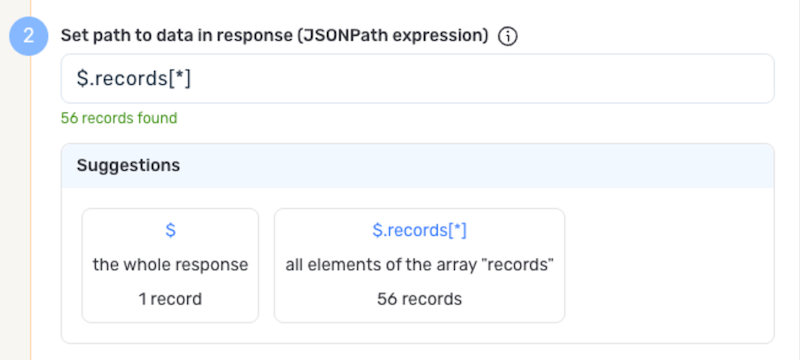
Nexla can also autogenerate data path suggestions based on the response from the API endpoint. These suggested paths can be used as-is or modified to exactly suit your needs.

  • To use this feature, click the Test button next to the Set API URL field to fetch a sample response from the API endpoint. Suggested data paths generated based on the content & format of the response will be displayed in the Suggestions box below the Set Path to Data in Response field.

  • Click on a suggestion to automatically populate the Set Path to Data in Response field with the corresponding path. The populated path can be modified directly within the field if further customization is needed.
    PathSuggestions.png

Metadata

If metadata is included in the response but is located outside of the defined path to relevant data, you can configure Nexla to include this data as common metadata in each record. This is useful when you want to preserve important contextual information that applies to all records but isn't part of the main data array.

For example, Interzoid API responses often include a Code field (indicating success or error status) and a Credits field (indicating remaining API credits) alongside the primary result data. You can use the metadata path feature to preserve this contextual information alongside each record.

Metadata paths are particularly useful for preserving Interzoid API response context such as status codes, remaining credit counts, or request identifiers that apply to all records in the response.

  • To specify the location of metadata that should be included with each record, enter the path to the relevant metadata in the Path to Metadata in Response field.

    • For responses in JSON format, enter the JSON path to the object or array that contains the metadata.

Request Headers

Optional
  • If Nexla should include any additional request headers in API calls to this source, enter the headers & corresponding values as comma-separated pairs in the Request Headers field (e.g., header1:value1,header2:value2). Additional headers may be required for specific Interzoid API endpoints or for content type specifications.

    You do not need to include any headers already present in the credentials. The Interzoid API key is automatically included in requests by Nexla using your saved credential configuration.

Endpoint Testing

After configuring all settings for the selected endpoint, Nexla can retrieve a sample of the data that will be fetched according to the current configuration. This allows users to verify that the source is configured correctly before saving.

  • To test the current endpoint configuration, click the Test button to the right of the endpoint selection menu. Sample data will be fetched & displayed in the Endpoint Test Result panel on the right.

  • If the sample data is not as expected, review the selected endpoint and associated settings, and make any necessary adjustments. Then, click the Test button again, and check the sample data to ensure that the correct information is displayed.

Save & Activate the Source

  1. Once all of the relevant steps in the above sections have been completed, click the Create button in the upper right corner of the screen to save and create the new Interzoid data source. Nexla will now begin ingesting data from the configured endpoint and will organize any data that it finds into one or more Nexsets.