Giphy Data Source

Giphy
Create a New Data Flow
-
To create a new data flow, navigate to the Integrate section, and click the New Data Flow button. Then, select the desired flow type from the list, and click the Create button.
-
Select the Giphy connector tile from the list of available connectors. Then, select the credential that will be used to connect to the Giphy API, and click Next; or, create a new Giphy credential for use in this flow.
-
In Nexla, Giphy data sources can be created using pre-built endpoint templates, which expedite source setup for common Giphy API endpoints. Each template is designed specifically for the corresponding Giphy endpoint, making source configuration easy and efficient.
• To configure this source using a template, follow the instructions in Configure Using a Template.Giphy sources can also be configured manually, allowing you to ingest data from Giphy API endpoints not included in the pre-built templates or apply further customizations to exactly suit your needs.
• To configure this source manually, follow the instructions in Configure Manually.
Configure Using a Template
Nexla provides pre-built templates that can be used to rapidly configure data sources to ingest data from common Giphy API endpoints. Each template is designed specifically for the corresponding Giphy endpoint, making data source setup easy and efficient.
Endpoint Settings
- Select the endpoint from which this source will fetch data from the Endpoint pulldown menu. Available endpoint templates are listed in the expandable boxes below. Click on an endpoint to see more information about it and how to configure your data source for this endpoint.
Endpoint Testing
Once the selected endpoint template has been configured, Nexla can retrieve a sample of the data that will be fetched according to the current settings. This allows users to verify that the source is configured correctly before saving.
-
To test the current endpoint configuration, click the Test button to the right of the endpoint selection menu. Sample data will be fetched & displayed in the Endpoint Test Result panel on the right.
-
If the sample data is not as expected, review the selected endpoint and associated settings, and make any necessary adjustments. Then, click the Test button again, and check the sample data to ensure that the correct information is displayed.
Configure Manually
Giphy data sources can be manually configured to ingest data from any valid Giphy API endpoint. Manual configuration provides maximum flexibility for accessing endpoints not covered by pre-built templates or when you need custom API configurations.
With manual configuration, you can also create more complex Giphy sources, such as sources that use chained API calls, custom query parameters, or endpoints like Translate, Random GIF, or Get GIFs by multiple IDs.
API Method
-
To manually configure this source, select the Advanced tab at the top of the configuration screen.
-
Select the API method that will be used for calls to the Giphy API from the Method pulldown menu. The Giphy API is a read-only REST API — all data-retrieval endpoints use GET.
API Endpoint URL
-
Enter the URL of the Giphy API endpoint from which this source will fetch data in the Set API URL field. All Giphy API endpoints begin with
https://api.giphy.com/v1/. Common endpoint URLs include:- Search GIFs:
https://api.giphy.com/v1/gifs/search?q=your+query&api_key=YOUR_API_KEY - Trending GIFs:
https://api.giphy.com/v1/gifs/trending?api_key=YOUR_API_KEY - Random GIF:
https://api.giphy.com/v1/gifs/random?api_key=YOUR_API_KEY - Get GIF by ID:
https://api.giphy.com/v1/gifs/GIF_ID?api_key=YOUR_API_KEY - Get GIFs by IDs:
https://api.giphy.com/v1/gifs?ids=ID1,ID2&api_key=YOUR_API_KEY - Translate (GIF):
https://api.giphy.com/v1/gifs/translate?s=your+phrase&api_key=YOUR_API_KEY - Trending Stickers:
https://api.giphy.com/v1/stickers/trending?api_key=YOUR_API_KEY - Search Stickers:
https://api.giphy.com/v1/stickers/search?q=your+query&api_key=YOUR_API_KEY
- Search GIFs:
Your Giphy API key is automatically injected by Nexla from the credential — you do not need to manually add the api_key query parameter when using credential-based authentication. Confirm with your Nexla administrator whether the credential is configured to pass the key as a query parameter or request header.
Date/Time Macros (API URL)
Optionally, the API URL can be customized using macros—all macros added to the API URL will be converted into values when Nexla executes the API call. Macros are dynamic placeholders that allow you to create flexible API endpoints that can adapt to different time periods or data requirements.
Macros are particularly useful for APIs that require date ranges, pagination parameters, or other dynamic values that change between data ingestion runs.
-
To add a macro, type
{at the appropriate position in the API URL (within the Set API URL field), and select the desired macro from the dropdown list.{now}– The current datetime{now-1}– The datetime one time unit before the current datetime{now+1}– The datetime one time unit after the current datetimecustom– Datetime macros can reference any number of time units before or after the current datetime—for example, enter(now-4)to indicate the datetime four time units before the current datetime
-
Select the format that will be applied to datetime macros from the Date Format for Date/Time Macro pulldown menu. This format will be applied to the base datetime value of the macro—i.e., the value of
{now}in{now-1}. -
Select the datetime unit that will be used to perform mathematical operations in the included macro(s) from the Time Unit for Operations pulldown menu—for example, for the macro
{now-1}, whenDayis selected,{now-1}will be converted to the datetime one day before the current datetime.
Lookup-Based Macros (API URL)
Column values from existing lookups can also be included as macros in the API URL. Lookup-based macros allow you to reference data from previously configured data sources or lookups, enabling dynamic API endpoints that can adapt based on existing data.
Lookup-based macros are useful when you need to create API endpoints that reference specific IDs, values, or parameters from other data sources in your Nexla environment.
-
To include a lookup column value macro, select the relevant lookup from the Add Lookups to Supported Macros pulldown menu.
-
Type
{at the appropriate position in the API URL, and select the lookup column-based macro from the dropdown list. Lookup-based macros are automatically populated into the macro list when a lookup is selected in the Add Lookups to Supported Macros pulldown menu.
Path to Data
If only a subset of the data returned by the Giphy API endpoint is needed, you can designate the part of the response that should be included in the Nexsets produced from this source. This is particularly useful because Giphy API responses wrap GIF records inside a data key along with pagination metadata in a pagination key and attribution information in a meta key.
For example, when fetching a list of GIFs, the Giphy API returns a JSON object where the array of GIF records is located at $.data[*]. By entering this path, you configure Nexla to treat each element of the returned array as a record.
Path to Data is essential when working with Giphy API responses. Without specifying the correct path, Nexla may ingest the entire response object — including pagination and meta sections — as a single record rather than ingesting individual GIF objects as separate records.
-
To specify which data should be treated as relevant in responses from this source, enter the path to the relevant data in the Set Path to Data in Response field.
-
For list endpoints (Search, Trending), the GIF records are located at the JSON path
$.data[*]. -
For the Get GIF by ID endpoint, the single GIF object is located at the JSON path
$.data.
Path to Data Example:For a Giphy Search or Trending response, enter
$.data[*]in the Set Path to Data in Response field to configure Nexla to treat each GIF object in the returned array as an individual record. -
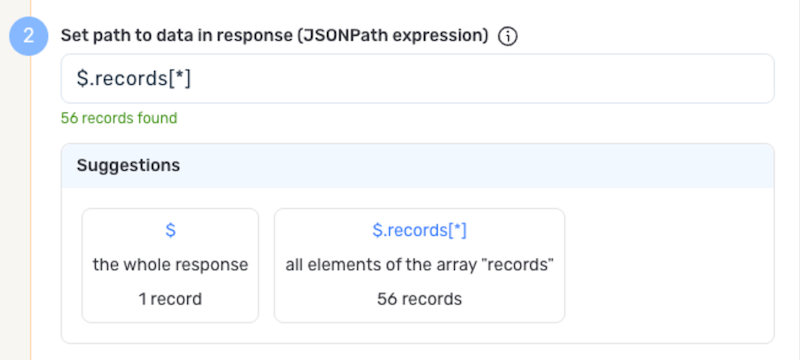
Autogenerate Path Suggestions
Nexla can also autogenerate data path suggestions based on the response from the API endpoint. These suggested paths can be used as-is or modified to exactly suit your needs.
-
To use this feature, click the Test button next to the Set API URL field to fetch a sample response from the API endpoint. Suggested data paths generated based on the content & format of the response will be displayed in the Suggestions box below the Set Path to Data in Response field.
-
Click on a suggestion to automatically populate the Set Path to Data in Response field with the corresponding path. The populated path can be modified directly within the field if further customization is needed.
Metadata
If metadata is included in the response but is located outside of the defined path to relevant data, you can configure Nexla to include this data as common metadata in each record. This is useful when you want to preserve pagination statistics or attribution details that apply to all records in a Giphy response.
For example, Giphy API list responses include a pagination object containing total_count, count, and offset fields, and a meta object containing the HTTP status, msg, and response_id. These fields are located outside the $.data[*] path and can be preserved as metadata on each ingested record.
Preserving the pagination.total_count field as metadata is helpful when you need to know how many total results exist for a given query, beyond the current page.
-
To specify the location of metadata that should be included with each record, enter the path to the relevant metadata in the Path to Metadata in Response field.
- For Giphy list responses, the pagination metadata is located at the JSON path
$.paginationand the API meta information is at$.meta.
- For Giphy list responses, the pagination metadata is located at the JSON path
Request Headers
-
If Nexla should include any additional request headers in API calls to this source, enter the headers & corresponding values as comma-separated pairs in the Request Headers field (e.g.,
header1:value1,header2:value2). The Giphy API does not require custom request headers for standard use, but headers can be added for advanced scenarios such as API versioning or proxy configurations.You do not need to include the API key as a request header here — it is handled automatically by Nexla based on your credential configuration.
Endpoint Testing
After configuring all settings for the selected endpoint, Nexla can retrieve a sample of the data that will be fetched according to the current configuration. This allows users to verify that the source is configured correctly before saving.
-
To test the current endpoint configuration, click the Test button to the right of the endpoint selection menu. Sample data will be fetched & displayed in the Endpoint Test Result panel on the right.
-
If the sample data is not as expected, review the selected endpoint and associated settings, and make any necessary adjustments. Then, click the Test button again, and check the sample data to ensure that the correct information is displayed.
Save & Activate the Source
- Once all of the relevant steps in the above sections have been completed, click the Create button in the upper right corner of the screen to save and create the new Giphy data source. Nexla will now begin ingesting data from the configured endpoint and will organize any data that it finds into one or more Nexsets.