Authorization

iLEVEL
Prerequisites
Before creating an iLEVEL credential, you need to obtain OAuth2 credentials (Client ID and Client Secret) from your iLEVEL Portfolio Monitoring Platform account. The OAuth2 credentials are required for 2-legged OAuth2 authentication with the iLEVEL API.
To obtain your OAuth2 credentials, you need to have an iLEVEL Portfolio Monitoring Platform account. Once you have access to your account, you can view and manage your API credentials in your iLEVEL account settings. The Client ID and Client Secret are used for 2-legged OAuth2 authentication, which uses the client credentials flow to obtain an access token. The access token is then sent in the Authorization header with the Bearer prefix for all API requests to the iLEVEL API. For detailed information about API credential setup and authentication, refer to the iLEVEL Portfolio Monitoring Platform documentation.
Create an iLEVEL Credential
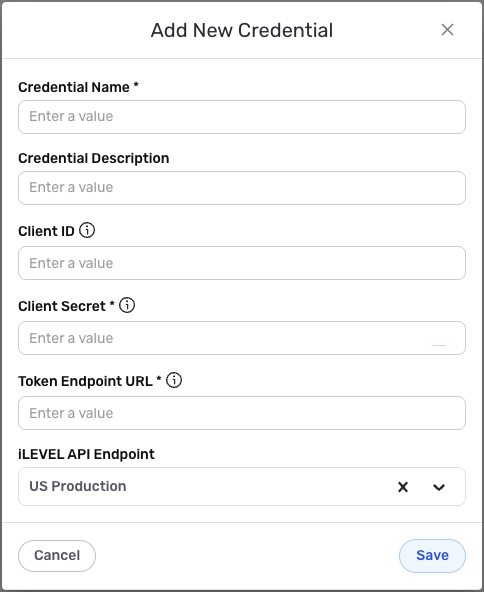
- To create a new iLEVEL credential, after selecting the data source/destination type, click the Add Credential tile to open the Add New Credential overlay.
New Credential Overlay – iLEVEL
Credential Name & Description
-
Enter a name for the credential in the Credential Name field and a short, meaningful description in the Credential Description field.
Resource descriptions are recommended but are not required. They should be used provide information about the resource purpose, data freshness, etc. that can help the owner and other users efficiently understand and utilize the resource.
OAuth2 Authentication
iLEVEL uses 2-legged OAuth2 authentication with the client credentials flow. The Client ID and Client Secret are used to obtain an access token, which is then used to authenticate API requests.
-
Enter your iLEVEL Client ID in the Client ID field. This is the Client ID you obtained from your iLEVEL Portfolio Monitoring Platform account settings. The Client ID is used along with the Client Secret to obtain an access token for API authentication.
-
Enter your iLEVEL Client Secret in the Client Secret field. This is the Client Secret you obtained from your iLEVEL Portfolio Monitoring Platform account settings. The Client Secret is used along with the Client ID to obtain an access token for API authentication.
Keep your Client Secret secure and do not share it publicly. The Client Secret provides access to your iLEVEL account data and should be treated as sensitive information. Your iLEVEL Client Secret can be found in your iLEVEL Portfolio Monitoring Platform account settings where you manage API credentials. The Client Secret is used along with the Client ID to obtain an access token using the 2-legged OAuth2 client credentials flow. Nexla automatically obtains and refreshes the access token as needed. For detailed information about finding your Client Secret, see the iLEVEL Portfolio Monitoring Platform documentation.
-
Enter the Token Endpoint URL in the Token Endpoint URL field. This is the URL used to obtain the access token for the iLEVEL API. The Token Endpoint URL is typically provided by iLEVEL and is specific to your environment (US or EU, Sandbox or Production).
-
Select the iLEVEL API endpoint environment from the iLEVEL API Endpoint dropdown menu. Available options include:
- US Sandbox: The US Sandbox environment is a secured copy of the Production environment for client testing.
- EU Sandbox: The EU Sandbox environment is a secured copy of the Production environment for client testing.
- US Production: The US Production environment is the live client environment.
- EU Production: The EU Production environment is the live client environment.
You can also enter a custom endpoint URL if needed. The selected environment determines which iLEVEL API endpoint will be used for all API requests.
Save the Credential
-
Once all of the relevant steps in the above sections have been completed, click the Save button at the bottom of the overlay to save the configured credential.
-
The newly added credential will now appear in a tile on the Authenticate screen during data source/destination creation and can be selected for use with a new data source or destination.