Authorization

Google Ads
Prerequisites
Before creating a Google Ads credential, you need to have a Google Ads account with API access enabled and obtain your Ads Manager ID (also known as login customer ID). The Ads Manager ID is required to authenticate with the Google Ads API.
To obtain your Ads Manager ID, you need to have a Google Ads account with manager account access. The Ads Manager ID is the Google Ads customer ID of the manager making the API call. The Ads Manager ID should be entered without hyphens (e.g., 1234567890 instead of 123-456-7890). You can find your Ads Manager ID in your Google Ads account settings. Google Ads uses OAuth 2.0 authentication with the scope https://www.googleapis.com/auth/adwords to securely authenticate API requests. For detailed information about Google Ads API authentication and setup, refer to the Google Ads API documentation.
Create a Google Ads Credential
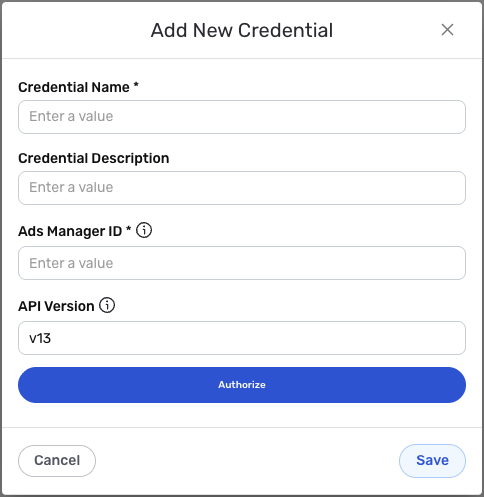
- To create a new Google Ads credential, after selecting the data source/destination type, click the Add Credential tile to open the Add New Credential overlay.
New Credential Overlay – Google Ads
Credential Name & Description
-
Enter a name for the credential in the Credential Name field and a short, meaningful description in the Credential Description field.
Resource descriptions are recommended but are not required. They should be used provide information about the resource purpose, data freshness, etc. that can help the owner and other users efficiently understand and utilize the resource.
OAuth 2.0 Authentication
Google Ads uses OAuth 2.0 authentication with Nexla's public application. The OAuth 2.0 authorization flow is handled automatically by Nexla, and most OAuth settings are pre-configured.
-
Click the Authorize button to start the OAuth 2.0 authorization flow. You will be redirected to Google's authorization page where you can sign in to your Google account and grant permissions to Nexla.
The OAuth 2.0 authorization flow allows Nexla to access your Google Ads account on your behalf. You will be asked to grant permissions for the scope
https://www.googleapis.com/auth/adwords, which provides access to your Google Ads data. The authorization process is handled automatically by Nexla, and you will be redirected back to Nexla once authorization is complete.
Ads Manager ID
-
Enter your Google Ads Ads Manager ID in the Ads Manager ID field. This is the Google Ads customer ID of the manager making the API call. The Ads Manager ID should be entered without hyphens (e.g.,
1234567890instead of123-456-7890). You can find your Ads Manager ID in your Google Ads account settings.The Ads Manager ID is the Google Ads customer ID of the manager account making the API call. This ID is used in the
login-customer-idheader for all API requests to the Google Ads API. Be sure to remove any hyphens from the customer ID when entering it (e.g.,1234567890instead of123-456-7890). For detailed information about finding your Ads Manager ID, see the Google Ads API documentation.
API Version
-
Enter the Google Ads API version you wish to use in the API Version field. This is the API version that will be used for all API requests. The default value is
v13if not specified.The API version determines which version of the Google Ads API will be used for requests. Google regularly releases new API versions with updated features and improvements. The default version is
v13, but you can specify a different version if needed. For detailed information about available API versions, see the Google Ads API documentation.
Save the Credential
-
Once all of the relevant steps in the above sections have been completed, click the Save button at the bottom of the overlay to save the configured credential.
-
The newly added credential will now appear in a tile on the Authenticate screen during data source/destination creation and can be selected for use with a new data source or destination.