
ContractPodAi - Leah CLM Data Source

The ContractPodAi - Leah CLM connector enables you to ingest contract data, AI-extracted metadata, obligations, audit trails, workflow records, and more from your Leah CLM tenant into Nexla. Follow the instructions below to create a new data flow that ingests data from a ContractPodAi - Leah CLM source in Nexla.
contractpodai_api.png

ContractPodAi - Leah CLM

Create a New Data Flow

  1. To create a new data flow, navigate to the Integrate section, and click the New Data Flow button. Then, select the desired flow type from the list, and click the Create button.

  2. Select the ContractPodAi - Leah CLM connector tile from the list of available connectors. Then, select the credential that will be used to connect to the Leah CLM tenant, and click Next; or, create a new ContractPodAi - Leah CLM credential for use in this flow.

  3. In Nexla, ContractPodAi - Leah CLM data sources can be created using pre-built endpoint templates, which expedite source setup for common Leah CLM API endpoints. Each template is designed specifically for the corresponding Leah CLM endpoint, making source configuration easy and efficient.
    • To configure this source using a template, follow the instructions in Configure Using a Template.

    ContractPodAi - Leah CLM sources can also be configured manually, allowing you to ingest data from Leah CLM API endpoints not included in the pre-built templates or to apply further customizations to exactly suit your needs.
    • To configure this source manually, follow the instructions in Configure Manually.

Configure Using a Template

Nexla provides pre-built templates that can be used to rapidly configure data sources to ingest data from common ContractPodAi - Leah CLM endpoints. Each template is designed specifically for the corresponding Leah CLM API endpoint, making data source setup easy and efficient.

Endpoint Settings

  • Select the endpoint from which this source will fetch data from the Endpoint pulldown menu. Available endpoint templates are listed in the expandable boxes below. Click on an endpoint to see more information about it and how to configure your data source for this endpoint.

Get Contracts

Retrieve a paginated list of all contracts in the Leah CLM repository. Use this endpoint to build a comprehensive inventory of contracts including their status, type, key dates, and counterparty information. This is the most common starting endpoint for contract analytics and reporting use cases.

  • Optionally, configure the following parameters to control what data is returned:

    • Page Size: Enter the number of contracts to retrieve per page in the Page Size field. The default is 50 and the maximum is 100. Nexla will automatically paginate through all available pages to retrieve the full dataset.
    • Contract Status Filter: Select a status from the Contract Status Filter pulldown to filter contracts by their current lifecycle status. Available values are: All (default, returns all contracts), Draft, Active, Expired, Terminated, and Pending Approval. Leave blank or select All to retrieve contracts in any status.

This endpoint uses incremental pagination, automatically fetching additional pages until all matching contracts have been retrieved. For large contract repositories, consider using the Contract Status Filter to scope the dataset and reduce processing time.

Get Contract by ID

Retrieve the full details of a single contract by its unique identifier. Use this endpoint when you need to pull complete contract information — including all metadata fields and custom attributes — for a specific contract. This is useful for contract-level detail reports or when building lookup-driven flows where contract IDs are sourced from another dataset.

  • Enter the unique identifier of the contract you want to retrieve in the Contract ID field. This is a required field. Contract IDs can be obtained from the Get Contracts endpoint or from the Leah CLM UI by navigating to a contract record and copying its ID from the URL or record details.

Contract IDs are unique within your Leah CLM tenant. To retrieve details for multiple contracts, consider using the Get Contracts endpoint to obtain a full list, then use Nexla lookup-based macros to drive individual contract lookups.

Search Contracts

Search contracts using a combination of keyword, date range, and status filters. Use this endpoint when you need a targeted subset of contracts rather than the full repository — for example, to retrieve all active contracts for a specific counterparty, or all contracts expiring within a given date range.

  • Search Keyword: Optionally enter a keyword or phrase in the Search Keyword field to search across contract titles and metadata. Leave blank to return all contracts matching other filter criteria.
  • Status Filter: Optionally enter a contract status in the Status Filter field to narrow results to contracts in a particular status (e.g., Active, Draft, Expired). Leave blank to return contracts in any status.
  • Optionally configure the date range filters to restrict results by effective or creation date:

    • Start Date: Enter the start of the date range in yyyy-MM-dd format. The default is {now-365} (365 days before the current date). Nexla date/time macros such as {now-365} and {now} are supported — these values are resolved dynamically at the time each data flow run executes.
    • End Date: Enter the end of the date range in yyyy-MM-dd format. The default is {now} (the current date).
  • Page Size: Enter the number of results to return per request in the Page Size field. The default is 50.

The Search Contracts endpoint submits a POST request with the filter parameters as a JSON body. Results are limited to a single page per execution; for large result sets, consider using the Get Contracts endpoint with the Status Filter instead.

Get Contract Documents

List all documents — including versions and attachments — associated with a specific contract. Use this endpoint to retrieve document-level metadata for a contract, such as document names, types, and version history.

  • Enter the unique identifier of the contract whose documents you want to list in the Contract ID field. This is a required field. Contract IDs can be obtained from the Get Contracts endpoint or from the Leah CLM UI.

Get Contract Metadata / AI Extracted Fields

Retrieve all metadata fields for a specific contract, including AI-extracted clauses, key dates, party names, obligations, and risk scores. Use this endpoint to access the full set of structured data that Leah CLM's AI has derived from the contract document — valuable for risk analytics, compliance reporting, and contract intelligence workflows.

  • Enter the unique identifier of the contract to retrieve metadata for in the Contract ID field. This is a required field. Contract IDs can be obtained from the Get Contracts endpoint or from the Leah CLM UI.

AI-extracted metadata includes fields such as clause types, extracted text, risk flags, key obligation dates, and counterparty details — all derived automatically by Leah's AI engine. The specific fields returned depend on the contract type configuration and AI models active in your tenant.

Get Contract Clauses (AI Extracted)

Retrieve AI-extracted clause data for a specific contract, including clause type, extracted clause text, risk level, and playbook deviation flags. Use this endpoint for detailed clause-level analysis — for example, to identify non-standard clauses, assess risk exposure, or audit clause compliance against your organization's playbook.

  • Enter the unique identifier of the contract to retrieve clause data for in the Contract ID field. This is a required field. Contract IDs can be obtained from the Get Contracts endpoint or from the Leah CLM UI.

Playbook deviation flags indicate where a contract's clause language differs from your organization's approved clause standards. These flags are particularly valuable for risk review workflows and contract audit use cases.

Get Contract Obligations

Retrieve obligation records for a specific contract, including obligation type, responsible party, due date, and completion status. Use this endpoint to track contractual commitments for a single contract — useful for obligation management dashboards and compliance monitoring.

  • Enter the unique identifier of the contract to retrieve obligations for in the Contract ID field. This is a required field. Contract IDs can be obtained from the Get Contracts endpoint or from the Leah CLM UI.

Get All Obligations

Retrieve all obligations across all contracts in the tenant, including status, due dates, owners, and associated contract references. Use this endpoint for tenant-wide obligation reporting, overdue obligation tracking, and compliance dashboards that span the entire contract portfolio.

  • Page Size: Optionally enter the number of obligation records per page in the Page Size field. The default is 50. Nexla will automatically paginate through all available pages to retrieve the complete dataset.

Get Users

Retrieve all users configured in the ContractPodAi tenant, including names, email addresses, roles, and active status. Use this endpoint to synchronize Leah CLM user records with other enterprise systems, or to build user-level access and activity reports.

  • Page Size: Optionally enter the number of user records per page in the Page Size field. The default is 100. Nexla will automatically paginate through all pages to retrieve the complete user list.

Get Contract Types

Retrieve all configured contract type definitions for the tenant, including names, IDs, and associated template and workflow mappings. Use this endpoint to understand the structure of your contract taxonomy or to build reference data for mapping contract types in downstream systems.

  • No additional configuration is required for this endpoint. All contract type definitions configured in your Leah CLM tenant will be returned automatically.

Get Workflows

Retrieve all workflow definitions and their current configuration, including stages and approval routing rules. Use this endpoint to document your organization's approval workflows, audit workflow configurations, or build process analytics that map contracts to their governing workflows.

  • No additional configuration is required for this endpoint. All workflow definitions configured in your Leah CLM tenant will be returned automatically.

Get Workflow Instances

Retrieve active and historical workflow instances for contracts, including the current stage, approvers, and timestamps. Use this endpoint to monitor approval pipeline health, track bottlenecks in the contract approval process, and audit the history of workflow execution for specific contracts.

  • Page Size: Optionally enter the number of workflow instance records per page in the Page Size field. The default is 50. Nexla will automatically paginate through all pages to retrieve the complete list.

Get Tasks

Retrieve all tasks across contracts, including task type, assignee, due date, priority, and completion status. Use this endpoint to build task management dashboards, track overdue items, or synchronize Leah CLM task records with external project management or ticketing systems.

  • Optionally, configure the following parameters to control what task data is returned:

    • Page Size: Enter the number of task records per page in the Page Size field. The default is 50. Nexla will automatically paginate through all pages.
    • Task Status Filter: Select a status from the Task Status Filter pulldown to filter tasks by completion status. Available values are: All (default), Open, Completed, and Overdue. Leave blank or select All to retrieve tasks in any status.

Get Reminders / Key Date Alerts

Retrieve contract reminders and key date alerts, including renewal dates, expiry notices, and custom milestone alerts. Use this endpoint to build proactive contract renewal pipelines, trigger notifications in downstream systems, or report on upcoming contractual milestones across the portfolio.

  • Page Size: Optionally enter the number of reminder records per page in the Page Size field. The default is 50. Nexla will automatically paginate through all pages to retrieve the complete list.

Get Counterparties

Retrieve counterparty records — vendors, suppliers, and customers — with names, IDs, and contact details. Use this endpoint to synchronize Leah CLM counterparty records with CRM or ERP systems, or to build a master vendor registry from contract data.

  • Page Size: Optionally enter the number of counterparty records per page in the Page Size field. The default is 100. Nexla will automatically paginate through all pages to retrieve the complete counterparty list.

Get Audit Trail

Retrieve audit trail events for a specific contract, recording all user actions, status changes, and document modifications. Use this endpoint for compliance reporting, change tracking, and forensic analysis of contract activity.

  • Enter the unique identifier of the contract to retrieve audit events for in the Contract ID field. This is a required field. Contract IDs can be obtained from the Get Contracts endpoint or from the Leah CLM UI.

Audit trail records include user identity, action type, timestamp, and before/after values for changed fields. These records are immutable and provide a complete chain of custody for each contract.

Get Contract Templates

Retrieve all contract template definitions available in the tenant, including template names, types, and associated clause libraries. Use this endpoint to document your template library, audit template coverage across contract types, or build reference data for template governance reporting.

  • No additional configuration is required for this endpoint. All contract template definitions in your Leah CLM tenant will be returned automatically.

Endpoint Testing

Once the selected endpoint template has been configured, Nexla can retrieve a sample of the data that will be fetched according to the current settings. This allows users to verify that the source is configured correctly before saving.

  • To test the current endpoint configuration, click the Test button to the right of the endpoint selection menu. Sample data will be fetched & displayed in the Endpoint Test Result panel on the right.

  • If the sample data is not as expected, review the selected endpoint and associated settings, and make any necessary adjustments. Then, click the Test button again, and check the sample data to ensure that the correct information is displayed.

Configure Manually

ContractPodAi - Leah CLM data sources can be manually configured to ingest data from any valid Leah CLM API endpoint. Manual configuration provides maximum flexibility for accessing endpoints not covered by pre-built templates or when you need custom API configurations.

With manual configuration, you can also create more complex Leah CLM sources, such as sources that use chained API calls to fetch data from multiple endpoints or sources that require custom request parameters.

API Method

  1. To manually configure this source, select the Advanced tab at the top of the configuration screen.

  2. Select the API method that will be used for calls to the Leah CLM API from the Method pulldown menu. The most common methods are:

    • GET: For retrieving data from the API (used by most Leah CLM endpoints)
    • POST: For sending a request body with filter parameters (used by the Search Contracts endpoint)
    • PUT: For updating existing data
    • PATCH: For partial updates to existing data
    • DELETE: For removing data

API Endpoint URL

  1. Enter the URL of the Leah CLM API endpoint from which this source will fetch data in the Set API URL field. Use the base URL from your Leah CLM credential followed by the endpoint path. For example, to retrieve all contracts, the URL would follow the pattern https://yourcompany-cloud.contractpod.com/api/v1/contracts.

Leah CLM API endpoints follow the pattern {base_url}/api/v1/{resource}. Ensure the API endpoint URL uses the same base URL entered in your credential, and that your Bearer token has the necessary permissions to access the requested resource.

Date/Time Macros (API URL)

Optional

Optionally, the API URL can be customized using macros—all macros added to the API URL will be converted into values when Nexla executes the API call. Macros are dynamic placeholders that allow you to create flexible API endpoints that can adapt to different time periods or data requirements. This is particularly useful for Leah CLM date-range filters such as startDate and endDate query parameters.

Macros are particularly useful for APIs that require date ranges, pagination parameters, or other dynamic values that change between data ingestion runs.

  1. To add a macro, type { at the appropriate position in the API URL (within the Set API URL field), and select the desired macro from the dropdown list.

    • {now} – The current datetime
    • {now-1} – The datetime one time unit before the current datetime
    • {now+1} – The datetime one time unit after the current datetime
    • custom – Datetime macros can reference any number of time units before or after the current datetime—for example, enter (now-4) to indicate the datetime four time units before the current datetime
  2. Select the format that will be applied to datetime macros from the Date Format for Date/Time Macro pulldown menu. This format will be applied to the base datetime value of the macro—i.e., the value of {now} in {now-1}.

  3. Select the datetime unit that will be used to perform mathematical operations in the included macro(s) from the Time Unit for Operations pulldown menu—for example, for the macro {now-1}, when Day is selected, {now-1} will be converted to the datetime one day before the current datetime.

Lookup-Based Macros (API URL)

Optional

Column values from existing lookups can also be included as macros in the API URL. Lookup-based macros allow you to reference data from previously configured data sources or lookups, enabling dynamic API endpoints that can adapt based on existing data. For example, you can drive individual contract lookups by sourcing Contract IDs from a Nexla dataset derived from the Get Contracts endpoint.

Lookup-based macros are useful when you need to create API endpoints that reference specific IDs, values, or parameters from other data sources in your Nexla environment.

  1. To include a lookup column value macro, select the relevant lookup from the Add Lookups to Supported Macros pulldown menu.

  2. Type { at the appropriate position in the API URL, and select the lookup column-based macro from the dropdown list. Lookup-based macros are automatically populated into the macro list when a lookup is selected in the Add Lookups to Supported Macros pulldown menu.

Path to Data

Optional

If only a subset of the data that will be returned by the API endpoint is needed, you can designate the part(s) of the response that should be included in the Nexset(s) produced from this source by specifying the path to the relevant data within the response. Most Leah CLM list endpoints return records nested within a data array in the JSON response body.

For example, when a request call is used to fetch a list of contracts, the API will typically return an array of contract records along with metadata in the response. By entering the path to the relevant data, you can configure Nexla to treat each element of the returned array as a record.

Path to Data is essential when API responses have nested structures. Without specifying the correct path, Nexla might not be able to properly parse and organize your data into usable records.

  • To specify which data should be treated as relevant in responses from this source, enter the path to the relevant data in the Set Path to Data in Response field.

    • For responses in JSON format, enter the JSON path that points to the object or array that should be treated as relevant data. JSON paths use dot notation (e.g., $.data.items[*] to access an array of items within a data object).

    • For responses in XML format, enter the XPath that points to the object/array containing relevant data. XPath uses slash notation (e.g., /response/data/item to access item elements within a data element).

    Path to Data Example:

    For most Leah CLM list endpoints, the response returns records inside a top-level data array. Enter $.data[*] in the Set Path to Data in Response field to treat each element of this array as a separate record.

Autogenerate Path Suggestions

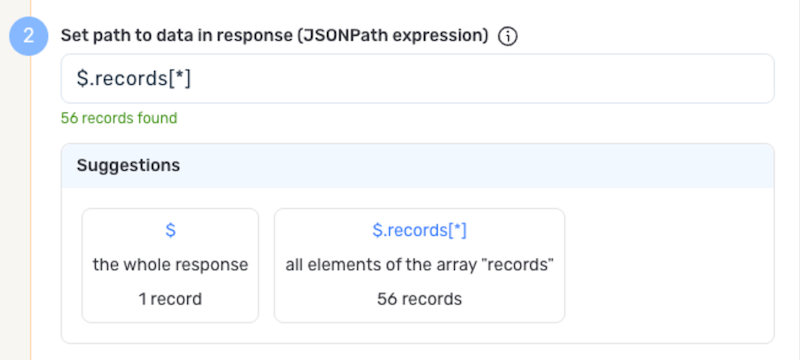
Nexla can also autogenerate data path suggestions based on the response from the API endpoint. These suggested paths can be used as-is or modified to exactly suit your needs.

  • To use this feature, click the Test button next to the Set API URL field to fetch a sample response from the API endpoint. Suggested data paths generated based on the content & format of the response will be displayed in the Suggestions box below the Set Path to Data in Response field.

  • Click on a suggestion to automatically populate the Set Path to Data in Response field with the corresponding path. The populated path can be modified directly within the field if further customization is needed.
    PathSuggestions.png

Metadata

If metadata is included in the response but is located outside of the defined path to relevant data, you can configure Nexla to include this data as common metadata in each record. This is useful when you want to preserve important contextual information that applies to all records but is not part of the main data array.

For example, when a request call is used to fetch a list of contracts, the API response will typically include an array of records along with metadata such as total count, pagination information, or request timestamps. In this case, if you have specified the path to the relevant data but metadata of interest is located in a different part of the response, you can specify a path to this metadata to include it with each record in the generated Nexset(s).

Metadata paths are particularly useful for preserving API response context like request IDs, timestamps, or summary statistics that apply to all records in the response.

  • To specify the location of metadata that should be included with each record, enter the path to the relevant metadata in the Path to Metadata in Response field.

    • For responses in JSON format, enter the JSON path to the object or array that contains the metadata, and for responses in XML format, enter the XPath.

Request Headers

Optional
  • If Nexla should include any additional request headers in API calls to this source, enter the headers & corresponding values as comma-separated pairs in the Request Headers field (e.g., header1:value1,header2:value2). Additional headers are often required for API versioning, content type specifications, or custom requirements.

    You do not need to include the Authorization header — it is automatically added by Nexla based on your Leah CLM credential. If your endpoint requires a Content-Type or Accept header, those should be included here (e.g., Accept:application/json).

Endpoint Testing

After configuring all settings for the selected endpoint, Nexla can retrieve a sample of the data that will be fetched according to the current configuration. This allows users to verify that the source is configured correctly before saving.

  • To test the current endpoint configuration, click the Test button to the right of the endpoint selection menu. Sample data will be fetched & displayed in the Endpoint Test Result panel on the right.

  • If the sample data is not as expected, review the selected endpoint and associated settings, and make any necessary adjustments. Then, click the Test button again, and check the sample data to ensure that the correct information is displayed.

Save & Activate the Source

  1. Once all of the relevant steps in the above sections have been completed, click the Create button in the upper right corner of the screen to save and create the new ContractPodAi - Leah CLM data source. Nexla will now begin ingesting data from the configured endpoint and will organize any data that it finds into one or more Nexsets.