Authorization

Google Campaign Manager 360
Prerequisites
Before creating a Google Campaign Manager 360 credential, you'll need to set up OAuth 2.0 authentication in the Google Cloud Console. Google Campaign Manager 360 uses OAuth 2.0 for secure API access, requiring you to create credentials and obtain authorization.
Google Cloud Console Setup
To obtain the required OAuth 2.0 credentials for Google Campaign Manager 360:
-
Sign in to Google Cloud Console: Navigate to https://console.cloud.google.com/ and sign in with your Google account. If you don't have a Google Cloud account, you can create one by clicking Get started for free and following the registration process.
-
Create or Select a Project: In the Google Cloud Console, either create a new project or select an existing project from the project dropdown at the top of the page. Click New Project to create a project, enter a project name (e.g., "Nexla CM360 Integration"), and click Create.
-
Enable Campaign Manager 360 API: Navigate to APIs & Services > Library in the left navigation menu. Search for "Campaign Manager 360 API" or "DCM/DFA Reporting and Trafficking API" and click on it. Click Enable to enable the API for your project.
-
Configure OAuth Consent Screen: Navigate to APIs & Services > OAuth consent screen in the left navigation menu. Select External as the user type (unless you have a Google Workspace account, in which case you can select Internal), and click Create.
-
Fill in the required application information:
- App name: Enter a name for your application (e.g., "Nexla CM360 Connector")
- User support email: Enter your email address
- Developer contact information: Enter your email address
-
Click Save and Continue to proceed to the Scopes step.
-
Click Add or Remove Scopes, then search for and add the following scopes:
https://www.googleapis.com/auth/dfareportinghttps://www.googleapis.com/auth/dfatrafficking
-
Click Update, then click Save and Continue to proceed.
-
Add test users if your app is in testing mode, then click Save and Continue.
-
Review the summary and click Back to Dashboard.
-
-
Create OAuth 2.0 Credentials: Navigate to APIs & Services > Credentials in the left navigation menu. Click Create Credentials > OAuth client ID.
-
Select Web application as the application type.
-
Enter a name for your OAuth client (e.g., "Nexla CM360 OAuth Client").
-
Under Authorized redirect URIs, add the redirect URI provided by Nexla. This URI is used to receive the authorization code after user consent.
-
Click Create to create the OAuth client.
-
Important: Copy both the Client ID and Client Secret immediately. The client secret will not be shown again. Store these securely.
-
The Client ID and Client Secret are sensitive credentials that should be kept secure. Store them in a secure location, as you'll need them when creating the credential in Nexla. Never share these credentials publicly or commit them to version control systems.
-
Obtain Profile ID: To use the Campaign Manager 360 API, you'll need your user profile ID. The profile ID is a numeric identifier that uniquely identifies your user account in Campaign Manager 360. You can find your profile ID using one of the following methods:
Method 1: Using Campaign Manager 360 UI
-
Sign in to Campaign Manager 360 at https://campaignmanager.google.com/.
-
Click on your user profile icon in the top right corner of the screen.
-
Select My Profile or Account Settings from the dropdown menu.
-
Your profile ID is typically displayed in the URL or in the profile information section. It appears as a numeric value (e.g.,
1234567).
Method 2: Using the API
-
After setting up OAuth credentials, you can use the Campaign Manager 360 API to list user profiles.
-
Make a GET request to
https://dfareporting.googleapis.com/dfareporting/v5/userprofileswith your OAuth token. -
The response will include a list of user profiles with their profile IDs.
-
The profile ID is required for all Campaign Manager 360 API requests. It determines which campaigns, reports, and resources you can access through the API. If you have access to multiple CM360 accounts, you may have multiple profile IDs - use the one associated with the account you want to access.
-
Determine API Version: Google Campaign Manager 360 API supports multiple versions (v4 and v5). The API version determines which endpoints and features are available:
- v5 (recommended): The latest API version with enhanced features, improved performance, and access to the most recent Campaign Manager 360 capabilities. This is the default version and recommended for new integrations.
- v4: Legacy API version maintained for backward compatibility with older integrations. Use v4 only if you have existing integrations that depend on it or if specific endpoints you need are only available in v4.
The API version is specified in the API endpoint URL (e.g.,
https://dfareporting.googleapis.com/dfareporting/v5/...). Most new features and improvements are added to v5 first.
For complete information about Google Campaign Manager 360 API authentication and OAuth setup, see the Google Campaign Manager 360 API Documentation. For OAuth 2.0 setup details, see the Google OAuth 2.0 Documentation.
API Access Requirements
Google Campaign Manager 360 API access requires:
- Valid Google Account: You must have an active Google account with access to Google Cloud Console
- Google Cloud Project: A project in Google Cloud Console with Campaign Manager 360 API enabled
- OAuth 2.0 Client ID: The client identifier from your OAuth 2.0 credentials
- OAuth 2.0 Client Secret: The client secret from your OAuth 2.0 credentials
- CM360 Profile ID: Your user profile ID in Campaign Manager 360
- API Version: The API version to use (v4 or v5, default is v5)
- Required Scopes:
https://www.googleapis.com/auth/dfareportingandhttps://www.googleapis.com/auth/dfatrafficking
The Google Campaign Manager 360 API uses OAuth 2.0 authorization code flow for authentication. Nexla handles the OAuth flow automatically when you provide your client credentials and authorize the application.
Create a Google Campaign Manager 360 Credential
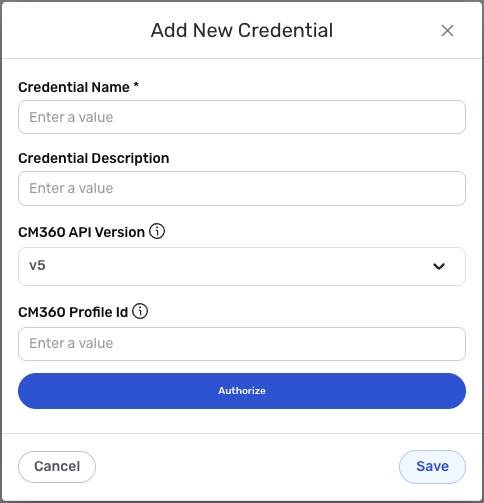
- To create a new Google Campaign Manager 360 credential, after selecting the data source/destination type, click the Add Credential tile to open the Add New Credential overlay.
New Credential Overlay – Google Campaign Manager 360
Credential Name & Description
-
Enter a name for the credential in the Credential Name field and a short, meaningful description in the Credential Description field.
Resource descriptions are recommended but are not required. They should be used to provide information about the resource purpose, data freshness, etc. that can help the owner and other users efficiently understand and utilize the resource.
OAuth 2.0 Authentication Configuration
-
CM360 API Version: Select the API version you want to use from the CM360 API Version dropdown menu. Available options are:
- v5: The latest API version with enhanced features and capabilities (recommended)
- v4: Legacy API version for compatibility with older integrations
-
CM360 Profile ID: Enter your Campaign Manager 360 user profile ID in the CM360 Profile Id field. This numeric identifier is associated with your CM360 user account and is required for all API requests. You can find your profile ID by signing in to Campaign Manager 360 and checking your user profile settings, or by using the API to list user profiles.
The Profile ID is specific to your CM360 user account and determines which campaigns, reports, and resources you can access through the API. Ensure you have the correct Profile ID for the account you want to use.
-
OAuth Authorization: When you click Save, Nexla will initiate the OAuth 2.0 authorization flow. You'll be redirected to Google's authorization page where you'll need to:
-
Sign in with your Google account that has access to Campaign Manager 360.
-
Review the permissions requested by Nexla (DFA Reporting and DFA Trafficking scopes).
-
Click Allow to grant Nexla access to your Campaign Manager 360 data.
-
You'll be redirected back to Nexla, and the credential will be saved with the authorization tokens.
-
The OAuth authorization process requires you to grant Nexla permission to access your Campaign Manager 360 data. These permissions allow Nexla to read campaign data, generate reports, and access other CM360 resources on your behalf. The authorization tokens are stored securely and can be refreshed automatically when needed.
Save the Credential
-
Once all of the relevant steps in the above sections have been completed, click the Save button at the bottom of the overlay to save the configured credential. If this is your first time creating the credential, you'll be redirected to complete the OAuth authorization flow.
-
The newly added credential will now appear in a tile on the Authenticate screen during data source/destination creation and can be selected for use with a new data source or destination.