
Close Data Source

The Close connector enables you to ingest CRM data from your Close account — including leads, contacts, opportunities, activities, and more — into Nexla data flows for reporting, analytics, and downstream integrations. Follow the instructions below to create a new data flow that ingests data from a Close source in Nexla.
close_com_api.png

Close

Create a New Data Flow

  1. To create a new data flow, navigate to the Integrate section, and click the New Data Flow button. Then, select the desired flow type from the list, and click the Create button.

  2. Select the Close connector tile from the list of available connectors. Then, select the credential that will be used to connect to the Close instance, and click Next; or, create a new Close credential for use in this flow.

  3. In Nexla, Close.com data sources can be created using pre-built endpoint templates, which expedite source setup for common Close.com endpoints. Each template is designed specifically for the corresponding Close.com endpoint, making data source setup easy and efficient.
    • To configure this source using a template, follow the instructions in Configure Using a Template.

    Close.com sources can also be configured manually, allowing you to ingest data from Close.com endpoints not included in the pre-built templates or apply further customizations to exactly suit your needs.
    • To configure this source manually, follow the instructions in Configure Manually.

Configure Using a Template

Nexla provides pre-built templates that can be used to rapidly configure data sources to ingest data from common Close.com endpoints. Each template is designed specifically for the corresponding Close.com endpoint, making data source setup easy and efficient.

Endpoint Settings

  • Select the endpoint from which this source will fetch data from the Endpoint pulldown menu. Available endpoint templates are listed in the expandable boxes below. Click on an endpoint to see more information about it and how to configure your data source for this endpoint.

    Get Current User

    This endpoint returns profile and permission information for the currently authenticated user. Use it to verify credential configuration or retrieve the user's organization membership details.

    • Sends a GET request to https://api.close.com/api/v1/user. No additional parameters are required.
    • Response data is extracted from $ (root object) — the entire response is treated as a single record containing the authenticated user's details.

    This endpoint is useful for confirming that your Close credential is correctly configured before building larger data flows.

    List Leads

    This endpoint returns a paginated list of all leads in the Close.com account. Leads represent companies or organizations and serve as the primary CRM object in Close. Use this endpoint to export lead records for analysis, syncing to a data warehouse, or downstream reporting.

    • Sends a GET request to https://api.close.com/api/v1/lead.
    • Response data is extracted from $.data[*]. Each record is a lead object including associated contacts, custom fields, and status. Results are paginated; use _skip and _limit query parameters to page through results.

    Use the date_updated__gte query parameter with a date/time macro to perform incremental loads — fetching only leads updated since the last ingestion run.

    List Contacts

    This endpoint returns a list of all contacts in the Close.com account. Contacts are individual people associated with leads. Use this endpoint to export contact records for CRM analysis, deduplication, or enrichment workflows.

    • Sends a GET request to https://api.close.com/api/v1/contact.
    • Response data is extracted from $.data[*]. Each record contains contact name, email addresses, phone numbers, and the associated lead ID.

    List Opportunities

    This endpoint returns a list of all sales opportunities in the Close.com account. Use it to export pipeline data, track deal progression, or analyze win/loss rates.

    • Sends a GET request to https://api.close.com/api/v1/opportunity.
    • Response data is extracted from $.data[*]. Each record includes opportunity value, status, close date, pipeline, and the associated lead ID.

    Use date_updated__gte with a date/time macro for incremental opportunity ingestion.

    List Events

    This endpoint returns a chronological list of events in the Close.com account, representing all changes and interactions logged in the system. Use it for audit trails, activity feeds, or change-data-capture workflows.

    • Sends a GET request to https://api.close.com/api/v1/event.
    • Response data is extracted from $.data[*]. Each record contains event type, timestamp, object type, object ID, and the changed data.

    List Email Activities

    This endpoint returns a list of email activities recorded in Close.com, including both inbound and outbound emails associated with leads. Use it to analyze communication patterns, email volume, or response rates.

    List Call Activities

    This endpoint returns a list of call activities recorded in Close.com, including inbound and outbound calls with their duration, disposition, and recording details. Use it to track sales call volume, agent performance, or call outcomes.

    • Sends a GET request to https://api.close.com/api/v1/activity/call.
    • Response data is extracted from $.data[*]. Each record includes call duration, direction, disposition, voicemail flag, recording URL, and the associated lead ID.

    Call recordings are not included in the response body; the record contains a URL to retrieve the recording separately if needed.

    List Note Activities

    This endpoint returns a list of note activities in Close.com — free-text notes logged against leads by sales reps. Use it to extract CRM notes for NLP analysis, activity auditing, or data migration.

    List SMS Activities

    This endpoint returns a list of SMS activities in Close.com, capturing text messages sent and received through the Close platform. Use it to analyze SMS engagement or log communication history.

    List Meeting Activities

    This endpoint returns a list of meeting activities recorded in Close.com. Use it to track meeting cadence, follow up on scheduled interactions, or analyze engagement patterns across your sales team.

    List Email Thread Activities

    This endpoint returns a list of email thread activities in Close.com, grouping related email messages into conversation threads. Use it to analyze email conversations at the thread level rather than individual message level.

    List Created Activities

    This endpoint returns a list of "created" activity records in Close.com, capturing the creation events for leads and other CRM objects. Use it to track when new leads were created and by whom.

    List Lead Status Change Activities

    This endpoint returns a list of activities recording status changes for leads in Close.com. Use it to track lead funnel progression, measure time in stage, or analyze conversion rates between lead statuses.

    List Opportunity Status Change Activities

    This endpoint returns a list of activities recording status changes for opportunities in Close.com. Use it to track deal progression through the pipeline and analyze stage-to-stage conversion rates.

    List Task Completed Activities

    This endpoint returns a list of activities recording completed tasks in Close.com. Use it to measure task completion rates, track follow-up discipline, or analyze rep productivity.

    List Lead Tasks

    This endpoint returns a list of tasks assigned to leads in Close.com. Use it to export open or completed tasks for follow-up tracking, rep workload analysis, or reporting dashboards.

    • Sends a GET request to https://api.close.com/api/v1/task filtered to lead tasks.
    • Response data is extracted from $.data[*]. Each record includes task type, due date, assigned user, completion status, and associated lead ID.

    List Incoming Email Tasks

    This endpoint returns tasks created from incoming emails in Close.com — emails that require a follow-up action. Use it to track inbound email response queues or measure response time SLAs.

    • Sends a GET request to https://api.close.com/api/v1/task filtered to incoming email task type.
    • Response data is extracted from $.data[*]. Each record includes the triggering email reference, due date, and assigned user.

    List Email Followup Tasks

    This endpoint returns a list of email follow-up tasks in Close.com. Use it to identify pending outreach tasks or analyze follow-up cadence across your sales team.

    List Missed Call Tasks

    This endpoint returns tasks created from missed calls in Close.com, representing callback reminders for unanswered inbound calls. Use it to track callback queues or measure missed-call follow-up rates.

    • Sends a GET request to https://api.close.com/api/v1/task filtered to missed call task type.
    • Response data is extracted from $.data[*]. Each record includes the missed call timestamp, associated lead, and assigned user.

    List Answered Detached Call Tasks

    This endpoint returns tasks created from answered detached calls — calls that were answered but not yet associated with a lead. Use it to identify calls requiring lead assignment or follow-up.

    List Voicemail Tasks

    This endpoint returns tasks created from voicemails in Close.com, representing callback reminders for inbound voicemails. Use it to track voicemail response queues.

    List Opportunity Due Tasks

    This endpoint returns tasks associated with opportunities that are due in Close.com. Use it to surface time-sensitive deal tasks for prioritization or reporting.

    • Sends a GET request to https://api.close.com/api/v1/task filtered to opportunity due task type.
    • Response data is extracted from $.data[*]. Each record includes the opportunity ID, due date, and assigned user.

    List Incoming SMS Tasks

    This endpoint returns tasks related to incoming SMS messages in Close.com, representing inbound text messages that require a reply or follow-up. Use it to track SMS response queues.

    List Lead Statuses

    This endpoint returns the list of available statuses configured for leads in Close.com. Use it to retrieve status definitions for mapping or validation in downstream workflows.

    List Opportunity Statuses

    This endpoint returns the list of available opportunity statuses configured in Close.com. Use it to retrieve status definitions for pipeline mapping or validation.

    List Pipelines

    This endpoint returns a list of sales pipelines configured in the Close.com organization. Use it to retrieve pipeline definitions for reporting or to map opportunity statuses to their parent pipelines.

    List Roles

    This endpoint returns a list of user roles available in the Close.com organization. Use it to retrieve role definitions for access control mapping or user management workflows.

    • Sends a GET request to https://api.close.com/api/v1/role.
    • Response data is extracted from $.data[*]. Each record contains the role ID, name, and associated permissions.

    List Smart Views

    This endpoint returns a list of saved searches (Smart Views) in the Close.com account. Smart Views are pre-configured filter sets used to segment leads and contacts. Use this endpoint to inventory available views or integrate view-based segmentation into data pipelines.

    List Email Templates

    This endpoint returns a list of email templates available in the Close.com account. Use it to export template definitions for documentation, replication, or content auditing.

    List Email Sequences

    This endpoint returns a list of email sequences configured in the Close.com account. Use it to inventory automation sequences, audit step configurations, or track which sequences are active.

    • Sends a GET request to https://api.close.com/api/v1/sequence.
    • Response data is extracted from $.data[*]. Each record contains the sequence name, steps, sender settings, and active status.

    List Custom Activities

    This endpoint returns a list of custom activity types defined in the Close.com organization. Custom activities extend the built-in activity types with user-defined structures. Use it to retrieve custom activity type definitions for schema mapping or validation.

    List Lead Custom Fields

    This endpoint returns a list of custom fields configured for leads in Close.com. Use it to retrieve field definitions for schema documentation, data mapping, or validation in downstream workflows.

    List Contact Custom Fields

    This endpoint returns a list of custom fields configured for contacts in Close.com. Use it to understand the contact data model or map custom fields to target schema in downstream systems.

    List Opportunity Custom Fields

    This endpoint returns a list of custom fields configured for opportunities in Close.com. Use it to map opportunity data models to target schemas or validate field coverage in pipeline reporting.

    List Activity Custom Fields

    This endpoint returns a list of custom fields configured for activities in Close.com. Use it to understand extended activity data structures when building activity-based reporting flows.

    List Integration Links

    This endpoint returns a list of integration links configured for the Close.com organization — deep links that connect Close records to external systems. Use it to audit third-party integrations or export integration configuration.

    List Send As

    This endpoint returns a list of email addresses and identities available for sending emails from Close.com. Use it to inventory sender identities for auditing or configuration management.

    Get Dialer

    This endpoint returns the dialer configuration and settings for the Close.com organization, including power dialer status and settings. Use it to retrieve dialer configuration for auditing or change tracking.

    • Sends a GET request to https://api.close.com/api/v1/dialer.
    • Response data is extracted from $ (root object). The entire response is treated as a single dialer configuration record.

    List Email Bulk Actions

    This endpoint returns a list of email bulk actions that have been created or executed in Close.com. Use it to audit mass email campaigns or track the status of bulk email operations.

    List Sequence Subscription Bulk Actions

    This endpoint returns a list of bulk actions for sequence subscriptions in Close.com. Use it to audit bulk enrollment or unenrollment operations from email sequences.

    List Delete Bulk Actions

    This endpoint returns a list of bulk delete actions that have been executed in Close.com. Use it to audit mass deletion operations for compliance or change-management tracking.

    List Edit Bulk Actions

    This endpoint returns a list of bulk edit actions that have been executed in Close.com. Use it to track mass field update operations across leads or contacts for auditing or change-data-capture workflows.

    List Google Connected Accounts

    This endpoint returns a list of Google accounts connected to Close.com for email and calendar integration. Use it to audit connected account configurations or verify integration status.

    List Custom Email Connected Accounts

    This endpoint returns a list of custom (non-Google, non-Microsoft) email accounts connected to Close.com via IMAP/SMTP. Use it to audit custom email integration configurations.

    List Zoom Connected Accounts

    This endpoint returns a list of Zoom accounts connected to Close.com for video meeting integration. Use it to audit Zoom integration configurations or verify connection status.

Endpoint Testing

Once the selected endpoint template has been configured, Nexla can retrieve a sample of the data that will be fetched according to the current settings. This allows users to verify that the source is configured correctly before saving.

  • To test the current endpoint configuration, click the Test button to the right of the endpoint selection menu. Sample data will be fetched & displayed in the Endpoint Test Result panel on the right.

  • If the sample data is not as expected, review the selected endpoint and associated settings, and make any necessary adjustments. Then, click the Test button again, and check the sample data to ensure that the correct information is displayed.

Configure Manually

Close.com sources can also be manually configured to ingest data from any valid Close API endpoint. Manual configuration provides maximum flexibility for accessing endpoints not covered by pre-built templates or when you need custom configurations.

API Method

  1. To manually configure this source, select the Advanced tab at the top of the configuration screen.

  2. Select the method that will be used for calls to the Close API from the Method pulldown menu. The most common methods are:

    • GET: For retrieving data from the API
    • POST: For sending data to the API or triggering actions
    • PUT: For updating existing data
    • PATCH: For partial updates to existing data
    • DELETE: For removing data

The Close REST API base URL is https://api.close.com/api/v1. All endpoint URLs entered in Nexla should include this base URL followed by the specific resource path (for example, https://api.close.com/api/v1/lead/). The Close API enforces a default rate limit of 60 requests per minute per organization. For details about available endpoints and their parameters, refer to the Close API Reference.

API Endpoint URL

  1. Enter the URL of the Close API endpoint from which this source will fetch data in the Set API URL field. This should be the complete URL including the protocol (https://) and the full resource path.

    Common Close API endpoints include:

    • Leads: https://api.close.com/api/v1/lead/ — Retrieves leads (companies or organizations) along with their associated contacts, tasks, opportunities, and custom fields.

    • Contacts: https://api.close.com/api/v1/contact/ — Retrieves individual contacts. Each contact belongs to exactly one lead and may include phone numbers, email addresses, and URLs.

    • Opportunities: https://api.close.com/api/v1/opportunity/ — Retrieves sales opportunities associated with leads, including status, value, and close date information.

    • Activities: https://api.close.com/api/v1/activity/ — Retrieves activity records (calls, emails, notes, meetings, SMS, and more) associated with leads and contacts. Activities are not included in lead responses and must be fetched separately.

    • Users: https://api.close.com/api/v1/user/ — Retrieves user records for members of your Close organization.

    • Pipelines: https://api.close.com/api/v1/pipeline/ — Retrieves sales pipeline definitions used in your Close account.

For a complete list of available Close API endpoints with full schema definitions and interactive examples, refer to the Close Developer Platform.

Date/Time Macros (API URL)

Optional

Optionally, the API URL can be customized using macros — all macros added to the API URL will be converted into values when Nexla executes the API call. Macros are dynamic placeholders that allow you to create flexible API endpoints that can adapt to different time periods or data requirements.

The Close API supports date filtering on many endpoints via query parameters such as date_created__gt and date_updated__gte. Combining these parameters with Nexla date/time macros enables incremental data ingestion — for example, fetching only leads updated since the last run.

Macros are particularly useful for Close APIs that filter by date ranges. For example, you can use {now-1} in a query parameter to fetch records updated within the last time unit, enabling efficient incremental data loads.

  1. To add a macro, type { at the appropriate position in the API URL (within the Set API URL field), and select the desired macro from the dropdown list.

    • {now} – The current datetime
    • {now-1} – The datetime one time unit before the current datetime
    • {now+1} – The datetime one time unit after the current datetime
    • custom – Datetime macros can reference any number of time units before or after the current datetime — for example, enter (now-4) to indicate the datetime four time units before the current datetime
  2. Select the format that will be applied to datetime macros from the Date Format for Date/Time Macro pulldown menu. This format will be applied to the base datetime value of the macro — i.e., the value of {now} in {now-1}.

  3. Select the datetime unit that will be used to perform mathematical operations in the included macro(s) from the Time Unit for Operations pulldown menu — for example, for the macro {now-1}, when Day is selected, {now-1} will be converted to the datetime one day before the current datetime.

Lookup-Based Macros (API URL)

Optional

Column values from existing lookups can also be included as macros in the API URL. Lookup-based macros allow you to reference data from previously configured data sources or lookups, enabling dynamic API endpoints that can adapt based on existing data.

Lookup-based macros are useful when you need to fetch Close records for specific IDs retrieved from another data source — for example, dynamically building a URL that includes a lead ID or opportunity ID from a prior step in your data pipeline.

  1. To include a lookup column value macro, select the relevant lookup from the Add Lookups to Supported Macros pulldown menu.

  2. Type { at the appropriate position in the API URL, and select the lookup column-based macro from the dropdown list. Lookup-based macros are automatically populated into the macro list when a lookup is selected in the Add Lookups to Supported Macros pulldown menu.

Path to Data

Optional

If only a subset of the data returned by the Close API endpoint is needed, you can designate which part of the response should be included in the Nexset(s) produced from this source by specifying the path to the relevant data within the response. This is particularly useful because Close API responses typically wrap the actual records in a data array alongside pagination metadata.

For example, when fetching a list of leads, the Close API returns a JSON response with a top-level data array containing the lead records, along with fields such as has_more and total_results. By specifying the path to the data array, you can configure Nexla to treat each element of that array as an individual record.

Path to Data is essential for Close API responses. Without specifying the correct path, Nexla will treat the entire response object (including pagination metadata) as a single record rather than extracting the individual records from the data array.

  • To specify which data should be treated as relevant in responses from this source, enter the path to the relevant data in the Set Path to Data in Response field.

    • For responses in JSON format, enter the JSON path that points to the object or array that should be treated as relevant data. JSON paths use dot notation (for example, $.data[*] to access the array of records within a Close API response).
    Path to Data Example for Close API:

    Most Close API list endpoints return records in a top-level data array. For these endpoints, enter $.data[*] in the Set Path to Data in Response field to extract individual records.

Autogenerate Path Suggestions

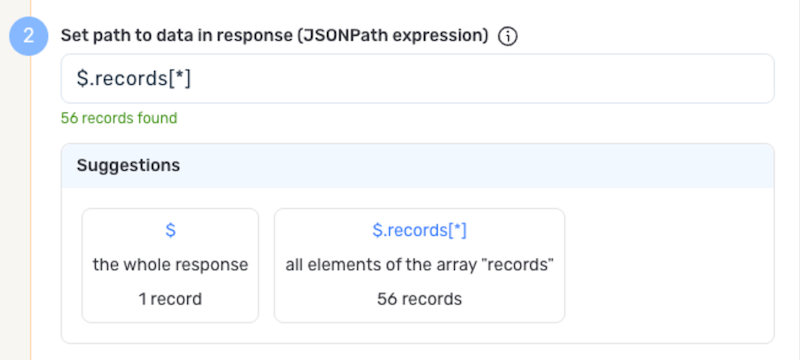
Nexla can also autogenerate data path suggestions based on the response from the API endpoint. These suggested paths can be used as-is or modified to exactly suit your needs.

  • To use this feature, click the Test button next to the Set API URL field to fetch a sample response from the API endpoint. Suggested data paths generated based on the content and format of the response will be displayed in the Suggestions box below the Set Path to Data in Response field.

  • Click on a suggestion to automatically populate the Set Path to Data in Response field with the corresponding path. The populated path can be modified directly within the field if further customization is needed.
    PathSuggestions.png

Metadata

If metadata is included in the response but is located outside of the defined path to relevant data, you can configure Nexla to include this data as common metadata in each record. This is useful when you want to preserve important contextual information from the Close API response — such as pagination details or total result counts — alongside the individual records.

For example, Close API responses include top-level fields such as has_more and total_results that apply to the entire response. If you have specified $.data[*] as the path to data, you can configure Nexla to include these top-level fields as metadata attached to each record.

Metadata paths are particularly useful for preserving Close API response context like total result counts or pagination indicators that apply to all records in the response.

  • To specify the location of metadata that should be included with each record, enter the path to the relevant metadata in the Path to Metadata in Response field.

    • For responses in JSON format, enter the JSON path to the object or array that contains the metadata.

Request Headers

Optional
  • If Nexla should include any additional request headers in API calls to this source, enter the headers and corresponding values as comma-separated pairs in the Request Headers field (for example, header1:value1,header2:value2). Additional headers may be needed for API versioning or custom request requirements.

    You do not need to include any headers already present in the credentials. The Close API's Authorization header is handled automatically by Nexla based on your credential configuration.

Endpoint Testing

After configuring all settings for the selected endpoint, Nexla can retrieve a sample of the data that will be fetched according to the current configuration. This allows users to verify that the source is configured correctly before saving.

  • To test the current endpoint configuration, click the Test button to the right of the endpoint selection menu. Sample data will be fetched and displayed in the Endpoint Test Result panel on the right.

  • If the sample data is not as expected, review the selected endpoint and associated settings, and make any necessary adjustments. Then, click the Test button again, and check the sample data to ensure that the correct information is displayed.

Save & Activate the Source

  1. Once all of the relevant steps in the above sections have been completed, click the Create button in the upper right corner of the screen to save and create the new Close data source. Nexla will now begin ingesting data from the configured endpoint and will organize any data that it finds into one or more Nexsets.