
ChurnZero Data Source

The ChurnZero connector enables you to ingest customer success data—including accounts, contacts, events, churn scores, journeys, surveys, tasks, and internal user data—from your ChurnZero account. Follow the instructions below to create a new data flow that ingests data from a ChurnZero source in Nexla.
churnzero_api.png

ChurnZero

Create a New Data Flow

  1. To create a new data flow, navigate to the Integrate section, and click the New Data Flow button. Then, select the desired flow type from the list, and click the Create button.

  2. Select the ChurnZero connector tile from the list of available connectors. Then, select the credential that will be used to connect to the ChurnZero instance, and click Next; or, create a new ChurnZero credential for use in this flow.

  3. In Nexla, ChurnZero data sources can be created using pre-built endpoint templates, which expedite source setup for common ChurnZero endpoints. Each template is designed specifically for the corresponding ChurnZero endpoint, making source configuration easy and efficient.
    • To configure this source using a template, follow the instructions in Configure Using a Template.

    ChurnZero sources can also be configured manually, allowing you to ingest data from ChurnZero endpoints not included in the pre-built templates or apply further customizations to exactly suit your needs.
    • To configure this source manually, follow the instructions in Configure Manually.

Configure Using a Template

Nexla provides pre-built templates that can be used to rapidly configure data sources to ingest data from common ChurnZero endpoints. Each template is designed specifically for the corresponding ChurnZero endpoint, making data source setup easy and efficient.

The ChurnZero REST API is an OData implementation, so most endpoint templates support $top (page size), $filter, and $orderby query options. Many templates expose a Days Back parameter that incrementally ingests records modified or created within a rolling window, and a Page Size parameter that controls how many records are requested per page. Pagination is handled automatically by following the OData @odata.nextLink value in each response.

For incremental endpoints, the Days Back parameter filters records by their last modified or created date relative to the current run time. Set this value to 0 to perform a full sync of all available records, and increase it when backfilling historical data.

Endpoint Settings

  • Select the endpoint from which this source will fetch data from the Endpoint pulldown menu. Available endpoint templates are listed in the expandable boxes below. Click on an endpoint to see more information about it and how to configure your data source for this endpoint.

    Get Accounts

    Retrieves all customer accounts with attributes, health scores, renewal dates, and billing details. Use this endpoint to maintain a synchronized copy of your ChurnZero account records for reporting and analysis.

    • Enter the number of accounts to return per page in the Page Size field. The default is 100, which is the OData maximum.
    • Enter the number of days to look back, based on each account's last modified date, in the Days Back field. The default is 30. Set this to 0 to perform a full sync of all accounts.

    Records are ordered by last modified date in ascending order, and pagination is handled automatically. Account records are the foundation for most other ChurnZero entities, so ingesting them first is recommended.

    Get Contacts

    Retrieves all contacts across accounts, including email, role, engagement metrics, and custom attributes. Use this endpoint to sync the people associated with your customer accounts.

    • Enter the number of contacts to return per page in the Page Size field. The default is 100.
    • Enter the number of days to look back, based on each contact's last modified date, in the Days Back field. The default is 30. Set this to 0 to perform a full sync of all contacts.

    Contacts are linked to accounts in ChurnZero. Ingesting the Get Accounts endpoint alongside this one provides the account context needed to join contact records to their parent accounts.

    Get Events

    Retrieves custom events tracked for contacts and accounts within a specified date range. Use this endpoint to analyze product usage and engagement signals over time.

    • Enter the number of events to return per page in the Page Size field. The default is 100.
    • Enter the number of days to look back, based on each event's created date, in the Days Back field. The default is 30.

    Events are filtered and ordered by their created date. Because event volumes can be large, choose a Days Back value that balances data freshness against ingestion volume.

    Get Event Types

    Retrieves all event type definitions configured in ChurnZero, including name and description. Use this endpoint as reference data to label and categorize the events returned by the Get Events endpoint.

    • This endpoint requires no additional configuration. Select the template to ingest all configured event types.
    • Records are paginated automatically, and up to 100 records are requested per page.

    Event type definitions change infrequently, so this endpoint is typically scheduled to run less often than the Get Events endpoint.

    Get Churn Scores

    Retrieves churn score model definitions for all accounts, including which score is designated as primary. Use this endpoint to understand how churn risk is modeled in your ChurnZero instance.

    • This endpoint requires no additional configuration. Select the template to ingest all churn score definitions.
    • Records are paginated automatically, and up to 100 records are requested per page.

    This endpoint returns score model definitions rather than per-account score values. Use the Get Churn Score Calculations endpoint to retrieve the computed scores for each account over time.

    Get Churn Score Calculations

    Retrieves per-account churn score calculation history, syncing the last N days of score computations. Use this endpoint to track how each account's churn risk changes over time.

    • Enter the number of days of score calculation history to sync in the Days Back field. The default is 2, which is suitable for frequent incremental syncs. Increase this value when backfilling historical score data.

    Score calculations can accumulate quickly across many accounts. A small Days Back value keeps each incremental run efficient, while a larger value supports one-time historical backfills.

    Get Churn Score Factors

    Retrieves churn score factor definitions, including factor type, name, and associated journey references. Use this endpoint as reference data to interpret the factor-level breakdown of churn scores.

    • This endpoint requires no additional configuration. Select the template to ingest all churn score factor definitions.
    • Records are paginated automatically, and up to 100 records are requested per page.

    Pair this endpoint with Get Churn Score Factor Calculations to map each factor definition to the values calculated for individual accounts.

    Get Churn Score Factor Calculations

    Retrieves per-factor score breakdown calculations per account, showing each factor's contribution to the overall churn score. Use this endpoint for detailed root-cause analysis of churn risk.

    • Enter the number of days of factor calculation history to sync in the Days Back field. The default is 2. Increase this value when backfilling historical data.

    This endpoint produces high-volume, granular data. Keep the Days Back value low for routine incremental syncs to manage ingestion volume.

    Get User Accounts

    Retrieves internal ChurnZero user accounts, such as customer success managers (CSMs) and admins, with role, email, and external ID fields. Use this endpoint to sync your team roster for ownership and assignment reporting.

    • This endpoint requires no additional configuration. Select the template to ingest all internal user accounts.
    • Records are ordered by last modified date and paginated automatically, with up to 100 records requested per page.

    User accounts represent ChurnZero staff users, not your customer contacts. Use this data to attribute accounts and tasks to the responsible CSMs.

    Get Segments

    Retrieves all account and contact segment definitions, including sharing type and owner. Use this endpoint to sync the saved segments used for filtering and targeting in ChurnZero.

    • Select the entity type by which to filter segments from the Entity Type pulldown menu. The available values are Account, Contact, and Event, and the default is Account.

    Create a separate data source for each entity type if you need to ingest segment definitions for accounts, contacts, and events.

    Get Segment Column Sets

    Retrieves saved column set configurations used for dynamic field selection in OData queries. Use this endpoint to understand which fields are grouped together for segment-based reporting.

    • This endpoint requires no additional configuration. Select the template to ingest all segment column set definitions.
    • Records are paginated automatically, and up to 100 records are requested per page.

    Segment column sets are reference data that define reusable field groupings. They change infrequently and can be synced on a less frequent schedule.

    Get Surveys

    Retrieves all NPS and custom survey definitions, including recurrence and campaign settings. Use this endpoint to sync the survey configurations used to collect customer feedback.

    • This endpoint requires no additional configuration. Select the template to ingest all survey definitions.
    • Records are paginated automatically, and up to 100 records are requested per page.

    Pair this endpoint with Get Survey Responses and Get Survey Follow-Ups to build a complete view of your survey program and its results.

    Get Survey Responses

    Retrieves survey responses, including NPS scores, follow-up answers, source, and respondent details. Use this endpoint to analyze customer sentiment and feedback trends.

    • Enter the number of days to look back for survey responses, based on the response created date, in the Days Back field. The default is 30.

    Responses are filtered and ordered by their created date. Choose a Days Back value that captures your most recent survey campaigns while keeping ingestion volume manageable.

    Get Survey Follow-Ups

    Retrieves follow-up question definitions attached to surveys, including question text and type. Use this endpoint as reference data to interpret follow-up answers in survey responses.

    • This endpoint requires no additional configuration. Select the template to ingest all survey follow-up definitions.
    • Records are paginated automatically, and up to 100 records are requested per page.

    Follow-up definitions provide the context needed to label the follow-up answers captured in the Get Survey Responses endpoint.

    Get Tasks

    Retrieves tasks assigned to CSMs, including due dates, priority, status, and associated accounts. Use this endpoint to track customer success workload and follow-up activity.

    • Enter the number of days to look back, based on each task's last modified date, in the Days Back field. The default is 30.

    Pair this endpoint with Get Task Priorities and Get Task Statuses to translate the priority and status reference codes on each task into human-readable labels.

    Get Task Priorities

    Retrieves task priority reference data, including the priority name and an is-high-priority flag. Use this endpoint to label the priority values returned by the Get Tasks endpoint.

    • This endpoint requires no additional configuration. Select the template to ingest all task priority definitions.
    • This endpoint returns the complete set of priorities in a single request.

    Task priority definitions are static reference data and are typically ingested once or on an infrequent schedule.

    Get Task Statuses

    Retrieves task status reference data, including default and closed status flags. Use this endpoint to label the status values returned by the Get Tasks endpoint.

    • This endpoint requires no additional configuration. Select the template to ingest all task status definitions.
    • This endpoint returns the complete set of statuses in a single request.

    Task status definitions are static reference data and are typically ingested once or on an infrequent schedule.

    Get Journeys

    Retrieves journey definitions, including milestones, expected duration, and sharing configuration. Use this endpoint to sync the structured customer onboarding and success journeys defined in ChurnZero.

    • This endpoint requires no additional configuration. Select the template to ingest all journey definitions.
    • Records are paginated automatically, and up to 100 records are requested per page.

    Journey definitions describe the overall structure of a journey. Use the related journey progress and milestone endpoints to track how individual accounts move through each journey.

    Get Journey Milestones

    Retrieves milestone definitions within journeys, including expected duration and task templates. Use this endpoint as reference data to interpret per-account milestone progress.

    • This endpoint requires no additional configuration. Select the template to ingest all journey milestone definitions.
    • Records are paginated automatically, and up to 100 records are requested per page.

    Milestone definitions are the building blocks of journeys. Pair this endpoint with Get Journey Milestone Progress to track completion per account.

    Get Journey Progress

    Retrieves account-level journey progress records, including phase, status, and milestone completion. Use this endpoint to monitor where each account stands in its assigned journeys.

    • Enter the number of days to look back for journey progress updates, based on the last modified date, in the Days Back field. The default is 30.

    Records are ordered by last modified date and paginated automatically. This endpoint provides the account-level rollup of journey progress; use the milestone-level endpoints for finer granularity.

    Get Journey Milestone Progress

    Retrieves per-account, per-milestone progress, including days in milestone and completion status. Use this endpoint for detailed tracking of how accounts advance through journey milestones.

    • Enter the number of days to look back for milestone progress updates, based on the last modified date, in the Days Back field. The default is 30.

    Records are ordered by last modified date and paginated automatically. This endpoint complements Get Journey Progress with milestone-level detail for each account.

    Get Journey Milestone Achievements

    Retrieves completed milestone achievement records for accounts, with achievement date and name. Use this endpoint to report on which milestones accounts have successfully completed.

    • Enter the number of days to look back for milestone achievements, based on the created date, in the Days Back field. The default is 30.

    Records are ordered by created date and paginated automatically. Achievement records are appended over time, so an incremental Days Back window captures newly completed milestones efficiently.

    Get Journey Instances

    Retrieves active journey instance records linking accounts to journeys, with start and end dates. Use this endpoint to see which accounts are currently enrolled in each journey.

    • Enter the number of days to look back for journey instance updates, based on the last modified date, in the Days Back field. The default is 30.

    Records are ordered by last modified date and paginated automatically. A journey instance represents a single account's enrollment in a journey.

    Get Journey Instance Tasks

    Retrieves task records generated within journey instances, including condition and optional status. Use this endpoint to track the tasks automatically created as accounts progress through journeys.

    • Enter the number of days to look back for journey instance task updates, based on the last modified date, in the Days Back field. The default is 30.

    Records are ordered by last modified date and paginated automatically. These tasks are scoped to journey instances and are distinct from the standalone tasks returned by the Get Tasks endpoint.

    Get Journey Milestone Step Progress

    Retrieves step-level progress within journey milestones per account, including completion status. Use this endpoint for the most granular view of how accounts complete the individual steps that make up each milestone.

    • Enter the number of days to look back for journey milestone step progress updates, based on the last modified date, in the Days Back field. The default is 30.

    Records are ordered by last modified date and paginated automatically. This endpoint provides step-level detail beneath the milestone-level progress returned by Get Journey Milestone Progress.

Endpoint Testing

Once the selected endpoint template has been configured, Nexla can retrieve a sample of the data that will be fetched according to the current settings. This allows users to verify that the source is configured correctly before saving.

  • To test the current endpoint configuration, click the Test button to the right of the endpoint selection menu. Sample data will be fetched & displayed in the Endpoint Test Result panel on the right.

  • If the sample data is not as expected, review the selected endpoint and associated settings, and make any necessary adjustments. Then, click the Test button again, and check the sample data to ensure that the correct information is displayed.

Configure Manually

ChurnZero data sources can be manually configured to ingest data from any valid ChurnZero REST API endpoint. Manual configuration provides maximum flexibility for accessing OData entities not covered by pre-built templates or when you need custom OData query options such as $select, $expand, or custom $filter expressions.

With manual configuration, you can also create more complex ChurnZero sources, such as sources that apply custom date filters or request specific fields to reduce payload size.

API Method

  1. To manually configure this source, select the Advanced tab at the top of the configuration screen.

  2. Select the API method that will be used for calls to the ChurnZero API from the Method pulldown menu. ChurnZero REST API read operations use the GET method:

    • GET: For retrieving data from the API

API Endpoint URL

  1. Enter the URL of the ChurnZero API endpoint from which this source will fetch data in the Set API URL field. This should be the complete URL including the protocol (https://) and any required OData query options. ChurnZero REST API endpoints follow the pattern https://{subdomain}.churnzero.net/public/v1/{Entity}, where {subdomain} is your account subdomain and {Entity} is an OData entity such as Account, Contact, or Event.

Ensure the API endpoint URL is correct and accessible with your current credentials. You can test the endpoint using the Test button after configuring the URL.

Date/Time Macros (API URL)

Optional

Optionally, the API URL can be customized using macros—all macros added to the API URL will be converted into values when Nexla executes the API call. Macros are dynamic placeholders that allow you to create flexible API endpoints that can adapt to different time periods or data requirements. For ChurnZero, datetime macros are commonly used inside OData $filter expressions to ingest only records created or modified since the previous run.

Macros are particularly useful for ChurnZero OData filters such as $filter=ObjectLastModifiedDate gt {now-30}, which limits results to records modified within a rolling window.

  1. To add a macro, type { at the appropriate position in the API URL (within the Set API URL field), and select the desired macro from the dropdown list.

    • {now} – The current datetime
    • {now-1} – The datetime one time unit before the current datetime
    • {now+1} – The datetime one time unit after the current datetime
    • custom – Datetime macros can reference any number of time units before or after the current datetime—for example, enter {now-4} to indicate the datetime four time units before the current datetime
  2. Select the format that will be applied to datetime macros from the Date Format for Date/Time Macro pulldown menu. This format will be applied to the base datetime value of the macro—i.e., the value of {now} in {now-1}. ChurnZero expects ISO 8601 UTC timestamps in the format yyyy-MM-dd'T'HH:mm:ss'Z'.

  3. Select the datetime unit that will be used to perform mathematical operations in the included macro(s) from the Time Unit for Operations pulldown menu—for example, for the macro {now-1}, when Day is selected, {now-1} will be converted to the datetime one day before the current datetime.

Lookup-Based Macros (API URL)

Optional

Column values from existing lookups can also be included as macros in the API URL. Lookup-based macros allow you to reference data from previously configured data sources or lookups, enabling dynamic API endpoints that can adapt based on existing data.

Lookup-based macros are useful when you need to create ChurnZero API endpoints that reference specific account or contact IDs from other data sources in your Nexla environment.

  1. To include a lookup column value macro, select the relevant lookup from the Add Lookups to Supported Macros pulldown menu.

  2. Type { at the appropriate position in the API URL, and select the lookup column-based macro from the dropdown list. Lookup-based macros are automatically populated into the macro list when a lookup is selected in the Add Lookups to Supported Macros pulldown menu.

Path to Data

Optional

If only a subset of the data that will be returned by the API endpoint is needed, you can designate the part(s) of the response that should be included in the Nexset(s) produced from this source by specifying the path to the relevant data within the response. This is particularly useful when API responses contain metadata, pagination information, or other data that you don't need for your analysis.

ChurnZero OData responses wrap the returned records in a top-level value array, alongside metadata such as the @odata.nextLink pagination link. By entering the path to the value array, you can configure Nexla to treat each element of the array as a record.

Path to Data is essential when API responses have nested structures. Without specifying the correct path, Nexla might not be able to properly parse and organize your data into usable records.

  • To specify which data should be treated as relevant in responses from this source, enter the path to the relevant data in the Set Path to Data in Response field.

    • For responses in JSON format enter the JSON path that points to the object or array that should be treated as relevant data. JSON paths use dot notation (e.g., $.value[*] to access the array of records in a ChurnZero OData response).

    • For responses in XML format, enter the XPath that points to the object/array containing relevant data. XPath uses slash notation (e.g., /response/data/item to access item elements within a data element).

    Path to Data Example:

    For ChurnZero OData responses, the records are contained in a top-level array named value, so the path to the relevant data is entered as $.value[*].

Autogenerate Path Suggestions

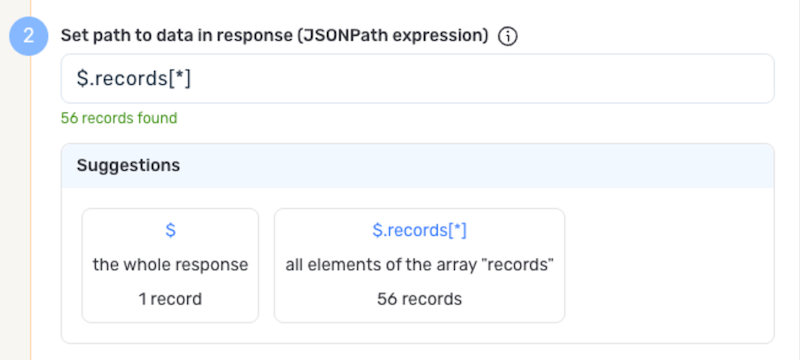
Nexla can also autogenerate data path suggestions based on the response from the API endpoint. These suggested paths can be used as-is or modified to exactly suit your needs.

  • To use this feature, click the Test button next to the Set API URL field to fetch a sample response from the API endpoint. Suggested data paths generated based on the content & format of the response will be displayed in the Suggestions box below the Set Path to Data in Response field.

  • Click on a suggestion to automatically populate the Set Path to Data in Response field with the corresponding path. The populated path can be modified directly within the field if further customization is needed.
    PathSuggestions.png

Metadata

If metadata is included in the response but is located outside of the defined path to relevant data, you can configure Nexla to include this data as common metadata in each record. This is useful when you want to preserve important contextual information that applies to all records but isn't part of the main data array.

For ChurnZero OData responses, the @odata.nextLink pagination link and any OData annotations sit outside the value array. In most cases this metadata is handled automatically for pagination, but you can specify a metadata path to retain selected response-level fields with each record.

Metadata paths are particularly useful for preserving API response context like request IDs, timestamps, or summary statistics that apply to all records in the response.

  • To specify the location of metadata that should be included with each record, enter the path to the relevant metadata in the Path to Metadata in Response field.

    • For responses in JSON format, enter the JSON path to the object or array that contains the metadata, and for responses in XML format, enter the XPath.

Request Headers

Optional
  • If Nexla should include any additional request headers in API calls to this source, enter the headers & corresponding values as comma-separated pairs in the Request Headers field (e.g., header1:value1,header2:value2). Additional headers are often required for API versioning, content type specifications, or custom authentication requirements.

    You do not need to include any headers already present in the credentials. The HTTP Basic Authentication header is added automatically by Nexla based on your ChurnZero credential configuration.

Endpoint Testing

After configuring all settings for the selected endpoint, Nexla can retrieve a sample of the data that will be fetched according to the current configuration. This allows users to verify that the source is configured correctly before saving.

  • To test the current endpoint configuration, click the Test button to the right of the endpoint selection menu. Sample data will be fetched & displayed in the Endpoint Test Result panel on the right.

  • If the sample data is not as expected, review the selected endpoint and associated settings, and make any necessary adjustments. Then, click the Test button again, and check the sample data to ensure that the correct information is displayed.

Save & Activate the Source

  1. Once all of the relevant steps in the above sections have been completed, click the Create button in the upper right corner of the screen to save and create the new ChurnZero data source. Nexla will now begin ingesting data from the configured endpoint and will organize any data that it finds into one or more Nexsets.