
Chorus.ai Data Source

The Chorus.ai connector enables you to ingest conversation intelligence data—including recorded calls and meetings, transcripts, AI insights, engagements, users, teams, scorecards, trackers, moments, and call analytics—from your Chorus.ai organization. Follow the instructions below to create a new data flow that ingests data from a Chorus.ai source in Nexla.
chorus_ai_api.png

Chorus.ai

Create a New Data Flow

  1. To create a new data flow, navigate to the Integrate section, and click the New Data Flow button. Then, select the desired flow type from the list, and click the Create button.

  2. Select the Chorus.ai connector tile from the list of available connectors. Then, select the credential that will be used to connect to the Chorus.ai instance, and click Next; or, create a new Chorus.ai credential for use in this flow.

  3. In Nexla, Chorus.ai data sources can be created using pre-built endpoint templates, which expedite source setup for common Chorus.ai endpoints. Each template is designed specifically for the corresponding Chorus.ai endpoint, making source configuration easy and efficient.
    • To configure this source using a template, follow the instructions in Configure Using a Template.

    Chorus.ai sources can also be configured manually, allowing you to ingest data from Chorus.ai endpoints not included in the pre-built templates or apply further customizations to exactly suit your needs.
    • To configure this source manually, follow the instructions in Configure Manually.

Configure Using a Template

Nexla provides pre-built templates that can be used to rapidly configure data sources to ingest data from common Chorus.ai endpoints. Each template is designed specifically for the corresponding Chorus.ai endpoint, making data source setup easy and efficient.

Endpoint Settings

  • Select the endpoint from which this source will fetch data from the Endpoint pulldown menu. Available endpoint templates are listed in the expandable boxes below. Click on an endpoint to see more information about it and how to configure your data source for this endpoint.

    Get Conversations

    This endpoint retrieves recorded conversations—calls and meetings—from your Chorus.ai organization, filtered by a date range. Use it to ingest the full catalog of conversations for revenue intelligence, reporting, or pipeline analysis. Results are paginated automatically, and Nexla follows the next-page link until all matching conversations are retrieved.

    • Enter the start of the date range in the From Date field as an ISO 8601 datetime (for example, 2024-01-01T00:00:00Z). This field is optional and defaults to {now-30}, which resolves to 30 days before the current date.
    • Enter the end of the date range in the To Date field as an ISO 8601 datetime (for example, 2024-12-31T23:59:59Z). This field is optional and defaults to {now}, the current date.

    The {now} and {now-30} values are Nexla date/time macros that are converted to actual datetimes when the flow runs, making it easy to ingest a rolling window of recent conversations on each scheduled run.

    Get Conversation by ID

    This endpoint fetches the full details of a single conversation, including the transcript, AI insights, participants, deal information, and recording metadata. Use it when you need the complete record for a specific call or meeting.

    • Enter the unique identifier of the conversation to retrieve in the Conversation ID field. This field is required. Conversation IDs can be obtained from the Get Conversations endpoint.

    To ingest details for many conversations, first run the Get Conversations endpoint to collect conversation IDs, then reference those IDs in this endpoint—optionally using a lookup-based macro to drive the requests dynamically.

    Get Users

    This endpoint retrieves all users in your Chorus.ai organization, including each user's email, name, role, team, and activity metrics. Use it to build a roster of users for joining against conversation, engagement, and scorecard data.

    • This endpoint requires no additional configuration beyond selecting the template. Results are paginated automatically using a continuation key, and Nexla retrieves all pages.

    This endpoint uses the Chorus.ai v3 API and returns users under the users array in the response.

    Get Engagements

    This endpoint retrieves call and meeting engagements from the Chorus.ai v3 API, filtered by a date range. Engagements represent customer-facing activity and can be filtered by participant, team, type, and tracker keyword matches. Use it for engagement-level analytics across your organization.

    • Enter the start of the date range in the From Date (Epoch Seconds) field as a Unix epoch timestamp in seconds. This field is optional and defaults to {now-30}, which resolves to 30 days ago.
    • Enter the end of the date range in the To Date (Epoch Seconds) field as a Unix epoch timestamp in seconds. This field is optional and defaults to {now}, the current date.

    Unlike the conversation endpoints, the engagements endpoint expects dates as Unix epoch seconds rather than ISO 8601 datetimes. Results are paginated automatically using a continuation key.

    Get Scorecards

    This endpoint retrieves AI-assisted and manual coaching scorecards, including scores, reviewers, recipients, the associated initiative, and submission status. Use it to analyze coaching activity and rep performance across your organization.

    • Use the Filter: Submitted Only field to control which scorecards are returned. When set to true, only submitted scorecards are returned; leave it as the default false to return all scorecards.
    • Enter an initiative (coaching template) identifier in the Filter: Initiative ID field to return only scorecards for a specific initiative. This field is optional. Initiative IDs can be obtained from the Get Initiatives endpoint.

    Results are paginated automatically. To narrow results to a specific coaching program, combine this endpoint with the Get Initiatives endpoint to look up the relevant initiative ID.

    Get Moments

    This endpoint retrieves highlighted AI moments—key call clips shared within your organization—along with account, opportunity, and creator context. Use it to track which call highlights are being shared and the deals they relate to.

    • Enter the start of the shared-on date range in the Shared On Start (ISO 8601) field (for example, 2024-01-01T00:00:00Z). This field is optional and defaults to {now-30}.
    • Enter the end of the shared-on date range in the Shared On End (ISO 8601) field (for example, 2024-12-31T23:59:59Z). This field is optional and defaults to {now}.

    The date range filters moments by the date they were shared in Chorus.ai, not by the date of the underlying conversation.

    Get Playlists

    This endpoint retrieves all curated call playlists used for coaching and onboarding, including each playlist's name, owner, path, and subscription metadata. Use it to catalog the coaching content available in your organization.

    • This endpoint requires no additional configuration beyond selecting the template. It returns all playlists accessible to the authenticated user.

    Playlists organize curated conversations for training and enablement. Pair this endpoint with conversation data to understand which calls are being used for coaching.

    Get Trackers

    This endpoint retrieves all AI keyword trackers configured in your organization. Trackers are topic detectors for competitors, objections, pricing, and custom keyword groups that Chorus.ai applies to conversations. Use it to ingest your tracker configuration for reporting on keyword mentions.

    • This endpoint requires no additional configuration beyond selecting the template. It returns all trackers defined in your organization.

    Tracker IDs and names retrieved here can be used to interpret tracker keyword matches that appear in the conversation and engagement endpoints.

    Get Initiatives

    This endpoint retrieves all coaching initiatives—scorecard templates—including their criteria, scoring structure, and associated team assignments. Use it to understand the coaching programs in your organization and to resolve initiative IDs for the Get Scorecards endpoint.

    • This endpoint requires no additional configuration beyond selecting the template. It returns all initiatives defined in your organization.

    Initiatives define the scoring criteria used to evaluate calls. Use the initiative IDs returned here to filter scorecards by a specific coaching program.

    Get Teams

    This endpoint retrieves all teams in your Chorus.ai organization, including team name, members, managers, and hierarchy. Use it to support performance reporting that rolls conversation and scorecard metrics up to the team level.

    • This endpoint requires no additional configuration beyond selecting the template. It uses the Chorus.ai v3 API and returns teams under the teams array.

    Combine team data with the Get Users endpoint to map users to their teams and managers for organizational reporting.

    Get Call Stats (Analytics)

    This endpoint retrieves aggregated AI call analytics for a date range, including talk-to-listen ratios, monologue duration, filler words, question rates, and next-steps adherence. Use it for trend reporting and coaching insights across your organization.

    • Enter the start of the analytics date range in the From Date (ISO 8601) field (for example, 2024-01-01T00:00:00Z). This field is optional and defaults to {now-30}.
    • Enter the end of the analytics date range in the To Date (ISO 8601) field (for example, 2024-12-31T23:59:59Z). This field is optional and defaults to {now}.

    Call stats are aggregated metrics rather than individual conversation records, making this endpoint well suited for dashboards that track coaching KPIs over time.

    Get Emails

    This endpoint retrieves emails tracked by Chorus.ai, filtered by a sent date range. Returned emails can include sender, participants, subject, and thread information. Use it to bring email engagement into the same dataset as calls and meetings.

    • Enter the start of the sent date range in the Sent At Start (ISO 8601) field (for example, 2024-01-01T00:00:00Z). This field is optional and defaults to {now-30}.
    • Enter the end of the sent date range in the Sent At End (ISO 8601) field (for example, 2024-12-31T23:59:59Z). This field is optional and defaults to {now}.

    Results are paginated automatically, and Nexla follows the next-page link until all matching emails within the date range are retrieved.

    Get Email by ID

    This endpoint retrieves a single tracked email by its identifier, with full details including the associated account, deal, owner, content, participants, and status. Use it when you need the complete record for a specific email.

    • Enter the unique identifier of the email record to retrieve in the Email ID field. This field is required. Email IDs can be obtained from the Get Emails endpoint.

    Run the Get Emails endpoint first to collect email IDs, then reference those IDs in this endpoint to ingest full email details.

    Get Email Thread Details

    This endpoint retrieves metadata for a specific tracked email thread, including its privacy status, deletion information, and associated participants. Use it to understand the context and access controls of an email thread.

    • Enter the unique identifier of the email thread to retrieve in the Email Thread ID field. This field is required.

    Email thread metadata is useful for compliance and privacy reporting, as it indicates whether a thread is private or has been deleted.

    Get Saved Searches

    This endpoint retrieves all saved conversation searches for the authenticated user, including their filters and default status. Use it to understand the search workflows configured for pipeline and conversation review.

    • This endpoint requires no additional configuration beyond selecting the template. It returns the saved searches belonging to the user associated with the credential's API token.

    Saved searches are scoped to the authenticated user, so the results reflect the searches created by the user who generated the API token used in the credential.

    Get Live Conversation

    This endpoint fetches details of an in-progress live conversation by meeting UUID, including participants, recording status, and account context. Use it to monitor active meetings in near real time.

    • Enter the UUID of the live meeting to fetch in the Meeting UUID field. This field is required. The meeting UUID is typically available from the calendar invite or the video conferencing platform hosting the meeting.

    This endpoint returns data only while a conversation is actively being recorded. Once a meeting ends, use the Get Conversations or Get Conversation by ID endpoints to retrieve the completed recording and transcript.

    Get Current User

    This endpoint retrieves the profile details for the user associated with the credential's API token, including access level, email, name, role, and team memberships. Use it to confirm the identity and permissions tied to the credential.

    • This endpoint requires no additional configuration beyond selecting the template. It returns the profile of the authenticated user.

    This is the same endpoint Nexla uses to validate the credential when it is saved, making it a quick way to confirm that an API token is working as expected.

Endpoint Testing

Once the selected endpoint template has been configured, Nexla can retrieve a sample of the data that will be fetched according to the current settings. This allows users to verify that the source is configured correctly before saving.

  • To test the current endpoint configuration, click the Test button to the right of the endpoint selection menu. Sample data will be fetched & displayed in the Endpoint Test Result panel on the right.

  • If the sample data is not as expected, review the selected endpoint and associated settings, and make any necessary adjustments. Then, click the Test button again, and check the sample data to ensure that the correct information is displayed.

Configure Manually

Chorus.ai data sources can be manually configured to ingest data from any valid Chorus.ai API endpoint. Manual configuration provides maximum flexibility for accessing endpoints not covered by pre-built templates or when you need custom API configurations.

With manual configuration, you can also create more complex Chorus.ai sources, such as sources that use chained API calls to fetch data from multiple endpoints or sources that require custom request headers or parameters.

API Method

  1. To manually configure this source, select the Advanced tab at the top of the configuration screen.

  2. Select the API method that will be used for calls to the Chorus.ai API from the Method pulldown menu. Chorus.ai data retrieval endpoints use the GET method.

API Endpoint URL

  1. Enter the URL of the Chorus.ai API endpoint from which this source will fetch data in the Set API URL field. This should be the complete URL including the protocol (https://) and any required path parameters. Chorus.ai endpoints follow patterns such as https://chorus.ai/api/v1/conversations for the v1 API and https://chorus.ai/v3/engagements for the v3 API.

Ensure the API endpoint URL is correct and accessible with your current credentials. You can test the endpoint using the Test button after configuring the URL.

Date/Time Macros (API URL)

Optional

Optionally, the API URL can be customized using macros—all macros added to the API URL will be converted into values when Nexla executes the API call. Macros are dynamic placeholders that allow you to create flexible API endpoints that can adapt to different time periods or data requirements. This is particularly useful for Chorus.ai endpoints that filter by date range, such as conversations, engagements, moments, call stats, and emails.

Macros are particularly useful for APIs that require date ranges, pagination parameters, or other dynamic values that change between data ingestion runs.

  1. To add a macro, type { at the appropriate position in the API URL (within the Set API URL field), and select the desired macro from the dropdown list.

    • {now} – The current datetime
    • {now-1} – The datetime one time unit before the current datetime
    • {now+1} – The datetime one time unit after the current datetime
    • custom – Datetime macros can reference any number of time units before or after the current datetime—for example, enter (now-4) to indicate the datetime four time units before the current datetime
  2. Select the format that will be applied to datetime macros from the Date Format for Date/Time Macro pulldown menu. This format will be applied to the base datetime value of the macro—i.e., the value of {now} in {now-1}. The Chorus.ai v1 API expects ISO 8601 datetimes (for example, yyyy-MM-dd'T'HH:mm:ss'Z'), while the v3 engagements endpoint expects Unix epoch seconds.

  3. Select the datetime unit that will be used to perform mathematical operations in the included macro(s) from the Time Unit for Operations pulldown menu—for example, for the macro {now-1}, when Day is selected, {now-1} will be converted to the datetime one day before the current datetime.

Lookup-Based Macros (API URL)

Optional

Column values from existing lookups can also be included as macros in the API URL. Lookup-based macros allow you to reference data from previously configured data sources or lookups, enabling dynamic API endpoints that can adapt based on existing data. For Chorus.ai, this is useful for driving requests to ID-based endpoints—such as fetching conversation, email, or thread details—using IDs collected from a list endpoint.

Lookup-based macros are useful when you need to create API endpoints that reference specific IDs, values, or parameters from other data sources in your Nexla environment.

  1. To include a lookup column value macro, select the relevant lookup from the Add Lookups to Supported Macros pulldown menu.

  2. Type { at the appropriate position in the API URL, and select the lookup column-based macro from the dropdown list. Lookup-based macros are automatically populated into the macro list when a lookup is selected in the Add Lookups to Supported Macros pulldown menu.

Path to Data

Optional

If only a subset of the data that will be returned by the API endpoint is needed, you can designate the part(s) of the response that should be included in the Nexset(s) produced from this source by specifying the path to the relevant data within the response. This is particularly useful when API responses contain metadata, pagination information, or other data that you don't need for your analysis.

For example, the Chorus.ai v1 API returns conversation and scorecard records inside a top-level data array, while the v3 API returns users and teams inside users and teams arrays respectively. By entering the path to the relevant data, you can configure Nexla to treat each element of the returned array as a record.

Path to Data is essential when API responses have nested structures. Without specifying the correct path, Nexla might not be able to properly parse and organize your data into usable records.

  • To specify which data should be treated as relevant in responses from this source, enter the path to the relevant data in the Set Path to Data in Response field.

    • For responses in JSON format enter the JSON path that points to the object or array that should be treated as relevant data. JSON paths use dot notation (e.g., $.data[*] to access an array of items within a data object).

    • For responses in XML format, enter the XPath that points to the object/array containing relevant data. XPath uses slash notation (e.g., /response/data/item to access item elements within a data element).

    Path to Data Example:

    For Chorus.ai v1 list endpoints, the response includes a top-level array named data that contains the relevant records, so the path to the response would be entered as $.data[*].

Autogenerate Path Suggestions

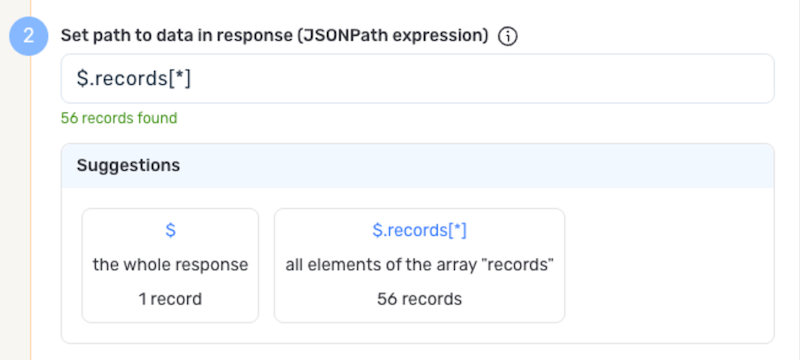
Nexla can also autogenerate data path suggestions based on the response from the API endpoint. These suggested paths can be used as-is or modified to exactly suit your needs.

  • To use this feature, click the Test button next to the Set API URL field to fetch a sample response from the API endpoint. Suggested data paths generated based on the content & format of the response will be displayed in the Suggestions box below the Set Path to Data in Response field.

  • Click on a suggestion to automatically populate the Set Path to Data in Response field with the corresponding path. The populated path can be modified directly within the field if further customization is needed.
    PathSuggestions.png

Metadata

If metadata is included in the response but is located outside of the defined path to relevant data, you can configure Nexla to include this data as common metadata in each record. This is useful when you want to preserve important contextual information that applies to all records but isn't part of the main data array.

For example, Chorus.ai list responses include pagination links and continuation keys outside the main data array. In this case, if you have specified the path to the relevant data but metadata of interest is located in a different part of the response, you can specify a path to this metadata to include it with each record in the generated Nexset(s).

Metadata paths are particularly useful for preserving API response context like request IDs, timestamps, or summary statistics that apply to all records in the response.

  • To specify the location of metadata that should be included with each record, enter the path to the relevant metadata in the Path to Metadata in Response field.

    • For responses in JSON format, enter the JSON path to the object or array that contains the metadata, and for responses in XML format, enter the XPath.

Request Headers

Optional
  • If Nexla should include any additional request headers in API calls to this source, enter the headers & corresponding values as comma-separated pairs in the Request Headers field (e.g., header1:value1,header2:value2). For Chorus.ai, the v1 API expects the Accept: application/vnd.api+json header, while the v3 API expects Accept: application/json along with the x-al-version: 2 header.

    You do not need to include any headers already present in the credentials. The Authorization header is handled automatically by Nexla based on your credential configuration.

Endpoint Testing

After configuring all settings for the selected endpoint, Nexla can retrieve a sample of the data that will be fetched according to the current configuration. This allows users to verify that the source is configured correctly before saving.

  • To test the current endpoint configuration, click the Test button to the right of the endpoint selection menu. Sample data will be fetched & displayed in the Endpoint Test Result panel on the right.

  • If the sample data is not as expected, review the selected endpoint and associated settings, and make any necessary adjustments. Then, click the Test button again, and check the sample data to ensure that the correct information is displayed.

Save & Activate the Source

  1. Once all of the relevant steps in the above sections have been completed, click the Create button in the upper right corner of the screen to save and create the new Chorus.ai data source. Nexla will now begin ingesting data from the configured endpoint and will organize any data that it finds into one or more Nexsets.