
Blackboard LMS Data Source

Blackboard Learn is a learning management system used by colleges, universities, and K-12 districts to deliver and administer online and blended courses. Follow the instructions below to create a new data flow that ingests data from a Blackboard LMS source in Nexla.
blackboard_api.png

Blackboard LMS

Create a New Data Flow

  1. To create a new data flow, navigate to the Integrate section, and click the New Data Flow button. Then, select the desired flow type from the list, and click the Create button.

  2. Select the Blackboard LMS connector tile from the list of available connectors. Then, select the credential that will be used to connect to the Blackboard Learn instance, and click Next; or, create a new Blackboard LMS credential for use in this flow.

  3. In Nexla, Blackboard LMS data sources can be created using pre-built endpoint templates, which expedite source setup for common Blackboard Learn endpoints. Each template is designed specifically for the corresponding Blackboard Learn endpoint, making source configuration easy and efficient.
    • To configure this source using a template, follow the instructions in Configure Using a Template.

    Blackboard LMS sources can also be configured manually, allowing you to ingest data from Blackboard Learn endpoints not included in the pre-built templates or apply further customizations to exactly suit your needs.
    • To configure this source manually, follow the instructions in Configure Manually.

Configure Using a Template

Nexla provides pre-built templates that can be used to rapidly configure data sources to ingest data from common Blackboard Learn endpoints. Each template is designed specifically for the corresponding Blackboard Learn endpoint, making data source setup easy and efficient.

Endpoint Settings

  • Select the endpoint from which this source will fetch data from the Endpoint pulldown menu. Available endpoint templates are listed in the expandable boxes below. Click on an endpoint to see more information about it and how to configure your data source for this endpoint.

    Get Courses

    This endpoint retrieves all courses from the Learn instance using GET /learn/api/public/v3/courses. It is the typical entry point for cohort, enrollment, and content pipelines because the returned id, courseId, and externalId values are used to drive most other course-scoped endpoints.

    • The Page Size field controls the number of records returned per page (Learn maximum is 200). The default value is 100.
    • The Availability Filter field restricts the result set to courses with the selected availability. Select Yes for active courses only, No for unavailable courses, or Disabled for disabled courses. The default value is Yes.

    This endpoint is paginated via $.paging.nextPage, and Nexla automatically advances through pages to retrieve all matching courses. The response is fielded down to id, courseId, externalId, name, created, modified, availability, hasChildren, dataSourceId to keep payloads compact.

    Get Users

    This endpoint retrieves all user accounts from the Learn instance using GET /learn/api/public/v1/users, including profile, contact information, institution roles, and system roles. Use it as the core source for learner identity, SIS reconciliation, and access-control pipelines.

    • The Page Size field controls the number of user records returned per page (Learn maximum is 200). The default value is 100.

    The response is fielded down to id, uuid, externalId, userName, name, contact, institutionRoleIds, systemRoleIds, availability, created, modified. Combine this endpoint with Get Institution Roles and Get Course Roles to resolve role IDs to display names.

    Get Course Enrollments

    This endpoint retrieves all user enrollments (memberships) for a specific course using GET /learn/api/public/v1/courses/{courseId}/users, including the course role, availability, child course ID, and the expanded user profile. Use it to build per-course rosters for enrollment and cohort analytics.

    • Enter the course identifier in the Course ID field. This field is required. Use the Learn internal course ID (for example, _123_1) or the SIS-style externalId:COURSECODE format. Course IDs can be obtained from the Get Courses endpoint.
    • The Page Size field controls the number of enrollment records returned per page (Learn maximum is 200). The default value is 100.

    This endpoint uses expand=user, so each enrollment record includes the user's userName and name without an extra lookup against the Get Users endpoint.

    Get Gradebook Columns

    This endpoint retrieves all gradebook columns for a course using GET /learn/api/public/v2/courses/{courseId}/gradebook/columns, including possible score, due date, grading type, category ID, availability, and rubric associations. Use it to discover the column IDs needed by the grade and attempt endpoints.

    • Enter the course identifier in the Course ID field. This field is required. Use the Learn internal course ID (for example, _123_1) or the externalId:COURSECODE format.
    • The Page Size field controls the number of column records returned per page (Learn maximum is 200). The default value is 100.

    The rubricAssociations field on each column links the column to the rubrics used to score it. Use it together with the Get Course Rubrics and Get Rubric Evaluations endpoints to assemble a complete graded-assessment dataset.

    Get Column Grades

    This endpoint retrieves all student grades for a specific gradebook column using GET /learn/api/public/v2/courses/{courseId}/gradebook/columns/{columnId}/users, including the score, status, feedback, and a changeIndex value that can drive incremental sync.

    • Enter the course identifier in the Course ID field. This field is required. Use the Learn internal course ID (for example, _123_1) or the externalId:COURSECODE format.
    • Enter the gradebook column identifier in the Column ID field. This field is required (for example, _456_1). Column IDs can be obtained from the Get Gradebook Columns endpoint.
    • The Page Size field controls the number of grade records returned per page (Learn maximum is 200). The default value is 100.

    The changeIndex field on each grade is monotonically increasing on grade changes within Learn. Persist the highest changeIndex seen in your warehouse to perform efficient incremental refreshes against this endpoint.

    Get Column Attempts

    This endpoint retrieves all student submission attempts for a specific gradebook column using GET /learn/api/public/v2/courses/{courseId}/gradebook/columns/{columnId}/attempts. This is the entry point for retrieving per-attempt rubric evaluations.

    • Enter the course identifier in the Course ID field. This field is required. Use the Learn internal course ID (for example, _123_1) or the externalId:COURSECODE format.
    • Enter the gradebook column identifier in the Column ID field. This field is required (for example, _456_1).
    • The Page Size field controls the number of attempt records returned per page (Learn maximum is 200). The default value is 100.

    Each attempt record carries a unique id (for example, _844981_1) that is used as the Attempt ID input to the Get Rubric Evaluations endpoint.

    Get Course Rubrics

    This endpoint retrieves all rubrics in a course using GET /learn/api/public/v1/courses/{courseId}/rubrics with expand=cells,columns,rows, returning the complete rubric definition. Use it to power AI grading consistency checks and rubric quality analytics.

    • Enter the course identifier in the Course ID field. This field is required. Use the Learn internal course ID (for example, _123_1) or the externalId:COURSECODE format.
    • The Page Size field controls the number of rubric records returned per page. The default value is 100.

    Because cells, columns, and rows are expanded inline, rubric responses can be large. Reduce the Page Size if you observe timeouts or memory pressure during ingestion.

    Get Rubric Evaluations

    This endpoint retrieves rubric cell-level evaluations for a single submission attempt using GET /learn/api/public/v1/courses/{courseId}/gradebook/columns/{columnId}/attempts/{attemptId}/rubric/evaluations, including per-criterion scores and feedback. It is critical for training and validating AI grading models.

    • Enter the course identifier in the Course ID field. This field is required (for example, _123_1).
    • Enter the gradebook column identifier for the rubric-graded assessment in the Column ID field. This field is required (for example, _456_1).
    • Enter the submission attempt identifier in the Attempt ID field. This field is required (for example, _844981_1). Attempt IDs can be obtained from the Get Column Attempts endpoint.
    • The Page Size field controls the number of evaluation records returned per page. The default value is 100.

    Use a Nexla lookup over the Get Column Attempts output to drive this endpoint across all attempts for a column, rather than configuring a separate source per attempt.

    Get Calendar Items

    This endpoint retrieves course, institutional, and gradebook calendar items within a date window using GET /learn/api/public/v1/calendars/items. Use it for schedule analytics, deadline tracking, and notification pipelines.

    • The Course ID field is optional. Provide a course ID (for example, _123_1) to filter calendar items to a single course, or leave it blank to include institution-wide items.
    • Enter the start of the date range in ISO-8601 format in the Since (Start Date) field (for example, 2024-01-01T00:00:00.000Z). The default value is {'{now-30}'}, which selects 30 time units before now once the date macro settings are applied.
    • Enter the end of the date range in ISO-8601 format in the Until (End Date) field (for example, 2024-04-01T00:00:00.000Z). The default value is {'{now+80}'}. The maximum supported window between Since and Until is 16 weeks.
    • The Page Size field controls the number of calendar item records returned per page. The default value is 100.

    Use the date/time macros described under Date/Time Macros (API URL) to keep the Since and Until values rolling forward on each ingestion run.

    Get Course Contents

    This endpoint retrieves content items in a course using GET /learn/api/public/v1/courses/{courseId}/contents, including folders, documents, assessments, and links. It is the foundation for retrieval-augmented generation (RAG) and content indexing pipelines built on Blackboard course material.

    • Enter the course identifier in the Course ID field. This field is required. Use the Learn internal course ID (for example, _123_1) or the externalId:COURSECODE format.
    • The Page Size field controls the number of content items returned per page (Learn maximum is 200). The default value is 100.
    • Set the Recursive field to true to recursively return child content items within folders, or leave it as false to return only the top-level items. The default value is false.

    The response is fielded down to id, title, body, created, modified, availability, position, contentHandler, reviewable. The contentHandler.id value identifies the content type (for example, document, link, assessment) and is useful for filtering downstream.

    Get Announcements

    This endpoint retrieves course announcements using GET /learn/api/public/v1/courses/{courseId}/announcements, including title, body text, and availability windows. Use it for natural language processing, sentiment analysis, and communication analytics over instructor-to-student messages.

    • Enter the course identifier in the Course ID field. This field is required (for example, _123_1).
    • The Page Size field controls the number of announcement records returned per page (Learn maximum is 200). The default value is 100.

    Announcement bodies are returned as HTML. Apply a Nexla transform to strip HTML tags if downstream models require plain text.

    Get Attendance Meetings

    This endpoint retrieves all attendance meeting sessions for a course using GET /learn/api/public/v1/courses/{courseId}/meetings. Each meeting record is the entry point for retrieving per-user attendance status, which is a key feature for at-risk and engagement models.

    • Enter the course identifier in the Course ID field. This field is required (for example, _123_1).
    • The Page Size field controls the number of meeting records returned per page. The default value is 100.

    Use the meeting id values returned here as the Meeting ID input to the Get Meeting Attendance Records endpoint.

    Get Meeting Attendance Records

    This endpoint retrieves per-user attendance status (Present, Absent, Late, Excused) for a single meeting session using GET /learn/api/public/v1/courses/{courseId}/meetings/{meetingId}/users. It is a key signal for at-risk student detection.

    • Enter the course identifier in the Course ID field. This field is required (for example, _123_1).
    • Enter the meeting identifier in the Meeting ID field. This field is required (for example, 465). Meeting IDs can be obtained from the Get Attendance Meetings endpoint.
    • The Page Size field controls the number of attendance records returned per page. The default value is 100.

    Get Course Groups

    This endpoint retrieves all groups and group sets within a course using GET /learn/api/public/v2/courses/{courseId}/groups. Use it for collaborative learning analytics and group performance modeling.

    • Enter the course identifier in the Course ID field. This field is required. Use the Learn internal course ID (for example, _123_1) or the externalId:COURSECODE format.
    • The Page Size field controls the number of group records returned per page (Learn maximum is 200). The default value is 100.

    The response is fielded down to id, externalId, name, description, availability, enrollment, uuid, created, modified.

    Get Gradebook Categories

    This endpoint retrieves all gradebook categories for a course using GET /learn/api/public/v1/courses/{courseId}/gradebook/categories. Use it to map columns to categories for weighted grade analytics and category-level reporting.

    • Enter the course identifier in the Course ID field. This field is required (for example, _123_1).
    • The Page Size field controls the number of category records returned per page. The default value is 100.

    Get Institution Roles

    This endpoint retrieves all institution-level roles defined on the Learn instance using GET /learn/api/public/v1/institutionRoles. Use it for user segmentation, access-control analytics, and to resolve the institutionRoleIds values returned by the Get Users endpoint.

    • The Page Size field controls the number of role records returned per page. The default value is 100.

    Get Course Roles

    This endpoint retrieves all course-level roles on the Learn instance using GET /learn/api/public/v1/courseRoles (for example, Instructor, Student, TA). Use it for role-based access analytics and to resolve the courseRoleId values returned by the Get Course Enrollments endpoint.

    • The Page Size field controls the number of role records returned per page. The default value is 100.

    Get Terms

    This endpoint retrieves all academic terms on the Learn instance using GET /learn/api/public/v1/terms. Use it for time-bound cohort analysis and to align performance metrics with the academic calendar.

    • The Page Size field controls the number of term records returned per page (Learn maximum is 200). The default value is 100.

    The response is fielded down to id, externalId, name, description, availability, dataSourceId.

    Get Data Sources

    This endpoint retrieves data source keys used to tag and track the origin of courses, users, and enrollments using GET /learn/api/public/v1/dataSources. Use it for SIS reconciliation and to map records back to their source feeds.

    • The Page Size field controls the number of data source records returned per page. The default value is 100.

Endpoint Testing

Once the selected endpoint template has been configured, Nexla can retrieve a sample of the data that will be fetched according to the current settings. This allows users to verify that the source is configured correctly before saving.

  • To test the current endpoint configuration, click the Test button to the right of the endpoint selection menu. Sample data will be fetched & displayed in the Endpoint Test Result panel on the right.

  • If the sample data is not as expected, review the selected endpoint and associated settings, and make any necessary adjustments. Then, click the Test button again, and check the sample data to ensure that the correct information is displayed.

Configure Manually

Blackboard LMS data sources can be manually configured to ingest data from any valid Blackboard Learn REST API endpoint. Manual configuration provides maximum flexibility for accessing endpoints not covered by pre-built templates — for example, the Course Analytics, Discussion, or LTI endpoints — or when chained API calls and custom request parameters are required.

API Method

  1. To manually configure this source, select the Advanced tab at the top of the configuration screen.

  2. Select the API method that will be used for calls to the Blackboard Learn API from the Method pulldown menu. The most common methods for read-oriented Learn endpoints are:

    • GET: For retrieving data from the API (the standard for all source endpoints listed above).
    • POST: For Learn endpoints that accept a request body, such as some search and analytics endpoints.

API Endpoint URL

  1. Enter the URL of the Blackboard Learn API endpoint from which this source will fetch data in the Set API URL field. This should be the complete URL including the protocol (https://) and any required path parameters. Blackboard Learn endpoints follow the format https://<your-learn-instance>/learn/api/public/v<n>/<resource> — for example, https://yourinstitution.blackboard.com/learn/api/public/v3/courses.

The same Learn endpoint may exist under multiple version prefixes (v1, v2, v3). Use the highest version that exposes the fields you need; older versions remain available for backward compatibility.

Date/Time Macros (API URL)

Optional

Optionally, the API URL can be customized using macros—all macros added to the API URL will be converted into values when Nexla executes the API call. Macros are dynamic placeholders that allow you to create flexible API endpoints that can adapt to different time periods or data requirements. This is particularly useful for Blackboard Learn endpoints that accept ISO-8601 datetime filters such as since, until, createdSince, or modifiedSince.

Macros are particularly useful for APIs that require date ranges, pagination parameters, or other dynamic values that change between data ingestion runs.

  1. To add a macro, type { at the appropriate position in the API URL (within the Set API URL field), and select the desired macro from the dropdown list.

    • {now} – The current datetime
    • {now-1} – The datetime one time unit before the current datetime
    • {now+1} – The datetime one time unit after the current datetime
    • custom – Datetime macros can reference any number of time units before or after the current datetime—for example, enter (now-4) to indicate the datetime four time units before the current datetime
  2. Select the format that will be applied to datetime macros from the Date Format for Date/Time Macro pulldown menu. This format will be applied to the base datetime value of the macro—i.e., the value of {now} in {now-1}. Use an ISO-8601 format (such as yyyy-MM-dd'T'HH:mm:ss.SSS'Z') so that values are accepted by Learn datetime filters.

  3. Select the datetime unit that will be used to perform mathematical operations in the included macro(s) from the Time Unit for Operations pulldown menu—for example, for the macro {now-1}, when Day is selected, {now-1} will be converted to the datetime one day before the current datetime.

Lookup-Based Macros (API URL)

Optional

Column values from existing lookups can also be included as macros in the API URL. Lookup-based macros allow you to reference data from previously configured data sources or lookups, enabling dynamic API endpoints that can adapt based on existing data. For Blackboard Learn, this is the typical pattern for fan-out — for example, driving the Get Course Enrollments, Get Gradebook Columns, or Get Course Contents endpoints across all course IDs returned by Get Courses.

Lookup-based macros are useful when you need to create API endpoints that reference specific IDs, values, or parameters from other data sources in your Nexla environment.

  1. To include a lookup column value macro, select the relevant lookup from the Add Lookups to Supported Macros pulldown menu.

  2. Type { at the appropriate position in the API URL, and select the lookup column-based macro from the dropdown list. Lookup-based macros are automatically populated into the macro list when a lookup is selected in the Add Lookups to Supported Macros pulldown menu.

Path to Data

Optional

If only a subset of the data that will be returned by the API endpoint is needed, you can designate the part(s) of the response that should be included in the Nexset(s) produced from this source by specifying the path to the relevant data within the response. This is essential for Blackboard Learn because list endpoints wrap records in a top-level results array alongside a paging object that contains the cursor used for pagination.

For example, when a request call is used to fetch a list of items, the API will typically return an array of records, along with metadata, in the response. By entering the path to the relevant data, you can configure Nexla to treat each element of the returned array as a record.

Path to Data is essential when API responses have nested structures. Without specifying the correct path, Nexla might not be able to properly parse and organize your data into usable records.

  • To specify which data should be treated as relevant in responses from this source, enter the path to the relevant data in the Set Path to Data in Response field.

    • For responses in JSON format enter the JSON path that points to the object or array that should be treated as relevant data. JSON paths use dot notation (e.g., $.data.items[*] to access an array of items within a data object).

    • For responses in XML format, enter the XPath that points to the object/array containing relevant data. XPath uses slash notation (e.g., /response/data/item to access item elements within a data element).

    Path to Data Example:

    Blackboard Learn list endpoints return records in a top-level results array. For endpoints such as /courses, /users, and /courses/&#123;courseId&#125;/users, the path to the response would be entered as $.results[*].

Autogenerate Path Suggestions

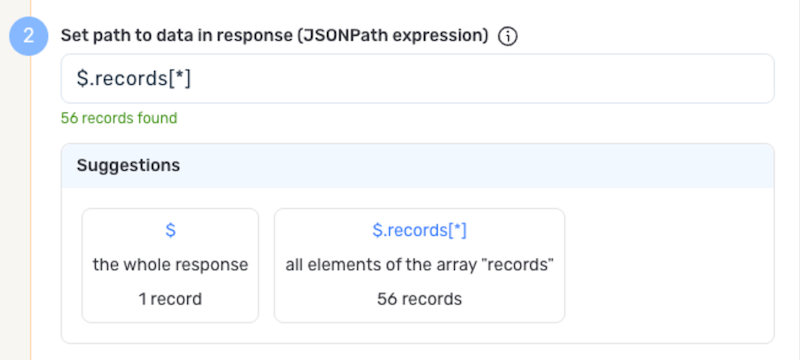
Nexla can also autogenerate data path suggestions based on the response from the API endpoint. These suggested paths can be used as-is or modified to exactly suit your needs.

  • To use this feature, click the Test button next to the Set API URL field to fetch a sample response from the API endpoint. Suggested data paths generated based on the content & format of the response will be displayed in the Suggestions box below the Set Path to Data in Response field.

  • Click on a suggestion to automatically populate the Set Path to Data in Response field with the corresponding path. The populated path can be modified directly within the field if further customization is needed.
    PathSuggestions.png

Metadata

If metadata is included in the response but is located outside of the defined path to relevant data, you can configure Nexla to include this data as common metadata in each record. This is useful when you want to preserve important contextual information that applies to all records but isn't part of the main data array.

For example, Blackboard Learn list responses include a top-level paging object alongside the results array. If you have specified the path to the records but want to retain pagination metadata such as the nextPage URL or any custom counters, you can specify a path to this metadata to include it with each record in the generated Nexset(s).

Metadata paths are particularly useful for preserving API response context like request IDs, timestamps, or summary statistics that apply to all records in the response.

  • To specify the location of metadata that should be included with each record, enter the path to the relevant metadata in the Path to Metadata in Response field.

    • For responses in JSON format, enter the JSON path to the object or array that contains the metadata, and for responses in XML format, enter the XPath.

Request Headers

Optional
  • If Nexla should include any additional request headers in API calls to this source, enter the headers & corresponding values as comma-separated pairs in the Request Headers field (e.g., header1:value1,header2:value2). Additional headers are occasionally required by Learn endpoints — for example, Accept: application/json is set automatically but can be overridden, and some integrations require an X-Forwarded-For value when called from behind a proxy.

    You do not need to include any headers already present in the credentials. The Blackboard Learn Authorization: Bearer ... header is handled automatically by Nexla based on your credential configuration.

Endpoint Testing

After configuring all settings for the selected endpoint, Nexla can retrieve a sample of the data that will be fetched according to the current configuration. This allows users to verify that the source is configured correctly before saving.

  • To test the current endpoint configuration, click the Test button to the right of the endpoint selection menu. Sample data will be fetched & displayed in the Endpoint Test Result panel on the right.

  • If the sample data is not as expected, review the selected endpoint and associated settings, and make any necessary adjustments. Then, click the Test button again, and check the sample data to ensure that the correct information is displayed.

Save & Activate the Source

  1. Once all of the relevant steps in the above sections have been completed, click the Create button in the upper right corner of the screen to save and create the new Blackboard LMS data source. Nexla will now begin ingesting data from the configured endpoint and will organize any data that it finds into one or more Nexsets.