Authorization

Bazaarvoice
Prerequisites
Before creating a Bazaarvoice credential in Nexla, you need to obtain your DCE passkey and HMAC shared secret from your Bazaarvoice account. Bazaarvoice uses HMAC (Hash-based Message Authentication Code) authentication for secure API access to the Displayable Content Export API.
Bazaarvoice DCE Credentials Setup
Bazaarvoice Displayable Content Export (DCE) API requires HMAC authentication using a passkey and shared secret. These credentials are used to create HMAC signatures for API requests.
-
Access Bazaarvoice Developer Portal: Sign in to your Bazaarvoice Developer Portal or contact your Bazaarvoice account representative to request DCE API access.
-
Obtain DCE Credentials: Request or retrieve your DCE credentials from Bazaarvoice:
- DCE Passkey: A unique identifier used in HMAC signature creation
- DCE HMAC Shared Secret: A secret key used to generate HMAC signatures for API authentication
-
Identify API Environment: Determine which Bazaarvoice API environment you want to use:
- Production:
https://api.bazaarvoice.com- Used when your application is complete. Contains consumer-generated content from real end-users. - Staging:
https://stg.api.bazaarvoice.com- Used while developing your application. Contains test data, not from real end-users.
- Production:
-
Review HMAC Signature Requirements: Understand how HMAC signatures are created for Bazaarvoice API requests. The signature is generated using your passkey, shared secret, and request parameters. For detailed instructions, see the Bazaarvoice DCE Creating Access Signature documentation.
-
Copy Credentials: Copy your DCE passkey and HMAC shared secret immediately after receiving them. Keep these credentials secure, as they provide access to your Bazaarvoice DCE data.
Bazaarvoice DCE credentials provide programmatic access to your Bazaarvoice content data. Keep your DCE passkey and HMAC shared secret secure and do not share them publicly or commit them to version control systems. The credentials are used to create HMAC signatures that authenticate API requests. The HMAC signature is included in request headers (
X-Bazaarvoice-Passkey,X-Bazaarvoice-Signature,X-Bazaarvoice-Timestamp). For detailed information about Bazaarvoice DCE authentication and HMAC signature creation, see the Bazaarvoice DCE documentation.
For additional information about Bazaarvoice DCE API authentication and credential management, see the Bazaarvoice Displayable Content Export documentation.
Create a Bazaarvoice Credential
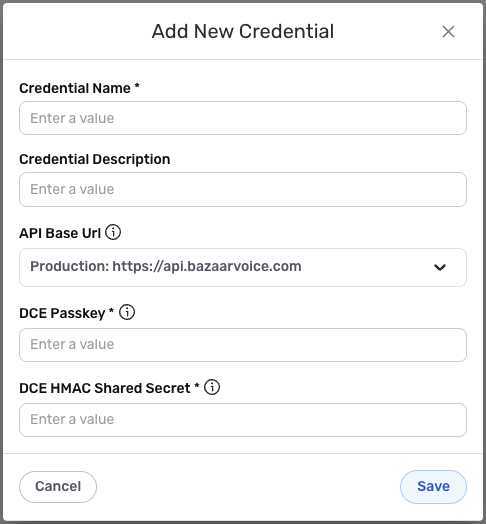
- To create a new Bazaarvoice credential, after selecting the data source/destination type, click the Add Credential tile to open the Add New Credential overlay.
New Credential Overlay – Bazaarvoice
Credential Name & Description
-
Enter a name for the credential in the Credential Name field and a short, meaningful description in the Credential Description field.
Resource descriptions are recommended but are not required. They should be used provide information about the resource purpose, data freshness, etc. that can help the owner and other users efficiently understand and utilize the resource.
Bazaarvoice DCE Configuration
-
Select the API base URL from the API Base Url dropdown menu. This determines which Bazaarvoice API environment you want to use:
- Production: https://api.bazaarvoice.com - Used when your application is complete. The data in production is consumer-generated content submitted by real end-users.
- Staging: https://stg.api.bazaarvoice.com - Used while developing your application. The data is not derived from real end users.
The API base URL determines which Bazaarvoice environment you're accessing. Use staging for development and testing, and production for live applications. The base URL is used to construct all API endpoint URLs for your requests.
-
Enter your Bazaarvoice DCE passkey in the DCE Passkey field. This should be the passkey obtained from your Bazaarvoice account. The passkey is used together with the shared secret to create HMAC signatures for API authentication.
-
Enter your Bazaarvoice DCE HMAC shared secret in the DCE HMAC Shared Secret field. This should be the shared secret obtained from your Bazaarvoice account. The shared secret is used together with the passkey to generate HMAC signatures for API requests.
The DCE passkey and HMAC shared secret are used to create HMAC signatures for Bazaarvoice API requests. The HMAC signature is automatically generated by Nexla using your credentials and request parameters. The signature is included in request headers (
X-Bazaarvoice-Passkey,X-Bazaarvoice-Signature,X-Bazaarvoice-Timestamp) for all API requests. Keep your credentials secure and do not share them publicly or commit them to version control systems. For detailed information about HMAC signature creation, see the Bazaarvoice DCE Creating Access Signature documentation.
Save the Credential
-
Once all of the relevant steps in the above sections have been completed, click the Save button at the bottom of the overlay to save the configured credential.
-
The newly added credential will now appear in a tile on the Authenticate screen during data source/destination creation and can be selected for use with a new data source or destination.