
AssemblyAI Data Source

AssemblyAI is a speech AI platform for high-accuracy transcription, real-time streaming, and audio intelligence. Follow the instructions below to create a new data flow that ingests data from an AssemblyAI source in Nexla.
assemblyai_api.png

AssemblyAI

Create a New Data Flow

  1. To create a new data flow, navigate to the Integrate section, and click the New Data Flow button. Then, select the desired flow type from the list, and click the Create button.

  2. Select the AssemblyAI connector tile from the list of available connectors. Then, select the credential that will be used to connect to the AssemblyAI account, and click Next; or, create a new AssemblyAI credential for use in this flow.

  3. In Nexla, AssemblyAI data sources can be created using pre-built endpoint templates, which expedite source setup for common AssemblyAI endpoints. Each template is designed specifically for the corresponding AssemblyAI endpoint, making source configuration easy and efficient.
    • To configure this source using a template, follow the instructions in Configure Using a Template.

    AssemblyAI sources can also be configured manually, allowing you to ingest data from AssemblyAI endpoints not included in the pre-built templates or apply further customizations to exactly suit your needs.
    • To configure this source manually, follow the instructions in Configure Manually.

Configure Using a Template

Nexla provides pre-built templates that can be used to rapidly configure data sources to ingest data from common AssemblyAI endpoints. Each template is designed specifically for the corresponding AssemblyAI endpoint, making data source setup easy and efficient.

Endpoint Settings

  • Select the endpoint from which this source will fetch data from the Endpoint pulldown menu. Available endpoint templates are listed in the expandable boxes below. Click on an endpoint to see more information about it and how to configure your data source for this endpoint.

    List Transcripts

    This endpoint returns a paginated list of transcripts on the account, optionally filtered by status, creation date, or transcript ID. Use it to sync the transcript catalog into a warehouse, build dashboards over transcription volume, or fan out into the Get Transcript endpoint for record-level enrichment.

    • All filter parameters are optional. Leave them blank to return transcripts using AssemblyAI's default ordering, or set specific values to narrow the result set.
    • Enter the maximum number of transcripts to return per request in the Limit field. The default is 10 and the API allows up to 200.
    • Restrict the result set to a specific lifecycle state by entering one of queued, processing, completed, or error in the Status field.
    • Enter a date in YYYY-MM-DD format in the Created On field to return only transcripts created on that day.
    • Enter a transcript ID in the Before ID field to return transcripts created before the specified transcript. This is the cursor used by AssemblyAI's pagination — Nexla advances this value automatically across iterations of a paginated source.
    • Set the Throttled Only field to true to return only transcripts that were throttled due to concurrency or rate limits. Leave blank to include all transcripts.

    This endpoint is paginated using the after_id cursor returned in each response. Nexla automatically follows the cursor until all matching transcripts have been retrieved. For complete parameter reference, see the List transcripts documentation.

    Transcribe Audio

    This endpoint submits an audio or video file for asynchronous transcription. Use it to programmatically kick off transcription jobs for media URLs upstream — for example, when a recording is uploaded to S3 or a webinar finishes — and to enable any of AssemblyAI's audio intelligence features (speaker labels, sentiment analysis, PII redaction, summarization, content safety, IAB categories, auto-chapters, and more).

    • Enter the publicly accessible URL of the audio or video file to transcribe in the Audio URL field. This is the only required parameter — AssemblyAI must be able to fetch the media from this URL. For private storage, use a signed/pre-signed URL.
    • Select the speech model in the Speech Model field. Common values are universal (highest accuracy, default), slam-1 (older slim model), and nano (lower cost, broader language support). Use Speech Models to provide a prioritized list when you want automatic fallback between models.
    • Set the Language Code field to a supported language code (for example, en, es, fr) when the source language is known. Alternatively, set Language Detection to true to let AssemblyAI detect the language automatically, and optionally restrict candidates with Language Codes and tune sensitivity with Language Confidence Threshold (0–1).
    • To bound the segment that is transcribed, set Audio Start From and/or Audio End At to the start and end offsets in milliseconds.
    • Enable audio intelligence features by setting the corresponding boolean field to true:

      • Speaker Labels — diarize speakers (mono audio). Pair with Speakers Expected when the speaker count is known, and Speaker Options for advanced behavior.
      • Multichannel — separate speakers using audio channels rather than diarization (use this for true stereo speaker tracks).
      • Auto Chapters — generate chapter titles and summaries.
      • Auto Highlights — surface key phrases and frequency counts.
      • Sentiment Analysis — score sentiment per sentence.
      • Entity Detection — return named entities (people, organizations, etc.).
      • IAB Categories — classify content against the IAB taxonomy.
      • Content Safety — flag sensitive content. Tune with Content Safety Confidence (a value between 25 and 100).
      • Summarization — generate a summary. Pair with Summary Type (e.g., bullets, paragraph, headline) and Summary Model (e.g., informative, conversational, catchy).
      • Speech Understanding — enable semantic speech understanding features.
    • Enable PII (personally identifiable information) handling with the redaction fields:

      • Set Redact PII to true to redact PII in the transcript text. Provide the entity classes to redact in Redact PII Policies (for example, person_name, email_address, phone_number) and the replacement strategy in Redact PII Substitution (for example, entity_type or hash).
      • Set Redact PII Audio to true to also redact PII from the source audio. The redacted audio file is then retrieved via the Get Redacted Audio endpoint. Tune output with Redact PII Audio Quality (e.g., mp3, wav) and Redact PII Audio Options.
      • Set Redact PII Return Unredacted to true to include both redacted and unredacted text in the response.
    • Provide transcription hints with Prompt (a context prompt for the model), Key Terms Prompt (a list of important terms), Custom Spelling (a JSON array of from/to mappings for domain-specific spellings), Custom Topics, Topics, and Domain.
    • Control text formatting using Punctuate (auto-punctuation), Format Text (numbers, dates, currencies), Disfluencies (keep filler words like uh/um), Filter Profanity, and Remove Audio Tags.
    • Tune model behavior with Temperature and Speech Threshold (minimum confidence for speech detection).
    • Subscribe to completion callbacks by entering an HTTPS URL in Webhook URL. AssemblyAI will POST the transcript ID and status to this URL when the job is complete. Use Webhook Auth Header Name and Webhook Auth Header Value to add a shared-secret header to the callback for verification.

    This endpoint queues a transcript and immediately returns the new transcript object with a status of queued. The actual transcript text is not yet available — use the Get Transcript endpoint (or a webhook) to retrieve the completed transcript once status transitions to completed. Full parameter reference is in the Transcribe audio documentation.

    Get Transcript

    This endpoint retrieves the full record for a single transcript by ID, including the transcript text, words with timestamps, and any audio intelligence outputs enabled at submission time. Use it to poll a queued transcript for completion or to enrich an existing dataset of transcript IDs.

    • Enter the transcript ID in the Transcript Id field. Transcript IDs can be obtained from the List Transcripts endpoint or from the response of Transcribe Audio.
    • The endpoint returns the full transcript object, including status (queued, processing, completed, or error), the transcript text, the per-word words array with start/end timestamps and confidence, and any enabled audio intelligence outputs (chapters, highlights, sentiment, entities, etc.).

    When polling a transcript that is still processing, AssemblyAI recommends waiting at least the duration of the audio file divided by 60 before the first poll. For complete schema reference, see the Get transcript documentation.

    Get Sentences in Transcript

    This endpoint returns the transcript broken into sentences, with per-sentence start and end timestamps and speaker labels. Use it to feed sentence-level analytics, build subtitle/caption layouts, or drive a downstream LLM with discrete utterances.

    • Enter the transcript ID in the Transcript Id field. The transcript must have reached completed status before sentences are available.

    Sentences are derived from punctuation, so this endpoint is most useful when Punctuate was enabled at submission time. For details, see the Get sentences documentation.

    Get Paragraphs in Transcript

    This endpoint returns the transcript broken into paragraphs with timestamps and speaker labels. Use it for long-form reading layouts, transcript display in a UI, or paragraph-level summarization pipelines.

    • Enter the transcript ID in the Transcript Id field. The transcript must have reached completed status before paragraphs are available.

    Get Redacted Audio

    This endpoint returns JSON metadata for the redacted audio file produced when Redact PII Audio was enabled at submission time. The response includes a status field and a redacted_audio_url pointing to the redacted audio file in AssemblyAI's CDN.

    • Enter the transcript ID in the Transcript Id field. The transcript must have been submitted with Redact PII Audio set to true; otherwise AssemblyAI returns no redacted audio.
    • The redacted audio URL returned by this endpoint is time-limited. Download or copy the file promptly if it must be retained.

    Use this endpoint as a downstream step after Transcribe Audio + Get Transcript when PII-safe audio is required for archival or onward distribution. For details, see the Get redacted audio documentation.

    Search Words in Transcript

    This endpoint searches a completed transcript for specific words or phrases and returns the matching occurrences with timestamps, confidence, and counts. Use it to surface keyword hits across long recordings or to build search-driven navigation over transcribed content.

    • Enter the transcript ID in the Transcript Id field. The transcript must be in completed status.
    • Enter the comma-separated terms to search for in the Words field (for example, nexla,assembly,transcribe). Each term is matched independently, and the response groups occurrences by term.

    Search is exact-token-based — partial matches and stems are not returned. Use lowercase terms; AssemblyAI normalizes case for matching. For details, see the Word search documentation.

    Create a Chat Completion

    This endpoint sends a chat completion request to AssemblyAI's LLM Gateway, which exposes a single OpenAI-compatible API surface over Anthropic, OpenAI, Google, and other LLM providers. Use it to summarize, answer questions over, or otherwise post-process transcripts from Get Transcript without integrating a separate LLM provider.

    • Enter the model identifier in the Model field. Use any model exposed by the LLM Gateway (for example, anthropic/claude-sonnet-4-5, openai/gpt-4o, or google/gemini-2.5-pro). Use Fallbacks and Fallback Config to provide a prioritized list of alternates if the primary model is unavailable.
    • Provide the conversation in Messages as a JSON array of {'{role, content}'} objects (system, user, assistant). Alternatively, use Prompt for a simple single-turn system prompt.
    • Bound the response with Max Tokens, and tune randomness with Temperature (lower is more deterministic; higher is more creative).
    • Set Stream to true to receive a Server-Sent Events stream of token chunks instead of a single completion. For batch ingestion in Nexla, leave this as false so the full response is materialized as a single record.
    • To enable function/tool calling, provide a JSON array of tool definitions in Tools and the routing strategy in Tool Choice (auto, none, or a specific tool object).
    • Use Response Format to constrain the response to a JSON schema or other structured format, and Post Processing Steps for any provider-level post-processing operations.

    The LLM Gateway is a relatively new AssemblyAI surface that replaces the older LeMUR API. For the most current model list and parameter reference, see the Chat completions documentation.

    Generate Temporary Streaming Token

    This endpoint mints a short-lived token that allows a client to connect directly to AssemblyAI's v3 Universal Streaming WebSocket (wss://streaming.assemblyai.com/v3/ws) without exposing the long-lived account API key. Use it from a server-side flow to provision tokens for browser, mobile, or edge clients that perform real-time transcription.

    • Enter the token lifetime (in seconds) in the Expires In Seconds field. This controls how long the issued token is valid for opening a new WebSocket connection.
    • Enter the maximum streaming session length (in seconds) in the Max Session Duration Seconds field. This caps the total duration of any session authenticated with the issued token.

    Use this endpoint when an upstream system is provisioning temporary credentials for downstream real-time clients. The token cannot be used against the REST API — it is exclusively for the v3 streaming WebSocket. For details, see the Universal-Streaming documentation.

    Generate Temporary Voice Agent Token

    This endpoint mints a short-lived token for AssemblyAI's Voice Agent API, which bundles STT, LLM reasoning, and TTS into a single WebSocket connection. Use it to provision client-side credentials for voice agents (browser, mobile, or telephony) without exposing the long-lived account API key.

    • Enter the token lifetime (in seconds) in the Expires In Seconds field. This controls how long the issued token is valid for opening a new Voice Agent session.
    • Enter the maximum session length (in seconds) in the Max Session Duration Seconds field. This caps the total duration of any Voice Agent session authenticated with the issued token.

    Voice Agent tokens are distinct from streaming tokens and cannot be used against the v3 streaming WebSocket or the REST API. For details, see the Voice Agent API documentation.

Endpoint Testing

Once the selected endpoint template has been configured, Nexla can retrieve a sample of the data that will be fetched according to the current settings. This allows users to verify that the source is configured correctly before saving.

  • To test the current endpoint configuration, click the Test button to the right of the endpoint selection menu. Sample data will be fetched & displayed in the Endpoint Test Result panel on the right.

  • If the sample data is not as expected, review the selected endpoint and associated settings, and make any necessary adjustments. Then, click the Test button again, and check the sample data to ensure that the correct information is displayed.

Configure Manually

AssemblyAI data sources can be manually configured to ingest data from any valid AssemblyAI API endpoint. Manual configuration provides maximum flexibility for accessing endpoints not covered by pre-built templates or when you need custom API configurations.

With manual configuration, you can also create more complex AssemblyAI sources, such as sources that chain calls together — for example, listing recently completed transcripts and then fetching the paragraphs for each — or sources that target the EU host at api.eu.assemblyai.com.

API Method

  1. To manually configure this source, select the Advanced tab at the top of the configuration screen.

  2. Select the API method that will be used for calls to the AssemblyAI API from the Method pulldown menu. Most AssemblyAI read endpoints use GET; submission endpoints use POST:

    • GET: For retrieving data from the API (list transcripts, get transcript, get sentences, get paragraphs, word search, get redacted audio, generate tokens).
    • POST: For submitting transcription jobs and chat completion requests.
    • DELETE: For removing transcripts (used by the destination configuration).

API Endpoint URL

  1. Enter the URL of the AssemblyAI API endpoint from which this source will fetch data in the Set API URL field. AssemblyAI uses the base https://api.assemblyai.com/ followed by the resource path. The most commonly used paths are:
    • v2/transcript — list and submit transcripts
    • v2/transcript/<transcript_id> — get a single transcript
    • v2/transcript/<transcript_id>/sentences and /paragraphs — get sentence/paragraph breakdowns
    • v2/transcript/<transcript_id>/word-search — word search within a transcript
    • v2/transcript/<transcript_id>/redacted-audio — fetch redacted audio metadata
    • chat/completions — LLM Gateway chat completions
    • v3/token and v1/token — streaming and Voice Agent tokens

For EU-hosted accounts, replace api.assemblyai.com with api.eu.assemblyai.com in the URL. Authentication is identical — the same Authorization header value works against both hosts.

Date/Time Macros (API URL)

Optional

Optionally, the API URL can be customized using macros—all macros added to the API URL will be converted into values when Nexla executes the API call. Macros are dynamic placeholders that allow you to create flexible API endpoints that adapt to different time periods. They are particularly useful for the created_on filter on the List Transcripts endpoint.

Macros are particularly useful for APIs that require date ranges or other dynamic values that change between data ingestion runs. For example, you can use {now-1} with a Day time unit to always fetch yesterday's transcripts.

  1. To add a macro, type { at the appropriate position in the API URL (within the Set API URL field), and select the desired macro from the dropdown list.

    • {now} – The current datetime

    • {now-1} – The datetime one time unit before the current datetime

    • {now+1} – The datetime one time unit after the current datetime

    • custom – Datetime macros can reference any number of time units before or after the current datetime—for example, enter (now-4) to indicate the datetime four time units before the current datetime

  2. Select the format that will be applied to datetime macros from the Date Format for Date/Time Macro pulldown menu. AssemblyAI expects YYYY-MM-DD for the created_on filter on List Transcripts.

  3. Select the datetime unit that will be used to perform mathematical operations in the included macro(s) from the Time Unit for Operations pulldown menu—for example, for the macro {now-1}, when Day is selected, {now-1} will be converted to the datetime one day before the current datetime.

Lookup-Based Macros (API URL)

Optional

Column values from existing lookups can also be included as macros in the API URL. Lookup-based macros allow you to reference data from previously configured data sources or lookups, enabling dynamic API endpoints that adapt based on existing data. For AssemblyAI, this is particularly useful when you have a Nexla dataset of transcript IDs and want to fetch sentences, paragraphs, redacted audio, or word-search results for each.

Lookup-based macros are useful when you need to create AssemblyAI URLs that reference specific transcript IDs from another data source — for example, fetching paragraphs for each transcript ID returned by a List Transcripts source.

  1. To include a lookup column value macro, select the relevant lookup from the Add Lookups to Supported Macros pulldown menu.

  2. Type { at the appropriate position in the API URL, and select the lookup column-based macro from the dropdown list. Lookup-based macros are automatically populated into the macro list when a lookup is selected in the Add Lookups to Supported Macros pulldown menu.

Path to Data

Optional

If only a subset of the data returned by an AssemblyAI endpoint is needed, you can designate the part(s) of the response that should be included in the Nexset(s) by specifying the path to the relevant data within the response.

The List Transcripts endpoint returns transcripts under a transcripts array, so the path to data is $.transcripts[*]. Single-object endpoints (such as GET /v2/transcript/<id> and the token endpoints) use $ to treat the entire response body as a single record. The Word Search response nests results under matches, so use $.matches[*] to fan out the matches as records.

Path to Data is essential when API responses have nested structures. Without specifying the correct path, Nexla might not be able to properly parse and organize your data into usable records.

  • To specify which data should be treated as relevant in responses from this source, enter the path to the relevant data in the Set Path to Data in Response field.

    • For responses in JSON format, enter the JSON path that points to the object or array that should be treated as relevant data. JSON paths use dot notation (for example, $.transcripts[*] to access every element of the transcripts array).
    Path to Data Example:

    For the AssemblyAI GET /v2/transcript endpoint, which returns a top-level transcripts array, enter $.transcripts[*] as the path to data. For GET /v2/transcript/{'{id}'}, which returns a single object, enter $.

Autogenerate Path Suggestions

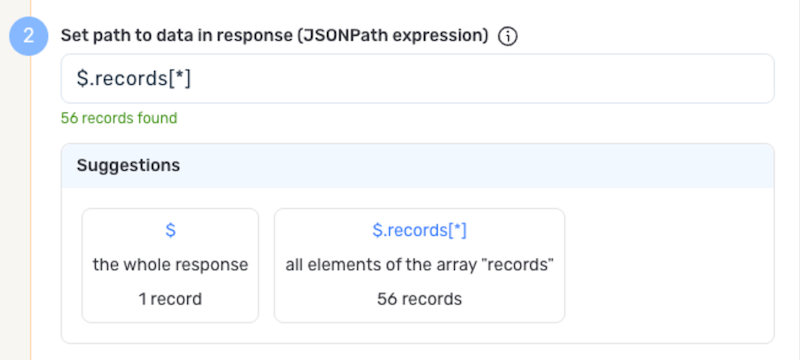
Nexla can also autogenerate data path suggestions based on the response from the API endpoint. These suggested paths can be used as-is or modified to exactly suit your needs.

  • To use this feature, click the Test button next to the Set API URL field to fetch a sample response from the API endpoint. Suggested data paths generated based on the content & format of the response will be displayed in the Suggestions box below the Set Path to Data in Response field.

  • Click on a suggestion to automatically populate the Set Path to Data in Response field with the corresponding path. The populated path can be modified directly within the field if further customization is needed.
    PathSuggestions.png

Metadata

If metadata is included in the response but is located outside of the defined path to relevant data, you can configure Nexla to include this data as common metadata in each record. This is useful when you want to preserve important contextual information that applies to all records but isn't part of the main data array.

For AssemblyAI's List Transcripts endpoint, the response also includes a page_details object with pagination metadata (limit, result_count, current_url, prev_url, next_url). Set the metadata path to $.page_details to attach this pagination context to each transcript record.

Metadata paths are particularly useful for preserving API response context like request IDs, pagination cursors, or summary statistics that apply to all records in the response.

  • To specify the location of metadata that should be included with each record, enter the path to the relevant metadata in the Path to Metadata in Response field.

    • For responses in JSON format, enter the JSON path to the object or array that contains the metadata.

Request Headers

Optional
  • If Nexla should include any additional request headers in API calls to this source, enter the headers & corresponding values as comma-separated pairs in the Request Headers field (for example, header1:value1,header2:value2). The most common addition is Content-Type:application/json for POST endpoints (chat completions, transcribe audio).

    You do not need to include any headers already present in the credentials. The Authorization header is added automatically based on your AssemblyAI credential.

Endpoint Testing

After configuring all settings for the selected endpoint, Nexla can retrieve a sample of the data that will be fetched according to the current configuration. This allows users to verify that the source is configured correctly before saving.

  • To test the current endpoint configuration, click the Test button to the right of the endpoint selection menu. Sample data will be fetched & displayed in the Endpoint Test Result panel on the right.

  • If the sample data is not as expected, review the selected endpoint and associated settings, and make any necessary adjustments. Then, click the Test button again, and check the sample data to ensure that the correct information is displayed.

Save & Activate the Source

  1. Once all of the relevant steps in the above sections have been completed, click the Create button in the upper right corner of the screen to save and create the new AssemblyAI data source. Nexla will now begin ingesting data from the configured endpoint and will organize any data that it finds into one or more Nexsets.