
AppFigures Data Source

AppFigures is an app analytics and intelligence platform for mobile app developers. Follow the instructions below to create a new data flow that ingests data from an AppFigures source in Nexla.
appfigures_api.png

AppFigures

Create a New Data Flow

  1. To create a new data flow, navigate to the Integrate section, and click the New Data Flow button. Then, select the desired flow type from the list, and click the Create button.

  2. Select the AppFigures connector tile from the list of available connectors. Then, select the credential that will be used to connect to the AppFigures instance, and click Next; or, create a new AppFigures credential for use in this flow.

  3. In Nexla, AppFigures data sources can be created using pre-built endpoint templates, which expedite source setup for common AppFigures endpoints. Each template is designed specifically for the corresponding AppFigures endpoint, making source configuration easy and efficient.
    • To configure this source using a template, follow the instructions in Configure Using a Template.

    AppFigures sources can also be configured manually, allowing you to ingest data from AppFigures endpoints not included in the pre-built templates or apply further customizations to exactly suit your needs.
    • To configure this source manually, follow the instructions in Configure Manually.

Configure Using a Template

Nexla provides pre-built templates that can be used to rapidly configure data sources to ingest data from common AppFigures endpoints. Each template is designed specifically for the corresponding AppFigures endpoint, making data source setup easy and efficient.

Endpoint Settings

  • Select the endpoint from which this source will fetch data from the Endpoint pulldown menu. Available endpoint templates are listed in the expandable boxes below. Click on an endpoint to see more information about it and how to configure your data source for this endpoint.

    Get Paid Keywords for an App

    This endpoint returns the paid Apple Search Ads keywords associated with a specific app. Use it to track which keywords competitors (or your own apps) are bidding on across storefronts.

    • Enter the AppFigures product ID of the app in the Product ID field. This field is required. Product IDs can be obtained from the List My Products or Search Products endpoints.
    • Optionally, enter a comma-separated list of two-letter country codes (for example, US,GB,DE) in the Countries field to limit results to specific storefronts. Use the List All Supported Countries endpoint for the full list of supported codes.
    • Optionally, enter the start date for the keyword data range (in YYYY-MM-DD format) in the Start Date field.

    Results are paginated automatically by Nexla (100 rows per page). For full request and response details, see the AppFigures Search Ads API documentation.

    List Apps that Pay for a Keyword

    This endpoint returns the list of apps currently bidding on a specific search keyword. Use it for competitive analysis — for example, to see which apps are paying to rank for a high-value query in a given storefront.

    • Enter the search keyword to investigate in the Keyword Term field.
    • Enter the two-letter country code (for example, US) in the Country field to scope the search to a single storefront.
    • Optionally, enter an AppFigures product ID in the Product ID field to restrict results to a single app.
    • Enter the storefront to search in the Storefront field — typically ios or android.

    Results are paginated automatically. For full details on Search Ads queries, see the AppFigures Search Ads documentation.

    Get Keyword Stats for an App

    This endpoint returns App Store Optimization (ASO) keyword performance statistics for one or more apps over a date range. Use it to monitor how your apps rank for tracked keywords and track changes over time.

    • Enter a comma-separated list of AppFigures product IDs in the Product IDs field. Product IDs can be obtained from the List My Products endpoint.
    • Optionally, enter a comma-separated list of country codes in the Countries field to filter results.
    • Enter the start and end dates of the reporting period (in YYYY-MM-DD format) in the Start Date and End Date fields.
    • Optionally, restrict results to a specific platform by entering iphone, ipad, or android in the Device Type field.
    • Enter the desired time bucket size in the Time Granularity field — daily, weekly, or monthly.

    For complete information on ASO endpoints and supported parameters, see the AppFigures ASO API documentation.

    Get Rank Trends

    This endpoint returns keyword ranking trends for apps over a specified date range, with grouping and filtering options. Use it to monitor how an app's rank for tracked keywords changes over time.

    • Enter the dimension to group results by in the Group By field — common values include country, product, and keyword.
    • Enter a comma-separated list of AppFigures product IDs in the Product IDs field.
    • Optionally, enter a comma-separated list of country codes in the Countries field.
    • Enter the start and end dates (in YYYY-MM-DD format) in the Start Date and End Date fields.
    • Optionally, enter the device type (iphone, ipad, or android) in the Device Type field.
    • Set the Normalize field to true to normalize ranking data for cross-keyword comparison, or leave blank for raw rank values.
    • Enter the time bucket size in the Time Granularity field — daily, weekly, or monthly.

    Results are paginated automatically. For complete details on rank trends and ASO endpoints, see the AppFigures ASO API documentation.

    Get Download and Revenue Estimates

    This endpoint returns estimated download and revenue figures for apps over a date range. Use it to benchmark performance against competitor apps for which you do not own the underlying store accounts.

    • Enter the start and end dates (in YYYY-MM-DD format) in the Start Date and End Date fields.
    • Enter the dimension to group results by in the Group By field — common values include country, product, and date.
    • Enter a comma-separated list of AppFigures product IDs in the Product IDs field.
    • Optionally, enter a comma-separated list of country codes in the Countries field.
    • Enter the desired response format in the Response Format field — typically json.

    For complete details on the reports endpoints and the data they return, see the AppFigures Reports API documentation.

    Get Payments

    This endpoint returns payment and financial data for your connected apps over a date range. Use it to reconcile actual payouts from app stores against expected revenue, or to feed accounting systems with store-paid amounts.

    • Enter the start and end dates (in YYYY-MM-DD format) in the Start Date and End Date fields.
    • Enter the dimension to group results by in the Group By field — common values include country, product, and date.
    • Enter a comma-separated list of AppFigures product IDs in the Product IDs field.
    • Optionally, enter a comma-separated list of country codes in the Countries field.
    • Enter the desired response format in the Response Format field — typically json.

    Get Ratings Totals

    This endpoint returns aggregated user ratings totals for apps over a date range. Use it to track average star rating, total review counts, and rating distribution trends across stores and countries.

    • Enter the dimension to group results by in the Group By field — common values include country, product, and date.
    • Enter the start and end dates (in YYYY-MM-DD format) in the Start Date and End Date fields.
    • Enter the time bucket size in the Time Granularity field — daily, weekly, or monthly.
    • Enter a comma-separated list of AppFigures product IDs in the Product IDs field.
    • Optionally, enter a comma-separated list of country codes in the Countries field.
    • Enter the desired response format in the Response Format field — typically json.

    Get Ad Spend Totals

    This endpoint returns aggregated advertising spend data across connected ad networks for your apps over a date range. Use it to evaluate the cost side of user-acquisition campaigns alongside revenue and downloads.

    • Enter the dimension to group results by in the Group By field — common values include country, product, network, and date.
    • Enter the start and end dates (in YYYY-MM-DD format) in the Start Date and End Date fields.
    • Enter a comma-separated list of AppFigures product IDs in the Product IDs field.
    • Optionally, enter a comma-separated list of country codes in the Countries field.
    • Optionally, enter a comma-separated list of ad networks in the Ad Networks field to limit the report to specific networks (for example, apple_search_ads,meta,google).
    • Enter the desired response format in the Response Format field — typically json.

    Get Subscriptions Totals

    This endpoint returns aggregated subscription revenue and event data for your apps over a date range, with optional inclusion of one-time in-app purchases. Use it to monitor MRR/ARR, churn, and trial conversions across stores.

    • Enter the start and end dates (in YYYY-MM-DD format) in the Start Date and End Date fields.
    • Enter the dimension to group results by in the Group By field — common values include country, product, and date.
    • Enter a comma-separated list of AppFigures product IDs in the Product IDs field.
    • Set the Include In-App Purchases field to true to include one-time IAPs alongside subscription events, or leave blank for subscription data only.
    • Optionally, enter a comma-separated list of country codes in the Countries field.
    • Enter the time bucket size in the Time Granularity field — daily, weekly, or monthly.
    • Enter the desired response format in the Response Format field — typically json.

    Get Usage Report Totals

    This endpoint returns aggregated usage and session data for apps across ad networks over a date range. Use it to combine impression, click, install, and session counts in a single report for cross-network attribution.

    • Enter the start and end dates (in YYYY-MM-DD format) in the Start Date and End Date fields.
    • Enter the dimension to group results by in the Group By field — common values include country, product, network, and date.
    • Enter a comma-separated list of AppFigures product IDs in the Product IDs field.
    • Optionally, enter a comma-separated list of country codes in the Countries field.
    • Optionally, enter a comma-separated list of ad networks in the Ad Networks field.
    • Enter the desired response format in the Response Format field — typically json.

    Get Revenue Totals

    This endpoint returns aggregated revenue data across all sources (sales, in-app purchases, subscriptions, and ads) for apps over a date range. Use it as a single source of truth for top-line app revenue across stores and countries.

    • Enter the start and end dates (in YYYY-MM-DD format) in the Start Date and End Date fields.
    • Enter the dimension to group results by in the Group By field — common values include country, product, and date.
    • Enter a comma-separated list of AppFigures product IDs in the Product IDs field.
    • Optionally, enter a comma-separated list of country codes in the Countries field.
    • Enter the desired response format in the Response Format field — typically json.

    Get Ratings

    This endpoint returns raw individual rating events for apps over a date range. Use it when you need the per-rating granularity that the Get Ratings Totals endpoint aggregates away — for example, to feed a sentiment dashboard or downstream review-management system.

    • Enter the start and end dates (in YYYY-MM-DD format) in the Start Date and End Date fields.
    • Enter the dimension to group results by in the Group By field, when needed.
    • Enter a comma-separated list of AppFigures product IDs in the Product IDs field.
    • Optionally, enter a comma-separated list of country codes in the Countries field.
    • Enter the desired response format in the Response Format field — typically json.

    List External Accounts

    This endpoint returns the list of external store and ad-network accounts connected to your AppFigures account. Use it to audit which connections are active or to drive downstream provisioning of new flows.

    • No additional configuration is required beyond selecting this endpoint template. The endpoint automatically returns all external accounts visible to the authorizing AppFigures user.

    For full details about external account properties and the connection lifecycle, see the AppFigures External Accounts reference.

    List Users

    This endpoint returns a paginated list of users in your AppFigures account. Use it for user-administration workflows — for example, syncing AppFigures users into an identity directory or building an internal access-review report.

    • No additional configuration is required beyond selecting this endpoint template. Results are paginated automatically by Nexla.

    For complete details about user properties and account-level permissions, see the AppFigures Users API reference.

    Get Sales Report

    This endpoint returns sales and download data aggregated by configurable dimensions with extensive filtering options. Use it as the primary feed for app-store sales analytics — daily revenue, downloads by product or country, paid versus free dataset breakdowns, and device-type splits.

    • Enter the start and end dates (in YYYY-MM-DD format) in the Start Date and End Date fields.
    • Enter the dimension to group results by in the Group By field — common values include country, product, and date.
    • Enter the time bucket size in the Time Granularity field — daily, weekly, or monthly.
    • Enter a comma-separated list of AppFigures product IDs in the Product IDs field.
    • Optionally, enter a comma-separated list of country codes in the Countries field.
    • Optionally, restrict the report to a specific dataset (for example, app, iap, or book) by entering the dataset name in the Dataset field.
    • Optionally, enter a comma-separated list of devices (iphone, ipad, android) in the Devices field.
    • Set the Include In-App Purchases field to true to include IAPs alongside outright app sales.
    • Enter the desired response format in the Response Format field — typically json.

    List Supported Store Categories

    This endpoint returns the list of app-store categories supported by AppFigures. Use it as a reference lookup to join category IDs to human-readable names in downstream warehouses.

    • No additional configuration is required beyond selecting this endpoint template.

    List All Supported Countries

    This endpoint returns the full list of countries supported by AppFigures for reporting and filtering. Use it as a reference lookup to validate country codes used elsewhere in your flows.

    • No additional configuration is required beyond selecting this endpoint template.

    List Countries Supported by Apple

    This endpoint returns the list of countries supported by the Apple App Store. Use it as a reference lookup specific to Apple App Store distribution and reporting.

    • No additional configuration is required beyond selecting this endpoint template.

    List Supported Languages for Review Translation

    This endpoint returns the list of languages that AppFigures can translate app reviews from. Use it as a reference lookup when configuring review-translation downstream pipelines.

    • No additional configuration is required beyond selecting this endpoint template.

    List Supported Currencies

    This endpoint returns the list of currencies supported by the AppFigures API. Use it to validate currency codes in sales and revenue reports or to join currency metadata downstream.

    • No additional configuration is required beyond selecting this endpoint template.

    List Supported Stores

    This endpoint returns the list of app stores supported by AppFigures (for example, Apple App Store, Google Play, Amazon Appstore). Use it as a reference lookup when joining store IDs to store names in downstream models.

    • No additional configuration is required beyond selecting this endpoint template.

    List Supported SDKs

    This endpoint returns the list of SDKs that AppFigures can detect inside apps. Use it as a reference lookup to enrich SDK-detection outputs with vendor metadata.

    • No additional configuration is required beyond selecting this endpoint template.

    Get Reviews

    This endpoint returns app reviews with extensive filtering, search, and translation options. Use it to feed review analytics, sentiment scoring, or response workflows downstream.

    • Enter a comma-separated list of AppFigures product IDs in the Product IDs field.
    • Optionally, enter a comma-separated list of country codes in the Countries field.
    • Optionally, enter a free-text query in the Search Query field to filter reviews by content.
    • Optionally, enter a comma-separated list of star ratings (for example, 1,2) in the Stars field to filter by rating.
    • Enter the start and end dates (in YYYY-MM-DD format) in the Start Date and End Date fields to scope the review date range.
    • Optionally, enter a comma-separated list of language codes (for example, en,es) in the Languages field to filter by review language.
    • Optionally, enter a target language code in the Translate To field to have AppFigures translate review bodies into the chosen language.
    • Enter the sort order in the Sort field — for example, date or stars.

    Results are paginated automatically by Nexla. Review translation may consume additional AppFigures API credits — see the AppFigures API credit usage reference.

    Get Ads Totals

    This endpoint returns aggregated paid advertising totals (impressions, clicks, installs, revenue) for your apps over a date range. Use it to evaluate paid acquisition effectiveness alongside organic data.

    • Enter the dimension to group results by in the Group By field — common values include country, product, network, and date.
    • Enter the start and end dates (in YYYY-MM-DD format) in the Start Date and End Date fields.
    • Enter a comma-separated list of AppFigures product IDs in the Product IDs field.
    • Optionally, enter a comma-separated list of country codes in the Countries field.
    • Optionally, enter a comma-separated list of ad networks in the Ad Networks field.
    • Enter the desired response format in the Response Format field — typically json.

    Generate Ranks Report

    This endpoint generates a chart-rank report for your apps across categories and storefronts over a date range. Use it to monitor category-leaderboard positioning and detect rank-movement events.

    • Enter a comma-separated list of AppFigures product IDs in the Product IDs field.
    • Optionally, enter a comma-separated list of country codes in the Countries field.
    • Enter the start and end dates (in YYYY-MM-DD format) in the Start Date and End Date fields.
    • Optionally, restrict results to a category by entering the category ID in the Category field. Category IDs can be obtained from the List Supported Store Categories endpoint.
    • Optionally, restrict results to specific subcategories by entering subcategory IDs in the Subcategory field.
    • Enter the chart type to retrieve in the Chart Type field — typically free, paid, or grossing.
    • Enter the time bucket size in the Granularity field — daily, weekly, or monthly.
    • Enter the dimension to group results by in the Group By field.

    Rank reports can be data-intensive and may consume additional API credits when run over wide date ranges or many categories. For credit costs, see the AppFigures API credit usage reference.

    Search Products

    This endpoint searches across all public app products available in AppFigures by name, vendor, or other attributes. Use it to look up competitor or partner app product IDs to feed into other report endpoints.

    • Enter the search query term in the Search Term field.
    • Optionally, filter by app store with the Store field — typically apple, google_play, or amazon_appstore.
    • Optionally, filter by app type with the Type field — for example, ios, android, mac, or book.
    • Optionally, enter a vendor or developer name in the Vendor field to scope the search.

    Results are paginated automatically. Use the returned id field as the product ID for other AppFigures endpoints.

    List My Products

    This endpoint returns the list of products (apps, IAPs, books) connected to your AppFigures account. Use it to discover the product IDs of your own apps to drive other report endpoints.

    • Optionally, set the Include Inactive field to true to include products that are no longer active in your account.
    • Optionally, set the Hide Section field to filter out a specific section (for example, archived apps) from the results.

    Results are paginated automatically. The returned id field is the product ID required by most of the reporting endpoints above.

Endpoint Testing

Once the selected endpoint template has been configured, Nexla can retrieve a sample of the data that will be fetched according to the current settings. This allows users to verify that the source is configured correctly before saving.

  • To test the current endpoint configuration, click the Test button to the right of the endpoint selection menu. Sample data will be fetched & displayed in the Endpoint Test Result panel on the right.

  • If the sample data is not as expected, review the selected endpoint and associated settings, and make any necessary adjustments. Then, click the Test button again, and check the sample data to ensure that the correct information is displayed.

Configure Manually

AppFigures data sources can be manually configured to ingest data from any valid AppFigures API endpoint under https://api.appfigures.com/v2/. Manual configuration provides maximum flexibility for accessing endpoints that are not covered by the pre-built templates above — for example, the public Partner API endpoints or newly released report dimensions.

With manual configuration, you can also create more complex AppFigures sources, such as sources that chain multiple API calls or sources that use custom request parameters.

API Method

  1. To manually configure this source, select the Advanced tab at the top of the configuration screen.

  2. Select the API method that will be used for calls to the AppFigures API from the Method pulldown menu. Nearly all AppFigures source endpoints use GET:

    • GET: For retrieving data from the API (used by every AppFigures reporting and reference endpoint)
    • POST: For endpoints that create resources (rarely needed for a source)

API Endpoint URL

  1. Enter the URL of the AppFigures API endpoint from which this source will fetch data in the Set API URL field. AppFigures API URLs are always prefixed with https://api.appfigures.com/v2/ and only accept requests over HTTPS. Include any required path or query parameters directly in the URL — for example, https://api.appfigures.com/v2/reports/sales?start_date=2026-01-01&end_date=2026-01-31&group_by=product.

Requests over plain HTTP will be rejected by AppFigures. Confirm that the API URL begins with https://. You can test the endpoint using the Test button after configuring the URL.

Date/Time Macros (API URL)

Optional

Optionally, the API URL can be customized using macros—all macros added to the API URL will be converted into values when Nexla executes the API call. Macros are particularly useful for AppFigures reporting endpoints (sales, payments, ads, subscriptions, etc.) that require start_date and end_date query parameters — replacing hard-coded dates with {now} / {now-1} style macros enables incremental ingestion.

AppFigures expects dates in the sortable YYYY-MM-DD format. Set the Date Format for Date/Time Macro value accordingly so that macro values render as 2026-05-15 rather than another date layout.

  1. To add a macro, type { at the appropriate position in the API URL (within the Set API URL field), and select the desired macro from the dropdown list.

    • {now} – The current datetime

    • {now-1} – The datetime one time unit before the current datetime

    • {now+1} – The datetime one time unit after the current datetime

    • custom – Datetime macros can reference any number of time units before or after the current datetime—for example, enter (now-4) to indicate the datetime four time units before the current datetime

  2. Select the format that will be applied to datetime macros from the Date Format for Date/Time Macro pulldown menu. For AppFigures, select the YYYY-MM-DD option to match the format the API expects.

  3. Select the datetime unit that will be used to perform mathematical operations in the included macro(s) from the Time Unit for Operations pulldown menu—for example, for the macro {now-1} with Day selected, {now-1} will resolve to the date one day before the current datetime.

Lookup-Based Macros (API URL)

Optional

Column values from existing lookups can also be included as macros in the API URL. For AppFigures, lookup-based macros are useful when one source feeds another — for example, when a list of product IDs returned by List My Products is used to drive per-product Get Sales Report calls.

Lookup-based macros are particularly useful when you need to create API endpoints that reference specific IDs, values, or parameters from other data sources in your Nexla environment.

  1. To include a lookup column value macro, select the relevant lookup from the Add Lookups to Supported Macros pulldown menu.

  2. Type { at the appropriate position in the API URL, and select the lookup column-based macro from the dropdown list. Lookup-based macros are automatically populated into the macro list when a lookup is selected in the Add Lookups to Supported Macros pulldown menu.

Path to Data

Optional

If only a subset of the data returned by the AppFigures API is needed, you can designate the part(s) of the response that should be included in the Nexset(s) produced from this source by specifying the path to the relevant data within the response.

AppFigures response shapes vary by endpoint:

  • List/search endpoints (for example, Search Products, Get Reviews) return an object with a results array — use $.results[*] to treat each element as a record.

  • Most reporting endpoints (for example, Get Sales Report, Get Subscriptions Totals) return an object keyed by group dimension (date, country, or product) — use $.* to flatten the keyed object into records.

  • Reference-data endpoints (for example, List Supported Currencies) return a top-level array — use $[*].

Path to Data is essential when API responses have nested structures. Without specifying the correct path, Nexla might not be able to properly parse and organize your data into usable records.

  • To specify which data should be treated as relevant in responses from this source, enter the path to the relevant data in the Set Path to Data in Response field.

    • For responses in JSON format (which AppFigures always returns), enter the JSON path that points to the object or array that should be treated as relevant data. JSON paths use dot notation (for example, $.results[*]).
    Path to Data Example:

    For an AppFigures /v2/products/search response that contains a top-level results array, set the path to $.results[*]. For a /v2/reports/sales?group_by=date response keyed by date, set the path to $.*.

Autogenerate Path Suggestions

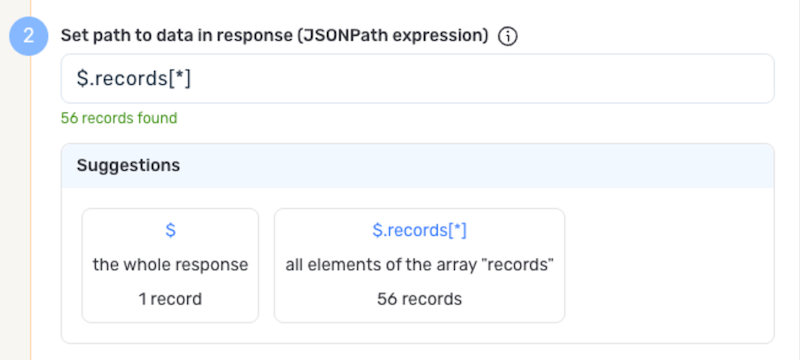
Nexla can also autogenerate data path suggestions based on the response from the API endpoint. These suggested paths can be used as-is or modified to exactly suit your needs.

  • To use this feature, click the Test button next to the Set API URL field to fetch a sample response from the API endpoint. Suggested data paths generated based on the content & format of the response will be displayed in the Suggestions box below the Set Path to Data in Response field.

  • Click on a suggestion to automatically populate the Set Path to Data in Response field with the corresponding path. The populated path can be modified directly within the field if further customization is needed.
    PathSuggestions.png

Metadata

If metadata is included in the response but is located outside of the defined path to relevant data, you can configure Nexla to include this data as common metadata in each record. AppFigures list endpoints frequently return pagination metadata (pages, total) alongside the results array — preserving these into each record can simplify downstream pagination auditing.

Metadata paths are particularly useful for preserving API response context like total counts or pagination information that apply to all records in the response.

  • To specify the location of metadata that should be included with each record, enter the path to the relevant metadata in the Path to Metadata in Response field.

    • For AppFigures responses in JSON format, enter the JSON path to the object that contains the metadata (for example, $.pages for paginated list responses).

Request Headers

Optional
  • If Nexla should include any additional request headers in API calls to this source, enter the headers & corresponding values as comma-separated pairs in the Request Headers field (for example, header1:value1,header2:value2). Most AppFigures endpoints do not require additional headers — the OAuth 2.0 Authorization: Bearer header is added automatically based on the credential.

    You do not need to include any headers already present in the credentials. The Authorization header for OAuth 2.0 is added automatically based on your AppFigures credential.

Endpoint Testing

After configuring all settings for the selected endpoint, Nexla can retrieve a sample of the data that will be fetched according to the current configuration. This allows users to verify that the source is configured correctly before saving.

  • To test the current endpoint configuration, click the Test button to the right of the endpoint selection menu. Sample data will be fetched & displayed in the Endpoint Test Result panel on the right.

  • If the sample data is not as expected, review the selected endpoint and associated settings, and make any necessary adjustments. Then, click the Test button again, and check the sample data to ensure that the correct information is displayed.

Save & Activate the Source

  1. Once all of the relevant steps in the above sections have been completed, click the Create button in the upper right corner of the screen to save and create the new AppFigures data source. Nexla will now begin ingesting data from the configured endpoint and will organize any data that it finds into one or more Nexsets.