Authorization

Wufoo Online Forms
Prerequisites
Before creating a Wufoo credential, you need to obtain your API Key and Base URL (subdomain) from your Wufoo account. Wufoo uses Basic Authentication for all API requests, with the API Key used as the username and a placeholder value used as the password.
To obtain your Wufoo credentials, follow these steps:
-
Sign in to your Wufoo account using your administrator credentials.
-
Navigate to your Wufoo account settings or API configuration in your Wufoo dashboard.
-
To obtain your API Key, navigate to Account Settings or API Settings in your Wufoo dashboard. Look for the API Key or Personal API Key section.
-
If you don't have an API key yet, click Generate API Key or Create API Key to create a new API key.
-
After the API key is created, copy the API Key value immediately, as it may not be accessible again after you navigate away from the page.
-
To obtain your Base URL, identify your Wufoo subdomain. Your Wufoo account URL typically follows the format
https://{subdomain}.wufoo.com. The subdomain portion (e.g.,yourcompany) is what you need for the Base URL. The Base URL should be entered as{subdomain}.wufoo.com(withouthttps://at the beginning). -
Store both credentials securely, as you will need them to configure your Nexla credential. The API Key is sensitive information and should be kept confidential.
The API Key is used as the username in Basic Authentication for all API requests to the Wufoo API. The Base URL is used to construct the API endpoint URLs. If your API key is compromised, you should immediately regenerate it in your Wufoo account settings. For detailed information about Wufoo API authentication, see the Wufoo API documentation.
Create a Wufoo Credential
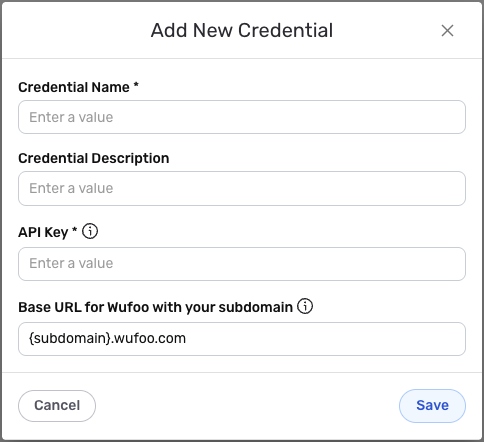
- To create a new Wufoo credential, after selecting the data source/destination type, click the Add Credential tile to open the Add New Credential overlay.
New Credential Overlay – Wufoo Online Forms
Credential Name & Description
-
Enter a name for the credential in the Credential Name field and a short, meaningful description in the Credential Description field.
Resource descriptions are recommended but are not required. They should be used provide information about the resource purpose, data freshness, etc. that can help the owner and other users efficiently understand and utilize the resource.
Basic Authentication
Wufoo uses Basic Authentication for all API requests. The API Key is used as the username, and a placeholder value is used as the password.
-
Enter your API Key in the API Key field. This is your personal API Key from your Wufoo account. The API Key is used as the username in Basic Authentication for all API requests to the Wufoo API.
-
The Password part for Basic auth field is automatically set to
xas a placeholder value. This field is hidden and does not require configuration. Wufoo API uses the API Key as the username and accepts any value for the password in Basic Authentication. -
Enter your Base URL for Wufoo with your subdomain in the Base URL for Wufoo with your subdomain field. This should be your Wufoo subdomain in the format
{subdomain}.wufoo.com(withouthttps://at the beginning). For example, if your Wufoo URL ishttps://yourcompany.wufoo.com, you would enteryourcompany.wufoo.com. The Base URL is used to construct the API endpoint URLs. The default value is{subdomain}.wufoo.com.Your Wufoo credentials (API Key, Base URL) can be found in your Wufoo account settings. The API Key is your personal API Key from your Wufoo account, which is used as the username in Basic Authentication. The Base URL should be your Wufoo subdomain in the format
{subdomain}.wufoo.com(withouthttps://at the beginning).If your API key is compromised, you should immediately regenerate it in your Wufoo account settings. The API key provides access to your Wufoo account data and should be treated as sensitive information. Keep your API key secure and do not share it publicly.
For detailed information about Wufoo API authentication, see the Wufoo API documentation.
Save the Credential
-
Once all of the relevant steps in the above sections have been completed, click the Save button at the bottom of the overlay to save the configured credential.
-
The newly added credential will now appear in a tile on the Authenticate screen during data source/destination creation and can be selected for use with a new data source or destination.