The TravelPerk connector enables you to ingest corporate travel data — including trips, bookings, invoices, users, cost centers, travel policies, and safety guidelines — directly into Nexla data flows. This connector is particularly useful for finance reconciliation pipelines, HR-driven provisioning workflows, travel spend analytics, and duty-of-care reporting. Follow the instructions below to create a new data flow that ingests data from a TravelPerk source in Nexla.
Create a New Data Flow
-
To create a new data flow, navigate to the Integrate section, and click the New Data Flow button. Then, select the desired flow type from the list, and click the Create button.
-
Select the TravelPerk connector tile from the list of available connectors. Then, select the credential that will be used to connect to the TravelPerk instance, and click Next; or, create a new TravelPerk credential for use in this flow.
-
In Nexla, TravelPerk data sources can be created using pre-built endpoint templates, which expedite source setup for common TravelPerk endpoints. Each template is designed specifically for the corresponding TravelPerk endpoint, making source configuration easy and efficient.
• To configure this source using a template, follow the instructions in Configure Using a Template.
TravelPerk sources can also be configured manually, allowing you to ingest data from TravelPerk endpoints not included in the pre-built templates or apply further customizations to exactly suit your needs.
• To configure this source manually, follow the instructions in Configure Manually.
Nexla provides pre-built templates that can be used to rapidly configure data sources to ingest data from common TravelPerk endpoints. Each template is designed specifically for the corresponding TravelPerk endpoint, making data source setup easy and efficient.
Endpoint Settings
- Select the endpoint from which this source will fetch data from the Endpoint pulldown menu. Available endpoint templates are listed in the expandable boxes below. Click on an endpoint to see more information about it and how to configure your data source for this endpoint.
List Invoices
Fetches all company invoices from the TravelPerk Expenses API, including issuing date, amount, VAT breakdown, currency, payment status, and line-level cost details. Use this endpoint to sync invoice data with your ERP, finance system, or GL coding pipeline. Results are paginated with a configurable page size up to 200 records.
List Invoice Lines
Fetches the line-item cost breakdown for all invoices. This endpoint uses a two-step chained call: first it retrieves all invoices, then for each invoice it fetches the individual line items. Use this endpoint for detailed GL coding, ERP mapping, and per-category spend analysis where you need to see how each invoice is broken down by travel segment, tax category, or cost center.
- No additional configuration parameters are required for this endpoint. The endpoint automatically retrieves all invoices and then fetches their line items in a sequential chained call.
- Each record returned represents a single invoice line item and includes the parent invoice serial number, allowing you to join line items back to invoice-level data.
Because this endpoint performs a chained two-step call (invoices → line items), ingestion time is proportional to the total number of invoices in your account. For large invoice volumes, consider using the List Invoices endpoint first with a date filter to narrow scope before using this endpoint. TravelPerk API reference: developers.travelperk.com/reference/listinvoicelines.
Get Invoice
Retrieves full details for a single invoice identified by its serial number, including all line items, VAT amounts, and payment status. Use this endpoint when you need to fetch a specific invoice for audit purposes, document archival, or targeted reconciliation.
- In the Serial Number field, enter the invoice serial number to retrieve. Invoice serial numbers can be obtained from the List Invoices endpoint. This field is required.
Get Invoice PDF
Downloads a single invoice as a PDF document by serial number. Use this endpoint for document archival workflows, audit trail requirements, or automated attachment pipelines that store invoice PDFs alongside financial records.
- In the Serial Number field, enter the invoice serial number to download as a PDF. Invoice serial numbers can be obtained from the List Invoices endpoint. This field is required.
List Invoices - VAT & Tax Data
Fetches invoices filtered by billing country with VAT amounts, designed for automated tax reclaim workflows and financial AI pipelines. Use this endpoint to extract VAT-eligible invoice data segmented by country for integration with tax compliance and reclaim tools.
- In the Issuing Date From field, enter the start date for VAT data extraction in
YYYY-MM-DD format. The default value is {now-365} (365 days ago), which is a common window for annual tax reclaim cycles. - In the Billing Country field, optionally enter an ISO 3166-1 alpha-2 country code (for example,
GB, DE, or ES) to filter invoices to a specific country. Leave blank to retrieve invoices across all billing countries.
List Invoice Profiles
Retrieves all invoice profiles configured in TravelPerk. Invoice profiles represent distinct billing entities within your organization (for example, separate legal entities or subsidiaries) and are used to filter invoices by billing entity and map them to the correct GL accounts in ERP integrations.
- No additional configuration parameters are required. This endpoint automatically retrieves all invoice profiles in your TravelPerk account.
List Trips
Fetches all company trips with traveler details, destination, travel dates, booking status, total cost, and CO2 emissions data. Use this endpoint for travel spend analytics, carbon footprint reporting, finance dashboards, and HR integrations that need a complete view of corporate travel activity.
Get Trip
Retrieves the full details of a single trip by ID, including all booking segments (flights, hotels, trains, car rentals), costs, approval chain, and CO2 emissions data. Use this endpoint when you need comprehensive details for a specific trip for reporting, audit, or reconciliation purposes.
- In the Trip ID field, enter the unique identifier of the trip to retrieve. Trip IDs can be obtained from the List Trips endpoint. This field is required.
List Trips - AI Signals
Fetches trips enriched with policy violation flags, CO2 emissions, booking lead times, and cost fields optimized for machine learning and spend forecasting models. Use this endpoint to build training datasets for compliance classification models, cost prediction models, or carbon reduction AI pipelines.
- In the Out-of-Policy Only field, set to
true to return only trips that violated travel policy. This is a key training signal for compliance ML classifiers. The default is false, which returns all trips regardless of policy compliance. - In the Start Date field, enter the earliest trip date for your model training window in
YYYY-MM-DD format. The default is {now-365} (365 days ago), which provides a full year of historical data — a common window for model training.
List Bookings
Fetches all bookings across all travel categories — flights, hotels, trains, and car rentals — with segment details, booking status, and traveler information. Use this endpoint for operational reporting, booking volume analysis, supplier spend categorization, and integration with travel management analytics tools.
List Bookings - Lead Time Analysis
Fetches all bookings with both booking date and travel date fields, enabling lead-time delta calculation. Lead time — the number of days between when a booking was made and when travel occurs — is a key cost driver in corporate travel: last-minute bookings typically cost significantly more than advance bookings. Use this endpoint to power cost optimization dashboards and AI-driven policy recommendations.
- In the Booking Date From field, enter the start of the historical analysis window in
YYYY-MM-DD format. The default is {now-365} (365 days ago), which provides a full year of lead-time data — sufficient for statistical analysis and model training.
List Users
Fetches all company travelers with their profile information, role, cost center assignment, manager, travel policy assignment, and active status. Use this endpoint for HR system synchronization, user directory exports, access audits, and as a reference data source for joining with trip and booking data.
- In the Page Size field, enter the number of users to return per page. The maximum is
200, which is also the default. - In the Active Users Only field, set to
true (default) to return only active users. Set to false to return all users including deactivated accounts — useful for full directory sync or offboarding audits.
This endpoint uses the TravelPerk REST API v2. For IdP-driven provisioning and SCIM-compatible pagination, see the List Users (SCIM Paginated) endpoint. TravelPerk API reference: developers.travelperk.com/reference/listusers.
List Users - Enriched Profiles
Fetches active travelers enriched with loyalty program IDs, travel preferences, frequent routes, and cost center assignments. Use this endpoint for traveler personalization engines, segmentation models, and AI-driven recommendation systems that need rich user profile data.
- No additional configuration parameters are required. This endpoint automatically retrieves all active users with their full profile data including loyalty program information and travel preferences.
Get User
Retrieves the full profile of a single user by ID via the SCIM 2.0 endpoint, including role, travel preferences, loyalty program IDs, and travel policy assignment. Use this endpoint for targeted user lookups, identity verification, or detailed profile retrieval in IdP-driven provisioning workflows.
- In the User ID field, enter the UUID of the user to retrieve. User UUIDs can be obtained from the List Users endpoint. This field is required.
List Users (SCIM Paginated)
Lists all users via the SCIM 2.0 endpoint using startIndex and count pagination. This endpoint is designed for full user directory synchronization with Identity Provider (IdP) systems such as Okta, Azure Active Directory, or Microsoft Entra ID.
- In the Page Size field, enter the number of users to return per SCIM page (the
count parameter). The default is 100. Unlike the REST API v2 Users endpoint, the SCIM endpoint uses 1-based pagination starting at startIndex=1.
SCIM access requires the TravelPerk Premium plan. This endpoint is best used for IdP-to-TravelPerk directory sync. For simpler user listing without SCIM requirements, use the List Users endpoint instead. TravelPerk API reference: developers.travelperk.com/reference/listusersscim.
Filter Users by External ID
Retrieves a user by their external ID via a SCIM filter query. Use this endpoint for IdP-driven user lookup and cross-system identity matching, where you need to find a TravelPerk user based on an identifier from an external system such as Okta, Azure AD, or an HR platform.
- In the External ID field, enter the external identifier to search for. This is typically the user ID from your IdP or HR system (for example, an Okta user ID or Workday employee ID). This field is required.
List Travel Policies
Fetches all configured travel policies in your TravelPerk account, including booking class rules, hotel star rating limits, approval thresholds, and out-of-policy flags. Use this endpoint to audit policy configurations, sync policy data with compliance systems, or provide policy context for travel analytics dashboards.
- No additional configuration parameters are required. This endpoint automatically retrieves all travel policies in your account.
List Cost Centers
Fetches all cost centers configured in TravelPerk for GL coding, departmental spend allocation, and ERP integration. Cost centers in TravelPerk represent the organizational units used to categorize travel spend — they map directly to chart-of-accounts entries in financial systems.
- No additional configuration parameters are required. This endpoint automatically retrieves all cost centers in your account.
Get Cost Center
Retrieves details for a specific cost center by ID, including its name and the list of users assigned to it. Use this endpoint for targeted cost center lookups, user-to-cost-center mapping verification, or GL account validation workflows.
- In the Cost Center ID field, enter the unique identifier of the cost center to retrieve. Cost center IDs can be obtained from the List Cost Centers endpoint. This field is required.
List Groups
Fetches all user groups in TravelPerk, which are used for travel policy assignment, bulk user operations, and organizational hierarchy management. Use this endpoint to sync group memberships with your HR system or to audit group configurations in TravelPerk.
- No additional configuration parameters are required. This endpoint automatically retrieves all groups in your account.
List Expense Reports
Fetches submitted expense reports for finance reconciliation, ERP export, and automated GL entry workflows. Expense reports in TravelPerk aggregate out-of-pocket expenses submitted by travelers alongside the automatically tracked booking costs.
- In the Page Size field, enter the number of expense reports per page. The maximum is
200, which is also the default. - In the Submitted Date From field, enter the earliest submission date to include in
YYYY-MM-DD format. The default is {now-90} (90 days ago). Adjust this window to match your expense reporting cycle.
List Suppliers
Retrieves all travel suppliers in your TravelPerk account, including airlines, hotel chains, and rail operators. Use this endpoint to build reference data tables for spend categorization, supplier performance analysis, or preferred vendor reporting.
- No additional configuration parameters are required. This endpoint automatically retrieves all suppliers in your account.
List Webhooks
Fetches all active webhook subscriptions configured in your TravelPerk account. Use this endpoint to audit your event-driven integrations, verify webhook configurations, and ensure that all required event subscriptions are in place before going live.
- No additional configuration parameters are required. This endpoint automatically retrieves all webhook subscriptions in your account.
Get Webhook
Retrieves the details of a specific webhook subscription by ID, including the target URL, subscribed event types, and current status. Use this endpoint to verify the configuration of a specific webhook subscription as part of integration testing or monitoring.
- In the Webhook ID field, enter the unique identifier of the webhook to retrieve. Webhook IDs can be obtained from the List Webhooks endpoint. This field is required.
List Webhook Event Types
Retrieves all available webhook event types that can be subscribed to in TravelPerk. Use this endpoint to discover the full list of subscribable events before creating or updating webhook subscriptions — ensuring your integration subscribes to all relevant event types.
- No additional configuration parameters are required. This endpoint returns the complete catalog of event types supported by TravelPerk webhooks.
Get Travel Safety Guidelines
Retrieves travel safety guidelines for a specific country or region from TravelPerk's TravelSafe API. Use this endpoint for duty-of-care dashboards, AI risk scoring models, or pre-trip safety briefing workflows that need current safety information by location.
Get Travel Restrictions
Retrieves travel restrictions between an origin and destination, including entry requirements, quarantine rules, and testing requirements. Use this endpoint for real-time travel eligibility checks, duty-of-care workflows, or pre-trip automation that needs to verify whether travel between two locations is currently possible or restricted.
- In the Origin Code field, enter the ISO country or region code of the travel origin (for example,
US or GB). This field is required. In the Origin Type field, select whether the origin is a Country or a Region. This field is required.
- In the Destination Code field, enter the ISO country or region code of the travel destination. This field is required.
In the Destination Type field, select whether the destination is a Country or a Region. This field is required.
- In the Travel Date field, enter the planned travel date in
YYYY-MM-DD format. The default is {now} (today). Specify a future date to check restrictions for a planned trip. - In the Language field, enter a BCP 47 language code for the response language. The default is
en.
Get Airline Safety Measures
Retrieves health and safety measures implemented by a specific airline, identified by its IATA airline code. Use this endpoint for duty-of-care reporting, traveler safety briefings, or risk assessment workflows that need airline-specific safety information.
- In the IATA Airline Code field, enter the two-letter IATA code for the airline (for example,
BA for British Airways, LH for Lufthansa, AA for American Airlines). This field is required. - In the Language field, enter a BCP 47 language code for the response language. The default is
en.
Get API Usage
Retrieves API call counts and usage statistics for your TravelPerk integration. Use this endpoint for rate limit monitoring, integration health checks, and API consumption reporting to ensure your integration stays within TravelPerk's API usage limits.
- No additional configuration parameters are required. This endpoint automatically returns the current API usage statistics for your account.
TravelPerk enforces API rate limits and returns HTTP 429 when limits are exceeded. Use this endpoint proactively to monitor consumption and avoid disruptions to dependent integrations. TravelPerk API reference: developers.travelperk.com/reference/getapiusage.
Endpoint Testing
Once the selected endpoint template has been configured, Nexla can retrieve a sample of the data that will be fetched according to the current settings. This allows users to verify that the source is configured correctly before saving.
-
To test the current endpoint configuration, click the Test button to the right of the endpoint selection menu. Sample data will be fetched & displayed in the Endpoint Test Result panel on the right.
-
If the sample data is not as expected, review the selected endpoint and associated settings, and make any necessary adjustments. Then, click the Test button again, and check the sample data to ensure that the correct information is displayed.
TravelPerk data sources can be manually configured to ingest data from any valid TravelPerk API endpoint. Manual configuration provides maximum flexibility for accessing endpoints not covered by pre-built templates or when you need custom API configurations.
With manual configuration, you can also create more complex TravelPerk sources, such as sources that use chained API calls to fetch data from multiple endpoints or sources that require custom request parameters.
API Method
-
To manually configure this source, select the Advanced tab at the top of the configuration screen.
-
Select the API method that will be used for calls to the TravelPerk API from the Method pulldown menu. For data retrieval from TravelPerk, the most common method is:
- GET: For retrieving data from TravelPerk endpoints (trips, invoices, users, cost centers, etc.)
API Endpoint URL
- Enter the URL of the TravelPerk API endpoint from which this source will fetch data in the Set API URL field. TravelPerk uses two base URLs:
- Production REST API:
https://app.travelperk.com/api/v2/ followed by the resource path (for example, https://app.travelperk.com/api/v2/trips)
- Production SCIM API:
https://app.travelperk.com/api/scim/v2/ for SCIM-compatible user management endpoints
- Sandbox: Replace
app.travelperk.com with app.sandbox.travelperk.com for testing
Ensure the API endpoint URL is correct and accessible with your current credentials. The TravelPerk API reference is available at developers.travelperk.com for a complete list of available endpoints and their URL formats.
Date/Time Macros (API URL)
Optional
Optionally, the API URL can be customized using macros—all macros added to the API URL will be converted into values when Nexla executes the API call. Macros are dynamic placeholders that allow you to create flexible API endpoints that can adapt to different time periods or data requirements.
Macros are particularly useful for TravelPerk date-filtered endpoints such as trips, bookings, and invoices that accept date range parameters like start_date, end_date, issuing_date_gte, and issuing_date_lte. TravelPerk date parameters use the format YYYY-MM-DD.
-
To add a macro, type { at the appropriate position in the API URL (within the Set API URL field), and select the desired macro from the dropdown list.
{now} – The current datetime{now-1} – The datetime one time unit before the current datetime{now+1} – The datetime one time unit after the current datetimecustom – Datetime macros can reference any number of time units before or after the current datetime—for example, enter (now-90) to indicate the datetime 90 time units before the current datetime
-
Select the format that will be applied to datetime macros from the Date Format for Date/Time Macro pulldown menu. TravelPerk date parameters require the format yyyy-MM-dd.
-
Select the datetime unit that will be used to perform mathematical operations in the included macro(s) from the Time Unit for Operations pulldown menu—for example, for the macro {now-90}, when Day is selected, {now-90} will be converted to the datetime 90 days before the current datetime.
Lookup-Based Macros (API URL)
Optional
Column values from existing lookups can also be included as macros in the API URL. Lookup-based macros allow you to reference data from previously configured data sources or lookups, enabling dynamic API endpoints that can adapt based on existing data.
Lookup-based macros are particularly useful for TravelPerk chained endpoints — for example, using trip IDs from a List Trips source as input to a Get Trip source, or using invoice serial numbers from a List Invoices source to drive a Get Invoice source.
-
To include a lookup column value macro, select the relevant lookup from the Add Lookups to Supported Macros pulldown menu.
-
Type { at the appropriate position in the API URL, and select the lookup column-based macro from the dropdown list. Lookup-based macros are automatically populated into the macro list when a lookup is selected in the Add Lookups to Supported Macros pulldown menu.
If only a subset of the data returned by the TravelPerk API endpoint is needed, you can designate the part of the response that should be included in the Nexset(s) produced from this source by specifying the path to the relevant data within the response.
TravelPerk API responses typically return data in one of the following structures:
- Paginated list responses: The relevant records are in a
data array — use the path $.data[*]
- Single resource responses: The entire response object is the record — use the path
$
- Nested resource responses: Some endpoints return resources in named arrays (for example,
$.guidelines[*], $.restrictions[*], $.suppliers[*])
Path to Data is essential when TravelPerk API responses have nested structures. Without specifying the correct path, Nexla might not be able to properly parse and organize your data into usable records.
Autogenerate Path Suggestions
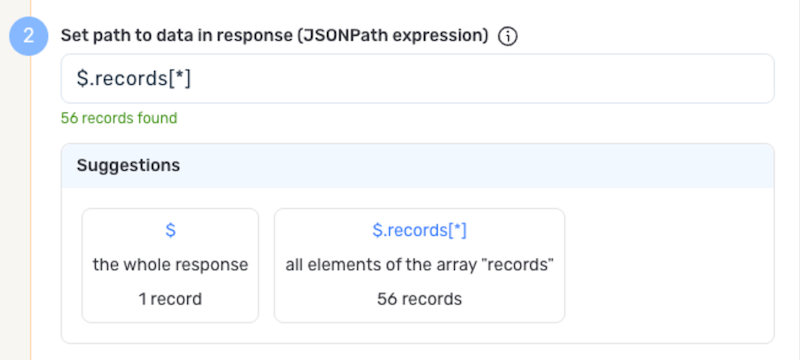
Nexla can also autogenerate data path suggestions based on the response from the API endpoint. These suggested paths can be used as-is or modified to exactly suit your needs.
-
To use this feature, click the Test button next to the Set API URL field to fetch a sample response from the API endpoint. Suggested data paths generated based on the content & format of the response will be displayed in the Suggestions box below the Set Path to Data in Response field.
-
Click on a suggestion to automatically populate the Set Path to Data in Response field with the corresponding path. The populated path can be modified directly within the field if further customization is needed.
If metadata is included in the TravelPerk response but is located outside of the defined path to relevant data, you can configure Nexla to include this data as common metadata in each record.
For example, TravelPerk paginated responses include top-level fields such as total_count, offset, and limit alongside the data array. If you have specified $.data[*] as your path to data, these pagination metadata fields can be captured and included with each record.
Metadata paths are particularly useful for preserving TravelPerk response context like pagination totals or request timestamps that apply to all records in the response.
-
If Nexla should include any additional request headers in API calls to this source, enter the headers & corresponding values as comma-separated pairs in the Request Headers field (for example, header1:value1,header2:value2).
You do not need to include the Authorization header — it is automatically added by Nexla based on your TravelPerk credential configuration. The TravelPerk API also accepts an Accept-Language header (BCP 47 format, for example en or de) on TravelSafe endpoints to specify the language of the response content.
Endpoint Testing
After configuring all settings for the selected endpoint, Nexla can retrieve a sample of the data that will be fetched according to the current configuration. This allows users to verify that the source is configured correctly before saving.
-
To test the current endpoint configuration, click the Test button to the right of the endpoint selection menu. Sample data will be fetched & displayed in the Endpoint Test Result panel on the right.
-
If the sample data is not as expected, review the selected endpoint and associated settings, and make any necessary adjustments. Then, click the Test button again, and check the sample data to ensure that the correct information is displayed.
Save & Activate the Source
- Once all of the relevant steps in the above sections have been completed, click the Create button in the upper right corner of the screen to save and create the new TravelPerk data source. Nexla will now begin ingesting data from the configured endpoint and will organize any data that it finds into one or more Nexsets.