
Seismic Data Source

The Seismic connector enables you to extract reporting and operational data directly from your Seismic Enablement Cloud instance into Nexla. Use this connector to build data pipelines that pull content usage analytics, user activity, AI engagement metrics, program data, library contents, and team management data from Seismic's Reporting API — ideal for feeding data lakes, data warehouses, and downstream analytics platforms.

The Seismic connector enables you to ingest reporting, content, channel, and user data from your Seismic Enablement Cloud instance. Follow the instructions below to create a new data flow that ingests data from a Seismic source in Nexla.
seismic_api.png

Seismic

Create a New Data Flow

  1. To create a new data flow, navigate to the Integrate section, and click the New Data Flow button. Then, select the desired flow type from the list, and click the Create button.

  2. Select the Seismic connector tile from the list of available connectors. Then, select the credential that will be used to connect to the Seismic instance, and click Next; or, create a new Seismic credential for use in this flow.

  3. In Nexla, Seismic data sources can be created using pre-built endpoint templates, which expedite source setup for common Seismic Reporting API endpoints. Each template is designed specifically for the corresponding Seismic endpoint, making source configuration easy and efficient.
    • To configure this source using a template, follow the instructions in Configure Using a Template.

    Seismic sources can also be configured manually, allowing you to ingest data from Seismic endpoints not included in the pre-built templates or apply further customizations to exactly suit your needs.
    • To configure this source manually, follow the instructions in Configure Manually.

Configure Using a Template

Nexla provides pre-built templates that can be used to rapidly configure data sources to ingest data from common Seismic Reporting API endpoints. Each template is designed specifically for the corresponding Seismic endpoint, making data source setup easy and efficient.

Endpoint Settings

  • Select the endpoint from which this source will fetch data from the Endpoint pulldown menu. Available endpoint templates are listed in the expandable boxes below. Click on an endpoint to see more information about it and how to configure your data source for this endpoint.

List Fields

Retrieves all available reporting fields in your Seismic tenant. Use this endpoint to discover which field names can be referenced when constructing reporting queries, building dashboards, or mapping Seismic data to external schemas. No additional configuration is required beyond selecting this template.

  • This endpoint requires no additional parameters. After selecting it, click Test to verify the connection and preview the list of available reporting fields.
  • Results include field names, display labels, and data types for all fields surfaced by the Seismic Reporting API.

The Seismic Reporting API requires the seismic.reporting.read OAuth2 scope. Ensure this scope is included in your registered Seismic application. For additional details, refer to the Seismic Reporting API Overview.

List Tables

Retrieves all reporting tables available in your Seismic tenant, optionally filtered by a release date range. Use this endpoint to discover which data tables can be queried through the Seismic Reporting API.

  • Optionally configure the following date filter parameters to narrow results to tables released within a specific window. All timestamps must be in ISO 8601 format (e.g., 2026-01-01T00:00:00Z):

    • Release Date Start Time: Filter to tables released on or after this timestamp. Defaults to 30 days before the current date ({now-30}).
    • Release Date End Time: Filter to tables released on or before this timestamp. Defaults to the current datetime ({now}).

Leave both date fields at their defaults to retrieve all tables released in the past 30 days. Clear the fields entirely to remove date filtering and retrieve all available tables regardless of release date.

Content Usage History

Retrieves historical content usage activity records from Seismic. This is one of the most commonly used Seismic reporting endpoints, providing detailed data about how sales content is being used — including shares, views, and downloads — along with metadata about the associated content items. Use this endpoint to analyze seller content adoption, identify top-performing assets, and feed sales analytics dashboards.

  • Configure the following parameters to control the date range of records returned. All timestamps must be in ISO 8601 format (e.g., 2026-05-01T00:00:00Z):

    • Modified At Start Time: Returns records modified on or after this timestamp. Defaults to 7 days before the current datetime ({now-7}).
    • Modified At End Time: Returns records modified on or before this timestamp. Defaults to the current datetime ({now}).
    • Occurred At Start Time: Returns records where the usage event occurred on or after this timestamp. Defaults to 7 days before the current datetime ({now-7}).
    • Occurred At End Time: Returns records where the usage event occurred on or before this timestamp. Defaults to the current datetime ({now}).

For incremental data loads, adjust the start and end time parameters to match your desired ingestion window. Using Nexla datetime macros (e.g., {now-1} with a Day time unit) allows you to automate daily incremental pulls from the Seismic Reporting API.

Content View History

Retrieves historical content view and access records from Seismic. This endpoint provides granular data about when and how buyers or internal users viewed Seismic content, making it valuable for buyer engagement analysis, content effectiveness reporting, and sales activity tracking.

  • Configure the following parameters to control the date range of records returned. All timestamps must be in ISO 8601 format:

    • Modified At Start Time: Returns records modified on or after this timestamp. Defaults to {now-7}.
    • Modified At End Time: Returns records modified on or before this timestamp. Defaults to {now}.
    • Occurred At Start Time: Returns records where the view event occurred on or after this timestamp. Defaults to {now-7}.
    • Occurred At End Time: Returns records where the view event occurred on or before this timestamp. Defaults to {now}.

Daily Active Users

Retrieves daily active user counts for your Seismic tenant within a specified date range. Use this endpoint to track platform adoption trends, measure engagement over time, and build user activity dashboards.

  • Configure the following parameters to define the date range. Dates must be in YYYY-MM-DD format (e.g., 2026-05-01):

    • Date Start: The start date for the daily active user data range. Defaults to 30 days before the current date ({now-30}).
    • Date End: The end date for the daily active user data range. Defaults to the current date ({now}).

Unlike most other Seismic Reporting endpoints that use ISO 8601 datetime format, the Daily Active Users endpoint expects dates in YYYY-MM-DD format only (no time component).

Distribution Approval Workflows

Retrieves content distribution approval workflow records and their statuses from Seismic. Use this endpoint to monitor content governance processes, track approval cycle times, and audit distribution compliance.

  • Configure the following parameters to filter results. All timestamps must be in ISO 8601 format:

    • System Modified At Start Time: Filter workflows system-modified on or after this timestamp. Defaults to {now-30}.
    • System Modified At End Time: Filter workflows system-modified on or before this timestamp. Defaults to {now}.
    • Started At Start Time: Filter workflows that started on or after this timestamp. Defaults to {now-30}.
    • Started At End Time: Filter workflows that started on or before this timestamp. Defaults to {now}.

AI Generated Text User Feedback

Retrieves user feedback records on AI-generated text features within Seismic. Use this endpoint to analyze how users are responding to AI-generated content suggestions, identify areas for AI improvement, and measure AI adoption across your organization.

  • Configure the following parameters to filter results by submission date. All timestamps must be in ISO 8601 format:

    • Submitted At Start Time: Returns feedback submitted on or after this timestamp. Defaults to {now-30}.
    • Submitted At End Time: Returns feedback submitted on or before this timestamp. Defaults to {now}.

AI Aura Activity Content Details

Retrieves detailed AI Aura activity information for specific content items in Seismic. Seismic Aura is Seismic's AI engine that powers content recommendations, search, and insights. Use this endpoint to analyze how the Aura AI is engaging with specific content and what activity patterns it generates.

  • Configure one or more of the following optional filter parameters to scope the results to specific content:

    • Content ID: Filter results to a specific content item by its unique identifier. Leave blank to retrieve Aura activity across all content.
    • Content Version ID: Filter results to a specific version of a content item. Leave blank if version-level filtering is not required.
    • AI Aura Activity ID: Filter results to a specific Aura activity record. Leave blank to retrieve all Aura activity records for the specified content.

Content IDs and Content Version IDs can be obtained from the List Contents endpoint. AI Aura Activity IDs are returned by the Seismic API when Aura activities are created.

AI Suggested Content Properties

Retrieves properties of content items that Seismic's AI has suggested to sellers, with filtering by creation and modification date ranges. Use this endpoint to analyze which content items are being recommended by Seismic's AI engine and how those recommendations evolve over time.

  • Configure the following optional date filter parameters. All timestamps must be in ISO 8601 format:

    • Created At Start Time: Filter to records created on or after this timestamp. Defaults to {now-30}.
    • Created At End Time: Filter to records created on or before this timestamp. Defaults to {now}.
    • Modified At Start Time: Filter to records modified on or after this timestamp. Defaults to {now-30}.
    • Modified At End Time: Filter to records modified on or before this timestamp. Defaults to {now}.

Copilot for Sales Recommendations

Retrieves recommendations generated by Seismic's Copilot for Sales feature. Copilot for Sales surfaces relevant content suggestions within CRM and sales tools to help sellers find the right assets at the right moment. Use this endpoint to analyze recommendation patterns, measure recommendation acceptance rates, and optimize AI-driven content delivery.

  • Configure the following optional parameters to filter by occurrence date. All timestamps must be in ISO 8601 format:

    • Occurred At Start Time: Returns recommendations that occurred on or after this timestamp. Defaults to {now-30}.
    • Occurred At End Time: Returns recommendations that occurred on or before this timestamp. Defaults to {now}.

List Contents

Retrieves content items from Seismic, with optional filtering by creation and modification date ranges. Use this endpoint to extract metadata about your Seismic content library — including content IDs, titles, types, and status — for inventory management, content audits, or feeding downstream analytics.

  • Configure the following optional date filter parameters. All timestamps must be in ISO 8601 format:

    • Modified At Start Time: Filter to content modified on or after this timestamp. Defaults to {now-30}.
    • Modified At End Time: Filter to content modified on or before this timestamp. Defaults to {now}.
    • Created At Start Time: Filter to content created on or after this timestamp. Defaults to {now-30}.
    • Created At End Time: Filter to content created on or before this timestamp. Defaults to {now}.

List Skill User Profiles

Retrieves skill user profiles from Seismic, with optional filtering by creation and modification date ranges. Seismic Skill profiles capture competency data for individual users — including completed training, certifications, and skill levels. Use this endpoint to analyze sales readiness and learning program effectiveness.

  • Configure the following optional date filter parameters. All timestamps must be in ISO 8601 format:

    • Modified At Start Time: Filter to profiles modified on or after this timestamp. Defaults to {now-30}.
    • Modified At End Time: Filter to profiles modified on or before this timestamp. Defaults to {now}.
    • Created At Start Time: Filter to profiles created on or after this timestamp. Defaults to {now-30}.
    • Created At End Time: Filter to profiles created on or before this timestamp. Defaults to {now}.

List Library Contents

Retrieves library content items from Seismic, with optional filtering by multiple date dimensions. The Seismic Library is the central content repository where all sales and marketing assets are stored. Use this endpoint for library inventory reporting, content freshness analysis, and data warehouse ingestion.

  • Configure the following optional date filter parameters. All timestamps must be in ISO 8601 format:

    • Modified At Start Time: Filter to content modified on or after this timestamp. Defaults to {now-30}.
    • Modified At End Time: Filter to content modified on or before this timestamp. Defaults to {now}.
    • Last Modified Start Time: Filter to content last modified on or after this timestamp. Defaults to {now-30}.
    • Last Modified End Time: Filter to content last modified on or before this timestamp. Defaults to {now}.
    • Created At Start Time: Filter to content created on or after this timestamp. Defaults to {now-30}.
    • Created At End Time: Filter to content created on or before this timestamp. Defaults to {now}.

The List Library Contents endpoint provides richer content metadata than the List Contents endpoint, including live content and versioning information specific to Seismic Library items.

List Programs

Retrieves Seismic program records, with optional filtering by system and user modification timestamps. Seismic Programs are structured enablement initiatives (such as onboarding programs or product launch programs) that guide sellers through a series of learning and content activities. Use this endpoint to track program progress and adoption.

  • Configure the following optional date filter parameters. All timestamps must be in ISO 8601 format:

    • System Modified At Start Time: Filter to programs system-modified on or after this timestamp. Defaults to {now-30}.
    • System Modified At End Time: Filter to programs system-modified on or before this timestamp. Defaults to {now}.
    • User Modified At Start Time: Filter to programs user-modified on or after this timestamp. Defaults to {now-30}.
    • User Modified At End Time: Filter to programs user-modified on or before this timestamp. Defaults to {now}.

List Groups

Retrieves all user groups defined in your Seismic tenant. Groups are used to organize users and control content access, permissions, and program assignment. Use this endpoint to synchronize Seismic group structures with external identity management systems or build group-based access reports.

  • This endpoint requires no additional parameters. Select the template and click Test to retrieve all groups in your Seismic tenant.

List Group Members

Retrieves group membership records from Seismic, with optional filtering by user ID or group ID. Use this endpoint to extract user-group associations for access audits, reporting, or synchronizing Seismic group memberships with external systems.

  • Configure the following optional filter parameters to scope the results:

    • User ID: Filter results to group memberships for a specific user. Leave blank to retrieve memberships across all users.
    • Group ID: Filter results to memberships within a specific group. Leave blank to retrieve memberships across all groups. Group IDs can be obtained from the List Groups endpoint.

List Users

Retrieves Seismic user accounts, with optional filtering by creation date, modification date, and user type. Use this endpoint to synchronize Seismic user directories with external HR systems, build user activity reports, or audit account provisioning.

  • Configure the following optional filter parameters. Date/time values must be in ISO 8601 format:

    • Modified At Start Time: Filter to users modified on or after this timestamp. Defaults to {now-30}.
    • Modified At End Time: Filter to users modified on or before this timestamp. Defaults to {now}.
    • Created At Start Time: Filter to users created on or after this timestamp. Defaults to {now-30}.
    • Created At End Time: Filter to users created on or before this timestamp. Defaults to {now}.
    • User Type: Filter to users of a specific type (e.g., standard users vs. guest users). Leave blank to retrieve all user types.

List Roles

Retrieves roles defined in your Seismic tenant, with optional filtering by creation and modification timestamps. Roles in Seismic control what features and content users can access. Use this endpoint to audit role definitions or feed identity management pipelines.

  • Configure the following optional date filter parameters. All timestamps must be in ISO 8601 format:

    • Modified At Start Time: Filter to roles modified after this timestamp. Defaults to {now-30}.
    • Modified At End Time: Filter to roles modified before this timestamp. Defaults to {now}.
    • Created At Start Time: Filter to roles created after this timestamp. Defaults to {now-30}.
    • Created At End Time: Filter to roles created before this timestamp. Defaults to {now}.

List User Permissions

Retrieves all user permission records from your Seismic tenant. Use this endpoint to audit which permissions are granted to which users, support compliance reporting, and synchronize permission data with external access management systems.

  • This endpoint requires no additional parameters. Select the template and click Test to retrieve all user permission records in your Seismic tenant.

List User Role Assignments

Retrieves user role assignment records from Seismic, with optional filtering by modification and assignment timestamps. Use this endpoint to track which roles are assigned to which users and how role assignments change over time — useful for access audits and compliance reporting.

  • Configure the following optional date filter parameters. All timestamps must be in ISO 8601 format:

    • Modified At Start Time: Filter to assignments modified after this timestamp. Defaults to {now-30}.
    • Modified At End Time: Filter to assignments modified before this timestamp. Defaults to {now}.
    • Assigned At Start Time: Filter to assignments assigned after this timestamp. Defaults to {now-30}.
    • Assigned At End Time: Filter to assignments assigned before this timestamp. Defaults to {now}.

List Channels

Retrieves all channels available in your Seismic instance. Seismic Channels are curated content hubs where specific audiences (such as a sales team or a customer segment) can find relevant posts and resources. Use this endpoint to enumerate available channels before retrieving channel-specific posts.

  • This endpoint requires no additional parameters. Select the template and click Test to retrieve the full list of channels in your Seismic tenant.

Channel IDs returned by this endpoint can be used as input for the List Posts in Channel endpoint to retrieve posts published within a specific channel.

List Posts in Channel

Retrieves all posts published in a specific Seismic channel. Use this endpoint to extract channel-specific content for analysis, archiving, or synchronization with external content management systems.

  • Channel ID (Required): Enter the unique identifier of the channel from which you want to retrieve posts. This value is required. Channel IDs can be obtained by first using the List Channels endpoint.

List Posts

Retrieves all posts across all channels in your Seismic instance. Use this endpoint when you need a comprehensive view of all published posts regardless of the channel in which they appear.

  • This endpoint requires no additional parameters. Select the template and click Test to retrieve all posts across your Seismic tenant.

Get Post

Retrieves detailed information about a single specific post in Seismic. Use this endpoint when you need the complete metadata and content details for a known post.

  • Post ID (Required): Enter the unique identifier of the post you want to retrieve. This value is required. Post IDs can be obtained from the List Posts or List Posts in Channel endpoints.

Bulk Get Content Access Data

Retrieves content access permission data in bulk for multiple content resources simultaneously. Use this endpoint to audit who has access to which content items within your Seismic Library — useful for compliance reporting and access governance.

  • Request Payload (Required): Enter a JSON array of objects, where each object specifies a teamSiteId and contentId to retrieve access data for. For example:

    • To retrieve access data for the root of team site 1, enter: [{"teamSiteId":"1","contentId":"root"}]
    • To retrieve access data for multiple content items, include multiple objects in the array, one per content item.

Team site IDs can be obtained from your Seismic administrator or from the Seismic API. Content IDs can be obtained from the List Contents or List Library Contents endpoints. The default payload [{"teamSiteId":"1","contentId":"root"}] retrieves access data for the root level of team site 1.

Endpoint Testing

Once the selected endpoint template has been configured, Nexla can retrieve a sample of the data that will be fetched according to the current settings. This allows users to verify that the source is configured correctly before saving.

  • To test the current endpoint configuration, click the Test button to the right of the endpoint selection menu. Sample data will be fetched & displayed in the Endpoint Test Result panel on the right.

  • If the sample data is not as expected, review the selected endpoint and associated settings, and make any necessary adjustments. Then, click the Test button again, and check the sample data to ensure that the correct information is displayed.

Configure Manually

Seismic data sources can be manually configured to ingest data from any valid Seismic API endpoint. Manual configuration provides maximum flexibility for accessing endpoints not covered by pre-built templates or when you need custom API configurations, such as endpoints from Seismic's Integration API, Content Management API, or other API surfaces beyond the Reporting API.

With manual configuration, you can also create more complex Seismic sources, such as sources that use chained API calls to fetch data from multiple endpoints or sources that require custom request parameters.

API Method

  1. To manually configure this source, select the Advanced tab at the top of the configuration screen.

  2. Select the API method that will be used for calls to the Seismic API from the Method pulldown menu. The most common methods are:

    • GET: For retrieving data from the Seismic API (used by all Seismic Reporting API endpoints)
    • POST: For sending data to the API or triggering actions (used by certain Seismic Integration API endpoints)

API Endpoint URL

  1. Enter the URL of the Seismic API endpoint from which this source will fetch data in the Set API URL field. All Seismic API endpoints begin with https://api.seismic.com/. For example, the Reporting API fields endpoint is https://api.seismic.com/reporting/fields.

Ensure the API endpoint URL is correct and accessible with your current credentials. The credential must include the OAuth2 scope required for the target endpoint. Refer to the Seismic API Reference for the complete list of available endpoints and their required scopes.

Date/Time Macros (API URL)

Optional

Optionally, the API URL can be customized using macros—all macros added to the API URL will be converted into values when Nexla executes the API call. Macros are dynamic placeholders that allow you to create flexible API endpoints that can adapt to different time periods or data requirements. This is particularly useful for Seismic Reporting API endpoints that accept date range parameters.

Most Seismic Reporting API endpoints accept timestamp parameters in ISO 8601 format (e.g., modifiedAtStartTime=2026-05-01T00:00:00Z). Use Nexla's datetime macros to dynamically set these parameters for automated incremental data loads.

  1. To add a macro, type { at the appropriate position in the API URL (within the Set API URL field), and select the desired macro from the dropdown list.

    • {now} – The current datetime
    • {now-1} – The datetime one time unit before the current datetime
    • {now+1} – The datetime one time unit after the current datetime
    • custom – Datetime macros can reference any number of time units before or after the current datetime—for example, enter (now-7) to indicate the datetime seven time units before the current datetime
  2. Select the format that will be applied to datetime macros from the Date Format for Date/Time Macro pulldown menu. Seismic Reporting API endpoints that accept timestamps expect ISO 8601 format (yyyy-MM-dd'T'HH:mm:ss'Z'), while the Daily Active Users endpoint expects yyyy-MM-dd.

  3. Select the datetime unit that will be used to perform mathematical operations in the included macro(s) from the Time Unit for Operations pulldown menu—for example, for the macro {now-1}, when Day is selected, {now-1} will be converted to the datetime one day before the current datetime.

Lookup-Based Macros (API URL)

Optional

Column values from existing lookups can also be included as macros in the API URL. Lookup-based macros allow you to reference data from previously configured data sources or lookups, enabling dynamic API endpoints that can adapt based on existing data.

Lookup-based macros are particularly useful for Seismic endpoints that require specific IDs (such as Channel ID or Post ID) that may come from a prior step in a multi-source data flow.

  1. To include a lookup column value macro, select the relevant lookup from the Add Lookups to Supported Macros pulldown menu.

  2. Type { at the appropriate position in the API URL, and select the lookup column-based macro from the dropdown list. Lookup-based macros are automatically populated into the macro list when a lookup is selected in the Add Lookups to Supported Macros pulldown menu.

Path to Data

Optional

If only a subset of the data returned by the Seismic API endpoint is needed, you can designate the part(s) of the response that should be included in the Nexset(s) produced from this source. Seismic API responses typically return data nested inside a top-level array property.

Path to Data is important when working with Seismic API responses, as Seismic wraps result records inside named arrays. For example, the Reporting API typically wraps results in $.records[*], $.data[*], $.fields[*], or $.tables[*] depending on the endpoint.

  • To specify which data should be treated as relevant in responses from this source, enter the path to the relevant data in the Set Path to Data in Response field.

    • For responses in JSON format, enter the JSON path that points to the object or array that should be treated as relevant data. JSON paths use dot notation (e.g., $.records[*] to access the records array, or $.data[*] to access the data array).
    Path to Data Example:

    For the Seismic Content Usage History endpoint, the response wraps records inside a top-level records array. Enter $.records[*] as the path to data to treat each usage record as a separate row.

Autogenerate Path Suggestions

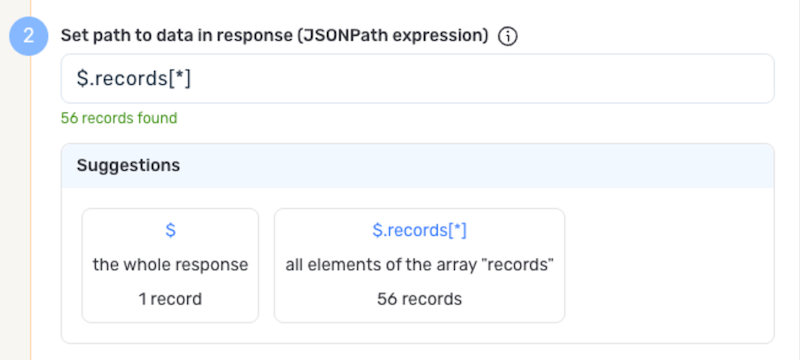
Nexla can also autogenerate data path suggestions based on the response from the API endpoint. These suggested paths can be used as-is or modified to exactly suit your needs.

  • To use this feature, click the Test button next to the Set API URL field to fetch a sample response from the API endpoint. Suggested data paths generated based on the content & format of the response will be displayed in the Suggestions box below the Set Path to Data in Response field.

  • Click on a suggestion to automatically populate the Set Path to Data in Response field with the corresponding path. The populated path can be modified directly within the field if further customization is needed.
    PathSuggestions.png

Metadata

If metadata is included in the response but is located outside of the defined path to relevant data, you can configure Nexla to include this data as common metadata in each record. For example, the Seismic Reporting API may return pagination metadata or summary counts at the top level of the response alongside the primary records array.

Metadata paths are particularly useful for preserving API response context like request IDs, timestamps, or total count values that apply to all records in the Seismic API response.

  • To specify the location of metadata that should be included with each record, enter the path to the relevant metadata in the Path to Metadata in Response field.

    • For responses in JSON format, enter the JSON path to the object or array that contains the metadata.

Request Headers

Optional
  • If Nexla should include any additional request headers in API calls to this source, enter the headers & corresponding values as comma-separated pairs in the Request Headers field (e.g., header1:value1,header2:value2).

    You do not need to include an Authorization header — it is automatically handled by the Seismic OAuth2 credential. All Seismic Reporting API endpoints require Content-Type: application/json, which Nexla includes automatically.

Endpoint Testing

After configuring all settings for the selected endpoint, Nexla can retrieve a sample of the data that will be fetched according to the current configuration. This allows users to verify that the source is configured correctly before saving.

  • To test the current endpoint configuration, click the Test button to the right of the endpoint selection menu. Sample data will be fetched & displayed in the Endpoint Test Result panel on the right.

  • If the sample data is not as expected, review the selected endpoint and associated settings, and make any necessary adjustments. Then, click the Test button again, and check the sample data to ensure that the correct information is displayed.

Save & Activate the Source

  1. Once all of the relevant steps in the above sections have been completed, click the Create button in the upper right corner of the screen to save and create the new Seismic data source. Nexla will now begin ingesting data from the configured endpoint and will organize any data that it finds into one or more Nexsets.