The SAP Ariba connector enables you to extract procurement, sourcing, spend analytics, and master data from your SAP Ariba environment using the SAP Ariba Open APIs. Follow the instructions below to create a new data flow that ingests data from an SAP Ariba source in Nexla.
Create a New Data Flow
-
To create a new data flow, navigate to the Integrate section, and click the New Data Flow button. Then, select the desired flow type from the list, and click the Create button.
-
Select the SAP Ariba connector tile from the list of available connectors. Then, select the credential that will be used to connect to the SAP Ariba instance, and click Next; or, create a new SAP Ariba credential for use in this flow.
-
In Nexla, SAP Ariba data sources can be created using pre-built endpoint templates, which expedite source setup for common SAP Ariba endpoints. Each template is designed specifically for the corresponding SAP Ariba API, making source configuration easy and efficient.
• To configure this source using a template, follow the instructions in Configure Using a Template.
SAP Ariba sources can also be configured manually, allowing you to ingest data from SAP Ariba endpoints not included in the pre-built templates or apply further customizations to exactly suit your needs.
• To configure this source manually, follow the instructions in Configure Manually.
Nexla provides pre-built templates that can be used to rapidly configure data sources to ingest data from common SAP Ariba endpoints. Each template is designed specifically for the corresponding SAP Ariba API, making data source setup easy and efficient.
Endpoint Settings
- Select the endpoint from which this source will fetch data from the Endpoint pulldown menu. Available endpoint templates are listed in the expandable boxes below. Click on an endpoint to see more information about it and how to configure your data source for this endpoint.
Requisitions
This endpoint extracts requisition documents from SAP Ariba, including full header and line item details such as requestor, commodity, cost center, and approval status. Use this endpoint to analyze purchase request activity, monitor approval cycle times, and track spend commitments before purchase orders are issued.
This endpoint uses SAP Ariba's asynchronous Operational Reporting API: Nexla submits a reporting job, polls until the job completes, then downloads the result file. A view template must be configured in SAP Ariba before data can be extracted.
Enter the name of the view template that will be used to define the fields and filters for this report in the View Template Name field. View templates are created and managed in the SAP Ariba UI under Manage > View Templates, or via the SAP Ariba View Management API. The template name is case-sensitive and must already be in "published" status in your Ariba realm.
Enter the start date for the extraction window in the Updated Date From field. The date must be in ISO 8601 format (for example, 2024-01-01T00:00:00Z). The default value is {now-30}, which represents the date 30 days before the current run date. Nexla will replace this macro with the appropriate date value at runtime.
Enter the end date for the extraction window in the Updated Date To field. The date must be in ISO 8601 format (for example, 2024-01-31T23:59:59Z). The default value is {now}, which represents the current run date and time.
The Updated Date From and Updated Date To parameters filter records by last-updated timestamp, not by creation date. For initial historical loads, set the date range to cover the full period of interest. For incremental loads, use the Nexla scheduling feature with the {'{now-N}'} macro pattern to move the window forward automatically on each run. Additional documentation on SAP Ariba view templates is available at the SAP Help Portal.
Purchase Orders
This endpoint extracts purchase order documents from SAP Ariba, including supplier details, line items, pricing, delivery schedules, and order status. Use this endpoint to monitor PO activity, reconcile orders with receipts and invoices, analyze supplier performance, and track open commitments.
This endpoint uses the asynchronous Operational Reporting API and requires a published view template in your Ariba realm to define the output fields and filters.
Enter the name of the published view template for PurchaseOrder documents in the View Template Name field. The template must be configured for the Purchase Order document type in the SAP Ariba UI or via the View Management API.
Enter the start date for the extraction window in the Updated Date From field using ISO 8601 format. The default value {now-30} covers the prior 30 days.
Enter the end date for the extraction window in the Updated Date To field using ISO 8601 format. The default value {now} is the current run date and time.
Purchase Order data extracted through this endpoint reflects records updated within the specified date range. To capture all POs regardless of update date, use a wide date range for the initial extraction, then narrow the window for subsequent incremental runs.
Invoices (Invoice Reconciliation)
This endpoint extracts invoice reconciliation documents from SAP Ariba, including payment status, reconciliation details, GL coding, tax information, and exceptions. Use this endpoint to analyze invoice processing cycle times, identify bottlenecks in the AP workflow, and reconcile invoices against purchase orders and receipts.
Enter the name of the published view template for InvoiceReconciliation documents in the View Template Name field.
Enter the start date for the extraction window in the Updated Date From field using ISO 8601 format. The default value is {now-30}.
Enter the end date for the extraction window in the Updated Date To field using ISO 8601 format. The default value is {now}.
Invoice Reconciliation records include both matched and exception invoices. This endpoint is particularly useful for accounts payable automation and three-way match (PO / receipt / invoice) validation workflows.
Contracts
This endpoint extracts contract documents from SAP Ariba, including contract terms, effective and expiration dates, counterparty information, pricing tiers, and amendment history. Use this endpoint to monitor contract compliance, track expiring contracts, and analyze contract coverage across spend categories.
Enter the name of the published view template for Contract documents in the View Template Name field.
Enter the start date for the extraction window in the Updated Date From field using ISO 8601 format. The default value is {now-90} (90 days prior), reflecting the longer-lived nature of contract records.
Enter the end date for the extraction window in the Updated Date To field using ISO 8601 format. The default value is {now}.
Receipts
This endpoint extracts goods receipt documents from SAP Ariba, including received quantities, receipt dates, line item details, and quality inspection results. Use this endpoint to track delivery performance, identify discrepancies between ordered and received quantities, and support three-way match processes.
Enter the name of the published view template for Receipt documents in the View Template Name field.
Enter the start date for the extraction window in the Updated Date From field using ISO 8601 format. The default value is {now-7} (7 days prior), reflecting the high-frequency update pattern typical for receiving activity.
Enter the end date for the extraction window in the Updated Date To field using ISO 8601 format. The default value is {now}.
Payments
This endpoint extracts payment documents from SAP Ariba, including payment amounts, payment methods, payment dates, bank account details, and payment status. Use this endpoint to analyze payment timing, identify early-payment discount opportunities, and reconcile payments against invoices for cash flow reporting.
Enter the name of the published view template for Payment documents in the View Template Name field.
Enter the start date for the extraction window in the Updated Date From field using ISO 8601 format. The default value is {now-30}.
Enter the end date for the extraction window in the Updated Date To field using ISO 8601 format. The default value is {now}.
Payment Requests
This endpoint extracts payment request documents from SAP Ariba, which are used to initiate disbursements outside of the standard PO-based procurement flow. Use this endpoint to track non-PO payment requests through approval workflows, monitor disbursement status, and analyze spending patterns for categories such as employee reimbursements or direct supplier payments.
Enter the name of the published view template for PaymentRequest documents in the View Template Name field.
Enter the start date for the extraction window in the Updated Date From field using ISO 8601 format. The default value is {now-30}.
Enter the end date for the extraction window in the Updated Date To field using ISO 8601 format. The default value is {now}.
Contract Workspaces
This endpoint extracts contract workspace collaboration data from SAP Ariba, including contract drafts, revisions, approval events, negotiation history, and associated documents. Use this endpoint to audit contract authoring and negotiation activity, measure contract cycle times from initiation to execution, and identify bottlenecks in the contracting process.
Enter the name of the published view template for ContractWorkspace documents in the View Template Name field.
Enter the start date for the extraction window in the Updated Date From field using ISO 8601 format. The default value is {now-90}.
Enter the end date for the extraction window in the Updated Date To field using ISO 8601 format. The default value is {now}.
Master Data - Suppliers
This endpoint retrieves supplier master data from SAP Ariba, including contact information, banking details, certifications, diversity classifications, and risk ratings. Use this endpoint to maintain an up-to-date supplier registry, populate supplier portals, enrich spend analytics with supplier attributes, and support supplier risk management programs.
- This endpoint retrieves all suppliers registered in your Ariba realm using offset-based pagination with a page size of 100 records. No date range parameters are required — Nexla automatically handles pagination to retrieve the complete supplier list.
- The endpoint returns all suppliers in the
Records array of each paginated response. Nexla treats each entry as an individual supplier record in the output Nexset.
Supplier master data in SAP Ariba is managed via the Supplier Management module and the Ariba Network. The API returns the current state of each supplier record at the time of extraction; it does not provide a change history. For supplier change tracking, consider scheduling incremental extractions and comparing snapshots downstream.
Master Data - Commodities
This endpoint retrieves the commodity (spend category) code master data from SAP Ariba, including hierarchical category structures and UNSPSC (United Nations Standard Products and Services Code) classifications. Use this endpoint to build category hierarchies for spend analytics, enrich transaction data with standardized category codes, and map internal commodity codes to industry standards.
- This endpoint retrieves all commodity records using offset-based pagination with a page size of 100. No date range or additional parameters are required.
- The response
Records array contains individual commodity entries. Each record includes the commodity code, description, parent code (for hierarchy traversal), and UNSPSC mapping where available.
Master Data - Users
This endpoint retrieves the user directory from SAP Ariba, including user roles, permissions, organizational unit assignments, and approval authority limits. Use this endpoint to audit user access controls, synchronize Ariba user data with HR or identity management systems, and validate approval delegation structures.
- This endpoint retrieves all users in your Ariba realm using offset-based pagination. No additional parameters are required beyond the credential's realm configuration.
User records include role assignments and approval limits that are configured within the SAP Ariba application. This data is particularly useful for access governance audits and ensuring that approval authority aligns with organizational policies.
Master Data - Cost Centers
This endpoint retrieves cost center master data from SAP Ariba for general ledger account assignment and financial reporting. Use this endpoint to synchronize cost center structures with ERP systems, enrich procurement transaction data with financial coding, and validate that cost center assignments in procurement documents are current and accurate.
- This endpoint retrieves all cost centers in your realm using offset-based pagination. No additional parameters are required.
Master Data - Departments
This endpoint retrieves the organizational department structure from SAP Ariba for spend analysis and user assignment. Use this endpoint to build organizational hierarchies for spend reporting, assign procurement transactions to departments, and validate that department configurations in Ariba reflect current organizational structure.
- This endpoint retrieves all department records using offset-based pagination. No additional parameters are required.
Master Data - Locations
This endpoint retrieves company location data from SAP Ariba, including delivery addresses and site management details. Use this endpoint to populate ship-to address lists, validate delivery locations on purchase orders, and synchronize facility data with facilities management or ERP systems.
- This endpoint retrieves all location records using offset-based pagination. No additional parameters are required.
Master Data - Accounts (GL Accounts)
This endpoint retrieves general ledger (GL) account master data from SAP Ariba for financial coding and reporting. Use this endpoint to validate GL account assignments in procurement documents, synchronize the Ariba chart of accounts with ERP systems, and enrich spend data with account-level financial classifications.
- This endpoint retrieves all GL account records using offset-based pagination. No additional parameters are required.
Master Data - Projects
This endpoint retrieves project code master data from SAP Ariba for project-based accounting and spend allocation. Use this endpoint to synchronize Ariba project codes with project management or ERP systems, validate project assignments on requisitions and purchase orders, and enable project-level spend reporting.
- This endpoint retrieves all project records using offset-based pagination. No additional parameters are required.
Master Data - Payment Terms
This endpoint retrieves payment terms master data from SAP Ariba for supplier contracts and invoice processing. Use this endpoint to audit payment terms assigned to suppliers, identify opportunities to standardize or optimize payment terms across the supply base, and synchronize payment terms data with ERP or treasury systems.
- This endpoint retrieves all payment terms records using offset-based pagination. No additional parameters are required.
Master Data - Currencies
This endpoint retrieves currency master data from SAP Ariba, including supported currency codes and associated exchange rate information. Use this endpoint to validate currency configurations, support multi-currency spend normalization workflows, and synchronize exchange rate data with financial reporting systems.
- This endpoint retrieves all currency records using offset-based pagination. No additional parameters are required.
Master Data - Units of Measure
This endpoint retrieves units of measure (UOM) master data from SAP Ariba for quantity conversions and standardization. Use this endpoint to validate UOM assignments in purchase order line items, normalize quantities across different units for spend analysis, and synchronize UOM configurations with ERP systems.
- This endpoint retrieves all UOM records using offset-based pagination. No additional parameters are required.
Sourcing Projects
This endpoint extracts sourcing project data from SAP Ariba, including RFx events, reverse auctions, negotiation details, awarded suppliers, and sourcing project status. Use this endpoint to analyze sourcing cycle times, track savings achieved through competitive events, and report on sourcing pipeline and activity.
This endpoint uses the SAP Ariba Sourcing Reporting View API, which returns results synchronously (no job submission or polling required).
Enter the start date for the extraction window in the Updated Date From field using ISO 8601 format. The default value is {now-90}, reflecting the longer duration of sourcing projects.
Enter the end date for the extraction window in the Updated Date To field using ISO 8601 format. The default value is {now}.
This endpoint uses the SourcingProject view from the Sourcing Reporting View API. Additional sourcing-related views may be available depending on your SAP Ariba configuration and API access. Refer to the SAP Ariba API documentation for the full list of available sourcing views.
Sourcing Requests (RFx)
This endpoint extracts RFI, RFP, and RFQ sourcing request documents from SAP Ariba, including bid responses from suppliers, evaluation scores, and award decisions. Use this endpoint to analyze competitive bidding activity, track supplier participation rates in sourcing events, and measure the effectiveness of sourcing strategies.
Enter the start date for the extraction window in the Updated Date From field using ISO 8601 format. The default value is {now-90}.
Enter the end date for the extraction window in the Updated Date To field using ISO 8601 format. The default value is {now}.
Sourcing Project Audit Trail
This endpoint extracts audit trail data for sourcing projects from SAP Ariba, capturing all user actions and system events associated with sourcing project activity. Use this endpoint for compliance reporting, to investigate sourcing process deviations, and to produce an auditable record of procurement decisions.
Enter the start date for the audit trail extraction in the Updated Date From field using ISO 8601 format. The default value is {now-90}.
Enter the end date for the audit trail extraction in the Updated Date To field using ISO 8601 format. The default value is {now}.
This endpoint uses the ProjectAuditInfo_SpendOverview view from the Sourcing Reporting View API. Audit trail data can be extensive for active sourcing environments — consider narrowing the date range if response times are slow or payload sizes are large.
Supplier Bid Responses
This endpoint extracts supplier bid and quote responses from SAP Ariba sourcing events, including pricing, proposed terms, and delivery commitments submitted by suppliers. Use this endpoint to analyze competitive pricing across sourcing events, benchmark supplier responses, and support strategic category management decisions.
Enter the start date for the extraction window in the Updated Date From field using ISO 8601 format. The default value is {now-90}.
Enter the end date for the extraction window in the Updated Date To field using ISO 8601 format. The default value is {now}.
Analytical Fact - Spend
This endpoint extracts aggregated spend analytics fact data from SAP Ariba, organized by supplier, commodity category, department, cost center, and time period. Use this endpoint to build spend dashboards, identify savings opportunities by category, analyze supplier concentration risk, and benchmark organizational spend patterns.
This endpoint uses the SAP Ariba Analytics Reporting Fact API and returns pre-aggregated spend records. Unlike the Operational Reporting endpoints, no view template is required.
The Analytics Reporting Fact API returns spend data that has been processed and enriched by SAP Ariba's analytics engine. Data availability may lag behind transactional data by 24 to 48 hours depending on your Ariba analytics configuration. For real-time transactional data, use the Operational Reporting endpoints (Requisitions, Purchase Orders, Invoices, etc.) instead.
Analytical Fact - Savings
This endpoint extracts savings analytics fact data from SAP Ariba, capturing savings achieved through sourcing events, contract negotiations, and procurement optimization initiatives. Use this endpoint to report on realized and pipeline savings, demonstrate procurement ROI, and track savings performance against targets.
Analytical Fact - Contracts
This endpoint extracts contract analytics fact data from SAP Ariba for contract performance and compliance tracking. Use this endpoint to measure contract utilization (spend on-contract vs. off-contract), monitor contract expiration timelines, analyze contract compliance rates by supplier and category, and report on the value of the managed contract portfolio.
Analytical Fact - Supplier Performance
This endpoint extracts supplier performance analytics fact data from SAP Ariba, including on-time delivery rates, quality ratings, and compliance metrics. Use this endpoint to score and rank suppliers, identify underperforming suppliers requiring corrective action, support supplier development programs, and produce supplier scorecards.
Supplier performance data in SAP Ariba is sourced from assessments, scorecards, and operational performance metrics configured in the Supplier Management module. The availability and content of this data depends on your organization's Ariba configuration and the performance management programs you have enabled.
List View Templates
This endpoint retrieves a list of all configured view templates in your SAP Ariba realm that are available for use in procurement reporting jobs and synchronous queries. Use this endpoint to discover the view templates available in your environment before configuring Operational Reporting endpoints that require a view template name.
- This endpoint requires no additional parameters beyond the credential's realm configuration. It returns all view templates registered in your realm, including their names, document types, and publication status.
- The view template name values returned by this endpoint are used as the View Template Name parameter in Operational Reporting endpoints such as Requisitions, Purchase Orders, and Invoices.
Only view templates with a status of "published" can be used in reporting job submissions. Draft or deactivated templates will appear in this list but will fail if used as the view template name in a reporting job. Run this endpoint first when setting up a new Operational Reporting source to identify the correct template names available in your realm.
Procurement Field Metadata
This endpoint retrieves field metadata for SAP Ariba procurement document types, enabling you to discover all available fields, their data types, and available filter criteria for a given document type. Use this endpoint to understand the schema of each document type before configuring view templates, to identify custom fields added to your Ariba configuration, and to build dynamic field mapping logic in downstream pipelines.
The metadata response includes both standard SAP Ariba fields and any custom fields configured for your organization's Ariba instance (returned when includeCustomFields=true, which is set automatically by this template). Use the field names returned by this endpoint to configure the correct field selections in your view templates.
Document Approval Flows
This endpoint retrieves approval workflow data for specific SAP Ariba procurement documents, including the list of approvers, their approval status, comments, timestamps, and the complete approval chain history. Use this endpoint to audit approval processes, measure approval cycle times for individual documents, and investigate procurement documents that are stalled in approval.
Select or enter the document type for which to retrieve the approval flow in the Document Type field. The default value is Requisition. Supported document types are:
- Requisition — Purchase requisitions
- PurchaseOrder — Purchase orders
- InvoiceReconciliation — Invoice reconciliation documents
- Contract — Contract documents
Enter the unique document ID of the specific procurement document for which to retrieve the approval flow in the Document ID field. The document ID is the internal Ariba identifier for the document (for example, PR123456 for a requisition or PO987654 for a purchase order). This value can be obtained from the Ariba UI, from other Nexla data flows that extract the relevant document type, or from the SAP Ariba operational reporting endpoints.
This endpoint retrieves the approval flow for a single document per execution. To retrieve approval flows for multiple documents, configure separate data sources for each document, or use a Nexla lookup-based macro in the manual configuration to iterate over a list of document IDs sourced from another Nexset.
Master Data - Entity Types Discovery
This endpoint lists all available master data entity types in your SAP Ariba realm, enabling discovery of which master data objects are configured and accessible via the Master Data API. Use this endpoint when setting up a new SAP Ariba integration to understand which entity types are available before configuring individual master data extraction endpoints.
- This endpoint requires no additional parameters. It returns the full list of entity types available in your realm along with their API identifiers, which correspond to the path segments used in the individual Master Data endpoints (for example,
suppliers, commodities, users).
The entity types returned by this endpoint reflect the master data modules enabled for your SAP Ariba subscription. Entity types that are not included in your subscription or have not been configured in your realm will not appear in the response.
Endpoint Testing
Once the selected endpoint template has been configured, Nexla can retrieve a sample of the data that will be fetched according to the current settings. This allows users to verify that the source is configured correctly before saving.
-
To test the current endpoint configuration, click the Test button to the right of the endpoint selection menu. Sample data will be fetched & displayed in the Endpoint Test Result panel on the right.
-
If the sample data is not as expected, review the selected endpoint and associated settings, and make any necessary adjustments. Then, click the Test button again, and check the sample data to ensure that the correct information is displayed.
SAP Ariba data sources can be manually configured to ingest data from any valid SAP Ariba API endpoint. Manual configuration provides maximum flexibility for accessing endpoints not covered by pre-built templates, building chained multi-step API calls (such as job submission followed by async polling and result download), or applying custom request parameters and headers.
With manual configuration, you can also create more complex SAP Ariba sources, such as sources that reference dynamic values from other Nexla data flows or sources that target specific SAP Ariba API versions.
API Method
-
To manually configure this source, select the Advanced tab at the top of the configuration screen.
-
Select the API method that will be used for calls to the SAP Ariba API from the Method pulldown menu. The most common methods for SAP Ariba APIs are:
- GET: For retrieving data directly (used by Master Data, Sourcing Reporting View, and Analytics Reporting Fact endpoints)
- POST: For submitting asynchronous reporting jobs (used by Operational Reporting job submission endpoints)
API Endpoint URL
- Enter the URL of the SAP Ariba API endpoint from which this source will fetch data in the Set API URL field. All SAP Ariba Open API URLs begin with the base URL
https://openapi.ariba.com/api, followed by the API-specific path, version, and environment segment.
SAP Ariba API URLs include the realm as a required query parameter (for example, ?realm=s1-acme-T). This parameter is automatically included by Nexla based on the Realm value configured in your SAP Ariba credential. Ensure the API endpoint URL is correct and accessible with your current credentials by using the Test button after configuring the URL.
Date/Time Macros (API URL)
Optional
Optionally, the API URL can be customized using macros—all macros added to the API URL will be converted into values when Nexla executes the API call. Macros are dynamic placeholders that allow you to create flexible API endpoints that can adapt to different time periods or data requirements. Date/time macros are particularly useful for SAP Ariba's filter parameters such as updatedDateFrom and updatedDateTo.
Macros are particularly useful for SAP Ariba APIs that require date ranges as filter parameters. Using macros such as {'{now-30}'} and {'{now}'} allows you to create incremental data flows that automatically advance the extraction window on each scheduled run without manual reconfiguration.
-
To add a macro, type { at the appropriate position in the API URL (within the Set API URL field), and select the desired macro from the dropdown list.
{now} – The current datetime{now-1} – The datetime one time unit before the current datetime{now+1} – The datetime one time unit after the current datetimecustom – Datetime macros can reference any number of time units before or after the current datetime—for example, enter (now-30) to indicate the datetime 30 time units before the current datetime
-
Select the format that will be applied to datetime macros from the Date Format for Date/Time Macro pulldown menu. SAP Ariba APIs require dates in ISO 8601 format (for example, YYYY-MM-DDTHH:mm:ssZ). Select the format that matches the expected input for your target API endpoint.
-
Select the datetime unit that will be used to perform mathematical operations in the included macro(s) from the Time Unit for Operations pulldown menu—for example, for the macro {now-30}, when Day is selected, the macro will be converted to the datetime 30 days before the current datetime.
Lookup-Based Macros (API URL)
Optional
Column values from existing lookups can also be included as macros in the API URL. Lookup-based macros allow you to reference data from previously configured data sources or lookups, enabling dynamic API endpoints that can adapt based on existing data.
Lookup-based macros are useful for SAP Ariba endpoints that require specific identifiers as path or query parameters. For example, you can use a lookup to supply a list of document IDs from an upstream Nexla flow that extracts purchase orders, then use those IDs to retrieve approval flows for each order.
-
To include a lookup column value macro, select the relevant lookup from the Add Lookups to Supported Macros pulldown menu.
-
Type { at the appropriate position in the API URL, and select the lookup column-based macro from the dropdown list. Lookup-based macros are automatically populated into the macro list when a lookup is selected in the Add Lookups to Supported Macros pulldown menu.
If only a subset of the data returned by the SAP Ariba API endpoint is needed, you can designate the part of the response that should be included in the Nexset(s) produced from this source by specifying the path to the relevant data. SAP Ariba API responses typically wrap data records in a Records array within the JSON response body.
For example, the SAP Ariba Master Data API returns supplier records under $.Records[*] in the response. By entering this path, Nexla treats each element of the Records array as an individual data record.
Specifying the correct Path to Data is essential for SAP Ariba API responses. Most SAP Ariba APIs wrap their payload arrays in response envelope objects. Without specifying the path to the Records array (or equivalent), Nexla will treat the entire response envelope as a single record rather than extracting individual records.
-
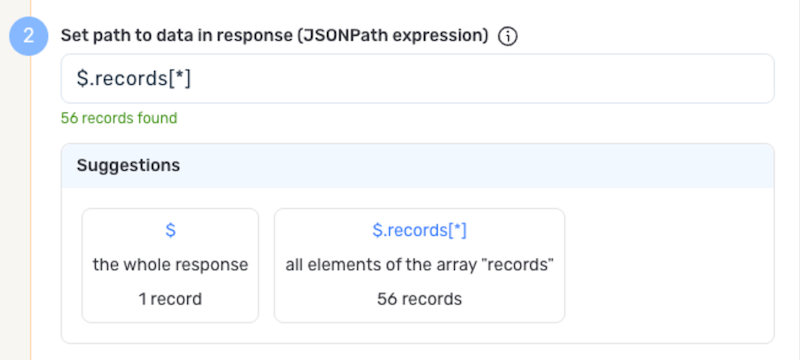
To specify which data should be treated as relevant in responses from this source, enter the path to the relevant data in the Set Path to Data in Response field using JSON path notation (for example, $.Records[*] for most SAP Ariba list endpoints, or $ to capture the entire response for job status polling steps).
Path to Data Example:For the SAP Ariba Master Data suppliers endpoint, the response includes a top-level Records array. Enter $.Records[*] as the Path to Data to treat each supplier entry as a separate record in the Nexset.
Autogenerate Path Suggestions
Nexla can also autogenerate data path suggestions based on the response from the API endpoint. These suggested paths can be used as-is or modified to exactly suit your needs.
-
To use this feature, click the Test button next to the Set API URL field to fetch a sample response from the API endpoint. Suggested data paths generated based on the content & format of the response will be displayed in the Suggestions box below the Set Path to Data in Response field.
-
Click on a suggestion to automatically populate the Set Path to Data in Response field with the corresponding path. The populated path can be modified directly within the field if further customization is needed.
If metadata is included in the response but is located outside of the defined path to relevant data, you can configure Nexla to include this data as common metadata in each record. For SAP Ariba APIs, this is useful when you want to preserve response-level information such as total record counts or request timestamps alongside each extracted record.
Metadata paths are particularly useful for preserving SAP Ariba API response context like request IDs, total record counts, or pagination information that applies to all records in the response.
- To specify the location of metadata that should be included with each record, enter the path to the relevant metadata in the Path to Metadata in Response field using JSON path notation.
-
If Nexla should include any additional request headers in API calls to this source, enter the headers & corresponding values as comma-separated pairs in the Request Headers field (for example, header1:value1,header2:value2). Additional headers may be required for SAP Ariba API versioning or when targeting specific API features.
You do not need to include the apiKey or Authorization headers — these are automatically applied by Nexla based on the API Key and OAuth credentials configured in your SAP Ariba credential.
Endpoint Testing
After configuring all settings for the selected endpoint, Nexla can retrieve a sample of the data that will be fetched according to the current configuration. This allows users to verify that the source is configured correctly before saving.
-
To test the current endpoint configuration, click the Test button to the right of the endpoint selection menu. Sample data will be fetched & displayed in the Endpoint Test Result panel on the right.
-
If the sample data is not as expected, review the selected endpoint and associated settings, and make any necessary adjustments. Then, click the Test button again, and check the sample data to ensure that the correct information is displayed.
Save & Activate the Source
- Once all of the relevant steps in the above sections have been completed, click the Create button in the upper right corner of the screen to save and create the new SAP Ariba data source. Nexla will now begin ingesting data from the configured endpoint and will organize any data that it finds into one or more Nexsets.