The Salesloft connector enables you to ingest data from your Salesloft sales engagement platform into Nexla, including accounts, people, cadences, activities, opportunities, call data records, bulk jobs, and more. Follow the instructions below to create a new data flow that ingests data from a Salesloft source in Nexla.
Create a New Data Flow
-
To create a new data flow, navigate to the Integrate section, and click the New Data Flow button. Then, select the desired flow type from the list, and click the Create button.
-
Select the Salesloft connector tile from the list of available connectors. Then, select the credential that will be used to connect to your Salesloft instance, and click Next; or, create a new Salesloft credential for use in this flow.
-
In Nexla, Salesloft data sources can be created using pre-built endpoint templates, which expedite source setup for common Salesloft endpoints. Each template is designed specifically for the corresponding Salesloft API endpoint, making source configuration easy and efficient.
• To configure this source using a template, follow the instructions in Configure Using a Template.
Salesloft sources can also be configured manually, allowing you to ingest data from Salesloft endpoints not included in the pre-built templates or apply further customizations to exactly suit your needs.
• To configure this source manually, follow the instructions in Configure Manually.
Nexla provides pre-built templates that can be used to rapidly configure data sources to ingest data from common Salesloft endpoints. Each template is designed specifically for the corresponding Salesloft API endpoint, making data source setup easy and efficient.
Endpoint Settings
- Select the endpoint from which this source will fetch data from the Endpoint pulldown menu. Available endpoint templates are listed in the expandable boxes below. Click on an endpoint to see more information about it and how to configure your data source for this endpoint.
Get Current Team
Retrieves information about the current Salesloft team, including team settings, configuration, and membership details. Use this endpoint when you need an overview of your Salesloft team's structure and settings.
- No additional configuration parameters are required for this endpoint. Once the template is selected, Nexla will automatically retrieve the current team information for the authenticated account.
- The response includes top-level team metadata such as the team name, settings, and associated configuration. This data is returned as a single record rather than a paginated list.
This endpoint returns data for the team associated with the authenticated credential. Ensure that the selected credential belongs to the team whose data you wish to retrieve. For more details, see the Salesloft API documentation.
List Account Stages
Retrieves all account stages configured in your Salesloft instance. Account stages define the lifecycle status of accounts (e.g., Prospect, Qualified, Customer) and are used to categorize and track accounts through your sales process.
- No additional configuration parameters are required for this endpoint. Nexla will automatically retrieve all account stages available in the authenticated Salesloft instance.
- The results are returned as an array of account stage objects, each containing the stage name, ID, and associated metadata.
Account stages are managed in Salesloft under Settings > CRM > Account Stages. This endpoint is useful for building reports or enriching account data with stage information.
List Account Tiers
Retrieves all account tiers configured in your Salesloft instance. Account tiers allow you to segment and prioritize accounts by their strategic importance or revenue potential (e.g., Tier 1, Tier 2, Tier 3).
- No additional configuration parameters are required. Nexla will automatically retrieve all account tiers available in the authenticated Salesloft instance.
- Each account tier record includes the tier name, ID, and associated configuration details.
Account tiers are a useful segmentation tool in account-based sales strategies. Use this endpoint to enrich account data or build dashboards that reflect account prioritization.
List Accounts
Retrieves a paginated list of all accounts in your Salesloft instance. Accounts represent companies or organizations being tracked in your sales process, including their contact information, stage, owner, and activity history.
- No additional configuration parameters are required. Nexla will automatically paginate through all available accounts and retrieve the full list.
- This endpoint uses offset-based pagination with up to 100 records per page. Nexla handles pagination automatically, so all accounts will be retrieved in a single data flow run.
- Each account record includes fields such as account name, domain, industry, owner, stage, tier, CRM ID, and timestamps for creation and last modification.
The Salesloft API applies rate limits on a team level. If your account list is very large, consider scheduling ingestion during off-peak hours to minimize the impact on other integrations sharing the same rate limit. For more information, see the Salesloft API Basics documentation.
Fetch an Account
Retrieves detailed information for a single Salesloft account identified by its unique Account ID. Use this endpoint when you need to fetch complete details for a specific account rather than listing all accounts.
Account IDs in Salesloft are integer values. Ensure the ID entered is valid and belongs to an account accessible by the authenticated credential.
List Actions
Retrieves a paginated list of all actions in your Salesloft instance. Actions represent tasks assigned to sales representatives as part of cadence steps, such as sending an email, making a phone call, or completing a LinkedIn outreach.
- No additional configuration parameters are required. Nexla will automatically paginate through all available actions and retrieve the full list.
- This endpoint uses offset-based pagination with up to 100 records per page. Nexla handles pagination automatically.
- Each action record includes the action type, associated person, cadence step, due date, status, and assigned owner.
Actions are tied to cadence steps and represent the work items that sales reps must complete. Use this endpoint to track team productivity, cadence adherence, and task completion rates.
Get Action
Retrieves detailed information for a specific action identified by its unique Action ID. Use this endpoint when you need complete details about a particular task or cadence step action.
List Past Activities
Retrieves a paginated list of historical activity records from your Salesloft account. Activity histories represent completed sales activities such as sent emails, completed calls, LinkedIn touchpoints, and other engagement events.
- No additional configuration parameters are required. Nexla will automatically paginate through all activity history records and retrieve the full list.
- This endpoint uses offset-based pagination with up to 100 records per page, and Nexla handles pagination automatically.
- Each record includes the activity type, associated person, account, cadence, outcome, timestamp, and owner information.
Activity history data is valuable for sales analytics, coaching, and reporting. Use this endpoint to build dashboards that track engagement metrics, call outcomes, email reply rates, and rep productivity over time.
List Bulk Jobs
Retrieves a paginated list of bulk jobs in your Salesloft instance. Bulk jobs are used for large-scale import, update, or delete operations on people, accounts, or other records. Use this endpoint to monitor job status and track results.
- No additional configuration parameters are required. Nexla will automatically paginate through all bulk jobs and retrieve the full list.
- This endpoint uses offset-based pagination with up to 100 records per page.
- Each bulk job record includes the job type, state (pending, processing, complete, failed), record counts, and timestamps.
Bulk jobs can be filtered by state (e.g., completed, failed) using query parameters when configuring a manual source. Use the List Bulk Job Results endpoint to retrieve the outcomes of a completed bulk job.
List Job Data for Bulk Job
Retrieves the job data records associated with a specific bulk job. Job data represents the individual records submitted for processing as part of a bulk import, update, or delete operation.
List Bulk Job Results
Retrieves the results for a completed bulk job, including the outcome (success or failure) for each individual record submitted in the job. Use this endpoint to audit bulk operations and identify records that failed to process.
This endpoint is particularly useful for validating bulk import or update operations. Failed records will include error messages that can help diagnose data quality issues.
List Cadence Memberships
Retrieves a paginated list of all cadence memberships in your Salesloft instance. A cadence membership represents the enrollment of a person (contact) in a specific cadence (outreach sequence), and tracks their progress through the cadence steps.
- No additional configuration parameters are required. Nexla will automatically paginate through all cadence memberships and retrieve the full list.
- This endpoint uses offset-based pagination with up to 100 records per page.
- Each membership record includes the associated person, cadence, current step, status (active, finished, removed), and timestamps.
Cadence membership data is valuable for tracking the engagement status of contacts across your outreach sequences. Use this data to build reports on cadence performance, contact engagement rates, and outreach effectiveness.
List Cadences
Retrieves a paginated list of all cadences in your Salesloft account. Cadences are multi-step outreach sequences that automate and guide sales representatives through a defined series of touchpoints—such as emails, calls, and social touches—to engage prospects effectively.
- No additional configuration parameters are required. Nexla will automatically paginate through all available cadences and retrieve the full list.
- This endpoint uses offset-based pagination with up to 100 records per page.
- Each cadence record includes the cadence name, owner, team visibility, step count, active/archived status, and creation and modification timestamps.
Salesloft cadences are the core of sales engagement automation. Use this endpoint to analyze cadence usage, track which cadences are most active, and audit the cadence library across your team.
Fetch a Cadence
Retrieves detailed information for a specific cadence identified by its unique Cadence ID. Use this endpoint when you need complete details about a particular outreach sequence, including its steps and configuration.
List Calendar Events
Retrieves a paginated list of calendar events from your Salesloft account. Calendar events include meetings, calls, and other scheduled activities that have been synced with Salesloft's calendar integration.
- No additional configuration parameters are required. Nexla will automatically paginate through all available calendar events and retrieve the full list.
- This endpoint uses offset-based pagination with up to 100 records per page.
- Each calendar event record includes the event title, start and end times, attendees, associated person and account, and event status.
Calendar events in Salesloft are synchronized from connected calendar providers (e.g., Google Calendar, Microsoft Outlook). Use this endpoint to track meeting activity, analyze meeting-to-opportunity conversion rates, or build scheduling reports.
List Call Data Records
Retrieves a paginated list of call data records from your Salesloft account. Call data records contain detailed telephony information for calls made through Salesloft Dialer, including call duration, recording URLs, disposition, and sentiment data.
- No additional configuration parameters are required. Nexla will automatically paginate through all available call data records and retrieve the full list.
- This endpoint uses offset-based pagination with up to 100 records per page.
- Each record includes the caller, recipient, call duration, recording URL (if available), call disposition, call sentiment, associated person and account, and timestamps.
Call data records are valuable for sales coaching, performance analysis, and compliance auditing. If call recording is enabled in your Salesloft account, recording URLs will be included in the response. Access to recordings may require additional permissions.
Fetch a Call Data Record
Retrieves detailed information for a specific call data record identified by its unique ID. Use this endpoint when you need complete telephony details for a single call.
List Opportunities
Retrieves a paginated list of all opportunities in your Salesloft account. Opportunities represent potential revenue-generating deals and can be managed directly within Salesloft or synchronized from a connected CRM system such as Salesforce.
- No additional configuration parameters are required. Nexla will automatically paginate through all available opportunities and retrieve the full list.
- This endpoint uses offset-based pagination with up to 100 records per page.
- Each opportunity record includes the opportunity name, amount, stage, associated account and people, close date, owner, and CRM synchronization status.
Salesloft supports managing opportunities via API for teams without a configured CRM. For teams with a CRM integration (e.g., Salesforce), opportunity data is typically synchronized from the CRM. For more details, see the Salesloft Opportunity API guide.
Fetch an Opportunity
Retrieves detailed information for a specific opportunity identified by its unique Opportunity ID. Use this endpoint when you need complete details about a single deal, including its current stage, associated contacts, and revenue information.
List Pending Emails
Retrieves a paginated list of pending emails in your Salesloft account. Pending emails are scheduled outreach emails that have been queued for sending as part of a cadence step but have not yet been delivered.
- No additional configuration parameters are required. Nexla will automatically paginate through all pending emails and retrieve the full list.
- This endpoint uses offset-based pagination with up to 100 records per page.
- Each pending email record includes the recipient, sender, email subject, scheduled send time, associated cadence step, and status.
Use this endpoint to audit the email queue, identify bottlenecks in email delivery, or build monitoring workflows that alert when emails remain pending beyond a defined threshold.
List People
Retrieves a paginated list of all people (contacts) in your Salesloft account. People represent individual contacts that your sales team is engaging with, and each person record contains their contact details, associated account, cadence memberships, and engagement history.
- No additional configuration parameters are required. Nexla will automatically paginate through all people records and retrieve the full list.
- This endpoint uses offset-based pagination with up to 100 records per page.
- Each person record includes fields such as first and last name, email address, phone number, title, associated account, owner, CRM ID, and engagement timestamps.
The People endpoint is one of the most frequently used in Salesloft integrations. It provides the foundation for contact synchronization workflows, engagement reporting, and CRM enrichment pipelines. For large contact databases, consider scheduling regular incremental syncs to keep your downstream systems current.
List Users
Retrieves a paginated list of all users in your Salesloft account. Users represent the members of your sales team who have access to the Salesloft platform, including their roles, permissions, and profile information.
- No additional configuration parameters are required. Nexla will automatically paginate through all users and retrieve the full list.
- This endpoint uses offset-based pagination with up to 100 records per page.
- Each user record includes the user's name, email address, role, team membership, active status, and associated settings.
This endpoint is useful for user management reporting, access auditing, and enriching activity or account data with sales rep information. Only users with appropriate Salesloft permissions will be visible via the authenticated credential's access scope.
Endpoint Testing
Once the selected endpoint template has been configured, Nexla can retrieve a sample of the data that will be fetched according to the current settings. This allows users to verify that the source is configured correctly before saving.
-
To test the current endpoint configuration, click the Test button to the right of the endpoint selection menu. Sample data will be fetched & displayed in the Endpoint Test Result panel on the right.
-
If the sample data is not as expected, review the selected endpoint and associated settings, and make any necessary adjustments. Then, click the Test button again, and check the sample data to ensure that the correct information is displayed.
Salesloft data sources can be manually configured to ingest data from any valid Salesloft REST API endpoint. Manual configuration provides maximum flexibility for accessing endpoints not covered by pre-built templates or when you need custom API configurations, such as applying query filters or chaining multiple API calls.
With manual configuration, you can also create more complex Salesloft sources, such as sources that use chained API calls to fetch data from multiple endpoints or sources that require custom query parameters to filter results by date range, owner, or status.
API Method
-
To manually configure this source, select the Advanced tab at the top of the configuration screen.
-
Select the API method that will be used for calls to the Salesloft API from the Method pulldown menu. The most common methods for Salesloft data sources are:
- GET: For retrieving data from the Salesloft API (used for all read operations)
- POST: For sending data to the API or triggering actions (used less commonly in source configurations)
API Endpoint URL
-
Enter the URL of the Salesloft API endpoint from which this source will fetch data in the Set API URL field. All Salesloft API v2 endpoints follow the base URL format https://api.salesloft.com/v2/, followed by the resource path.
For example:
https://api.salesloft.com/v2/people — retrieves all peoplehttps://api.salesloft.com/v2/accounts — retrieves all accountshttps://api.salesloft.com/v2/cadences — retrieves all cadences
The Salesloft API enforces rate limits at the team level. All integrations and users within a team share the same rate limit pool. If you anticipate high-volume requests, schedule data flows during off-peak hours or contact Salesloft support for information about rate limit increases. For more details, see the Salesloft API Basics documentation.
Date/Time Macros (API URL)
Optional
Optionally, the API URL can be customized using macros—all macros added to the API URL will be converted into values when Nexla executes the API call. Macros are dynamic placeholders that allow you to create flexible API endpoints that can adapt to different time periods or data requirements.
Date/time macros are particularly useful with Salesloft API endpoints that support date-based filtering parameters, such as updated_at[gt] or created_at[lt], allowing you to incrementally ingest only records modified since the last run.
-
To add a macro, type { at the appropriate position in the API URL (within the Set API URL field), and select the desired macro from the dropdown list.
{now} – The current datetime{now-1} – The datetime one time unit before the current datetime{now+1} – The datetime one time unit after the current datetimecustom – Datetime macros can reference any number of time units before or after the current datetime—for example, enter (now-4) to indicate the datetime four time units before the current datetime
-
Select the format that will be applied to datetime macros from the Date Format for Date/Time Macro pulldown menu. This format will be applied to the base datetime value of the macro—i.e., the value of {now} in {now-1}.
-
Select the datetime unit that will be used to perform mathematical operations in the included macro(s) from the Time Unit for Operations pulldown menu—for example, for the macro {now-1}, when Day is selected, {now-1} will be converted to the datetime one day before the current datetime.
Lookup-Based Macros (API URL)
Optional
Column values from existing lookups can also be included as macros in the API URL. Lookup-based macros allow you to reference data from previously configured data sources or lookups, enabling dynamic API endpoints that can adapt based on existing data.
Lookup-based macros are useful when building Salesloft sources that need to fetch data for specific IDs—for example, fetching call data records or bulk job results for a set of IDs retrieved from a prior data flow step.
-
To include a lookup column value macro, select the relevant lookup from the Add Lookups to Supported Macros pulldown menu.
-
Type { at the appropriate position in the API URL, and select the lookup column-based macro from the dropdown list. Lookup-based macros are automatically populated into the macro list when a lookup is selected in the Add Lookups to Supported Macros pulldown menu.
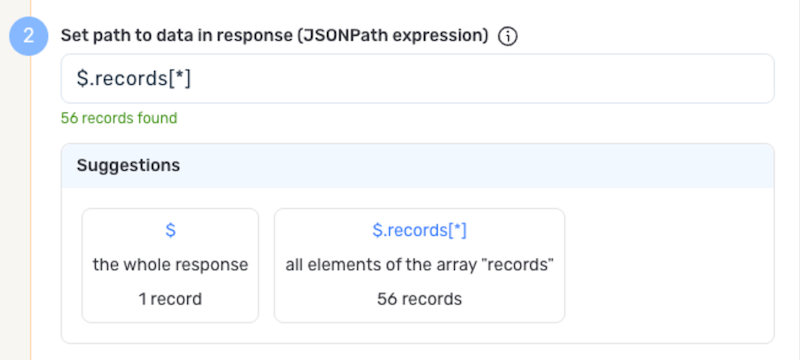
If only a subset of the data returned by the Salesloft API endpoint is needed, you can designate the part(s) of the response that should be included in the Nexset(s) produced from this source by specifying the path to the relevant data within the response.
Salesloft API responses commonly wrap the returned records in a data array at the top level of the response JSON. For example, a call to https://api.salesloft.com/v2/people returns a response with the format {"data": [...], "metadata": {...}}. In this case, you would specify $.data[*] to extract the individual person records.
Correctly specifying the path to data is important for Salesloft list endpoints, which wrap results in a data array. Without the correct path, Nexla may treat the entire response object (including pagination metadata) as a single record rather than extracting the individual items.
Autogenerate Path Suggestions
Nexla can also autogenerate data path suggestions based on the response from the API endpoint. These suggested paths can be used as-is or modified to exactly suit your needs.
-
To use this feature, click the Test button next to the Set API URL field to fetch a sample response from the API endpoint. Suggested data paths generated based on the content & format of the response will be displayed in the Suggestions box below the Set Path to Data in Response field.
-
Click on a suggestion to automatically populate the Set Path to Data in Response field with the corresponding path. The populated path can be modified directly within the field if further customization is needed.
If metadata is included in the response but is located outside of the defined path to relevant data, you can configure Nexla to include this data as common metadata in each record.
For example, Salesloft list responses include a metadata object at the top level that contains pagination information (total count, current page, filters applied). If you specify $.data[*] as the path to data, you can additionally specify $.metadata as the metadata path to attach pagination context to each extracted record.
Including Salesloft response metadata (such as total record counts and pagination details) can be useful when building monitoring or auditing workflows that need to track how many records were returned per API call.
-
If Nexla should include any additional request headers in API calls to this source, enter the headers & corresponding values as comma-separated pairs in the Request Headers field (e.g., header1:value1,header2:value2). Additional headers may be required for API versioning or content type specifications.
You do not need to include the Authorization header, as it is handled automatically by the Salesloft credential. The Content-Type and Accept headers are also managed automatically by Nexla.
Endpoint Testing
After configuring all settings for the selected endpoint, Nexla can retrieve a sample of the data that will be fetched according to the current configuration. This allows users to verify that the source is configured correctly before saving.
-
To test the current endpoint configuration, click the Test button to the right of the endpoint selection menu. Sample data will be fetched & displayed in the Endpoint Test Result panel on the right.
-
If the sample data is not as expected, review the selected endpoint and associated settings, and make any necessary adjustments. Then, click the Test button again, and check the sample data to ensure that the correct information is displayed.
Save & Activate the Source
- Once all of the relevant steps in the above sections have been completed, click the Create button in the upper right corner of the screen to save and create the new Salesloft data source. Nexla will now begin ingesting data from the configured endpoint and will organize any data that it finds into one or more Nexsets.