
Precoro Data Source

The Precoro connector enables you to ingest procurement data from your Precoro account into Nexla, including purchase requisitions, purchase orders, receipts, expenses, payments, suppliers, inventory items, contracts, budgets, and more. This connector is particularly useful for organizations that need to centralize procurement data for reporting, analytics, ERP synchronization, or compliance workflows. Follow the instructions below to create a new data flow that ingests data from a Precoro source in Nexla.
precoro_api.png

Precoro

Create a New Data Flow

  1. To create a new data flow, navigate to the Integrate section, and click the New Data Flow button. Then, select the desired flow type from the list, and click the Create button.

  2. Select the Precoro connector tile from the list of available connectors. Then, select the credential that will be used to connect to the Precoro instance, and click Next; or, create a new Precoro credential for use in this flow.

  3. In Nexla, Precoro data sources can be created using pre-built endpoint templates, which expedite source setup for common Precoro endpoints. Each template is designed specifically for the corresponding Precoro endpoint, making source configuration easy and efficient.
    • To configure this source using a template, follow the instructions in Configure Using a Template.

    Precoro sources can also be configured manually, allowing you to ingest data from Precoro endpoints not included in the pre-built templates or apply further customizations to exactly suit your needs.
    • To configure this source manually, follow the instructions in Configure Manually.

Configure Using a Template

Nexla provides pre-built templates that can be used to rapidly configure data sources to ingest data from common Precoro endpoints. Each template is designed specifically for the corresponding Precoro endpoint, making data source setup easy and efficient.

Endpoint Settings

  • Select the endpoint from which this source will fetch data from the Endpoint pulldown menu. Available endpoint templates are listed in the expandable boxes below. Click on an endpoint to see more information about it and how to configure your data source for this endpoint.

Get OCR Documents

Retrieve a list of OCR documents from the Precoro accounts payable system. Use this endpoint to access digitized invoice and receipt documents that have been processed through Precoro's OCR functionality for automated data extraction.

  • This endpoint retrieves all available OCR documents accessible to the authenticated user. No additional parameters are required beyond selecting this endpoint template.
  • The authenticated user's roles and data access permissions in Precoro determine which OCR documents are returned. Ensure the API key was generated under a user account with access to accounts payable documents.

For additional information about OCR documents in Precoro, refer to the Precoro OCR Documents API documentation.

Get Warehouse Requests List

Retrieve a paginated list of warehouse requests with optional filtering by modification date and approval date range. Use this endpoint when you need to synchronize warehouse request data with an external system or analyze internal inventory movement requests.

  • Configure the optional date filters to narrow the results returned by this endpoint:

    • Enter a date and time in the Modified Since field to retrieve only warehouse requests that have been modified after the specified date. Use ISO 8601 format (e.g., 2022-12-12T00:00:00). Leave blank to retrieve all warehouse requests regardless of modification date.
    • Enter a date and time in the Approval Left Date field to set the start of the approval date range filter. Use ISO 8601 format (e.g., 2022-12-12T00:00:00).
    • Enter a date and time in the Approval Right Date field to set the end of the approval date range filter. Use ISO 8601 format (e.g., 2024-01-10T00:00:00).
  • This endpoint uses page-based pagination to handle large result sets, automatically fetching up to 100 records per page and continuing to additional pages as needed.

All date filter fields are optional. When omitted, the endpoint returns all warehouse requests accessible to the authenticated user. For incremental data ingestion, set the Modified Since field to the date of your last successful run.

Get Purchase Requisitions List

Retrieve a paginated list of purchase requisitions with optional filtering by modification date and approval date range. Purchase requisitions (PRs) are internal requests submitted by employees to procure goods or services, and are the starting point of the Precoro procurement workflow.

  • Configure the optional date filters to narrow the results returned by this endpoint:

    • Enter a date and time in the Modified Since field to retrieve only purchase requisitions modified after the specified date. Use ISO 8601 format (e.g., 2022-12-12T00:00:00).
    • Enter a date and time in the Approval Left Date field to set the start of the approval date range filter. Use ISO 8601 format (e.g., 2022-12-12T00:00:00).
    • Enter a date and time in the Approval Right Date field to set the end of the approval date range filter. Use ISO 8601 format (e.g., 2024-01-10T00:00:00).
  • This endpoint uses page-based pagination and returns up to 100 records per page, automatically fetching additional pages as needed.

For additional information about purchase requisitions in Precoro, refer to the Precoro Purchase Requisitions API documentation.

Get Request For Proposals List

Retrieve a paginated list of requests for proposals (RFPs) with optional filtering by modification date. RFPs are documents sent to potential suppliers to solicit bids or quotations for goods and services.

  • Enter a date and time in the Modified Since field to retrieve only RFPs modified after the specified date. Use ISO 8601 format (e.g., 2022-12-12T00:00:00). Leave blank to retrieve all RFPs accessible to the authenticated user.
  • This endpoint uses page-based pagination and returns up to 100 records per page, automatically fetching additional pages as needed.

For additional information about requests for proposals in Precoro, refer to the Precoro RFP API documentation.

Get Purchase Orders List

Retrieve a paginated list of purchase orders with optional filtering by modification date, approval date range, and logic type. Purchase orders (POs) are formal documents issued to suppliers confirming the purchase of goods or services, and are a central record in the Precoro procurement workflow.

  • Configure the optional filters to narrow the results returned by this endpoint:

    • Enter a date and time in the Modified Since field to retrieve only purchase orders modified after the specified date. Use ISO 8601 format (e.g., 2023-10-10T00:00:00).
    • Enter a value in the Logic Type field to filter by document type. Enter 0 to retrieve standard purchase orders. Leave blank to retrieve all document types.
    • Enter a date and time in the Approval Left Date field to set the start of the approval date range filter. Use ISO 8601 format (e.g., 2023-10-10T00:00:00).
    • Enter a date and time in the Approval Right Date field to set the end of the approval date range filter. Use ISO 8601 format (e.g., 2024-01-10T00:00:00).
  • This endpoint uses page-based pagination and returns up to 100 records per page, automatically fetching additional pages as needed.

For additional information about purchase orders in Precoro, refer to the Precoro Purchase Orders API documentation.

Get Receipts List

Retrieve a paginated list of receipts with optional filtering by modification date and approval date range. Receipts in Precoro document the confirmation that ordered goods or services have been received, and are used to match against purchase orders in a three-way matching process.

  • Configure the optional date filters to narrow the results returned by this endpoint:

    • Enter a date and time in the Modified Since field to retrieve only receipts modified after the specified date. Use ISO 8601 format (e.g., 2022-12-12T00:00:00).
    • Enter a date and time in the Approval Left Date field to set the start of the approval date range filter. Use ISO 8601 format (e.g., 2022-12-12T00:00:00).
    • Enter a date and time in the Approval Right Date field to set the end of the approval date range filter. Use ISO 8601 format (e.g., 2024-01-10T00:00:00).
  • This endpoint uses page-based pagination and returns up to 100 records per page, automatically fetching additional pages as needed.

For additional information about receipts in Precoro, refer to the Precoro Receipts API documentation.

Get Expenses List

Retrieve a paginated list of expenses with optional filtering by modification date and approval date range. Use this endpoint to access employee expense records submitted and managed in Precoro for reporting, reimbursement tracking, or integration with financial systems.

  • Configure the optional date filters to narrow the results returned by this endpoint:

    • Enter a date and time in the Modified Since field to retrieve only expenses modified after the specified date. This field supports Nexla date macros — for example, the default value {'{now-30}'} retrieves records modified in the past 30 days. You can also enter a fixed ISO 8601 date (e.g., 2022-12-12T00:00:00).
    • Enter a date and time in the Approval Left Date field to set the start of the approval date range filter. Use ISO 8601 format (e.g., 2022-12-12T00:00:00).
    • Enter a date and time in the Approval Right Date field to set the end of the approval date range filter. Use ISO 8601 format (e.g., 2024-01-10T00:00:00).
  • This endpoint uses page-based pagination and returns up to 100 records per page, automatically fetching additional pages as needed.

For additional information about expenses in Precoro, refer to the Precoro Expenses API documentation.

Get Payments

Retrieve a list of all payments recorded in Precoro. Use this endpoint to access payment records for reconciliation, financial reporting, or synchronization with an accounting or ERP system.

  • This endpoint retrieves all payments accessible to the authenticated user. No additional parameters are required beyond selecting this endpoint template.
  • The authenticated user's roles and permissions in Precoro determine which payment records are returned.

For additional information about payments in Precoro, refer to the Precoro Payments API documentation.

Get Budgets List

Retrieve a list of all budgets configured in Precoro. Use this endpoint to access budget data for financial reporting, spend analysis, or integration with budgeting and planning tools.

  • This endpoint retrieves all budgets accessible to the authenticated user. No additional parameters are required beyond selecting this endpoint template.
  • The authenticated user's roles and access permissions in Precoro determine which budget records are returned.

For additional information about budgets in Precoro, refer to the Precoro Budgets API documentation.

Get Stock Transfers List

Retrieve a list of all stock transfers recorded in Precoro. Use this endpoint to track the movement of inventory items between warehouses for reconciliation or inventory management reporting.

  • This endpoint retrieves all stock transfer records accessible to the authenticated user. No additional parameters are required beyond selecting this endpoint template.

For additional information about stock transfers in Precoro, refer to the Precoro Stock Transfers API documentation.

Get Warehouse Items

Retrieve a list of items currently held in a specific warehouse. Use this endpoint to access warehouse inventory levels for a particular warehouse location, enabling stock visibility and inventory reporting.

  • Enter the ID of the warehouse whose items you want to retrieve in the Warehouse ID field. This field is required. Warehouse IDs can be obtained by first running the Get Warehouses List endpoint.
  • The endpoint returns all items in the specified warehouse that are accessible to the authenticated user.

For additional information about warehouse items in Precoro, refer to the Precoro Warehouse Items API documentation.

Get Stock-Takings List

Retrieve a list of all stock takings (physical inventory counts) recorded in Precoro. Use this endpoint to access records of inventory reconciliation activities conducted in your warehouses.

  • This endpoint retrieves all stock-taking records accessible to the authenticated user. No additional parameters are required beyond selecting this endpoint template.

For additional information about stock takings in Precoro, refer to the Precoro Stock-Takings API documentation.

List Suppliers

Retrieve a paginated list of suppliers registered in Precoro, with optional filtering by modification date. Use this endpoint to synchronize supplier master data with an ERP, accounting system, or vendor management platform.

  • Enter a date and time in the Modified Since field to retrieve only suppliers modified after the specified date. Use ISO 8601 format (e.g., 2022-12-12T00:00:00). Leave blank to retrieve all suppliers.
  • This endpoint uses page-based pagination and returns up to 100 records per page, automatically fetching additional pages as needed.

For additional information about suppliers in Precoro, refer to the Precoro Suppliers API documentation.

List Items

Retrieve a paginated list of inventory items (catalog products) configured in Precoro, with optional filtering by modification date. Use this endpoint to synchronize your item catalog with an external system or analyze items available for procurement.

  • Enter a date and time in the Modified Since field to retrieve only items modified after the specified date. Use ISO 8601 format (e.g., 2022-12-12T00:00:00). Leave blank to retrieve all items.
  • This endpoint uses page-based pagination and returns up to 100 records per page, stopping automatically when no more data is available.

For additional information about items in Precoro, refer to the Precoro Items API documentation.

List Contracts

Retrieve a list of supplier contracts managed in Precoro. Use this endpoint to access contract data for spend analysis, compliance tracking, or contract lifecycle management integrations.

  • This endpoint retrieves all contracts accessible to the authenticated user. No additional parameters are required beyond selecting this endpoint template.

For additional information about contracts in Precoro, refer to the Precoro Contracts API documentation.

List Document Custom Fields

Retrieve a list of custom fields available for documents in Precoro. Document custom fields allow organizations to capture additional metadata on procurement documents such as purchase orders and invoices. Use this endpoint to understand the custom field schema before building integrations that rely on custom field data.

  • This endpoint retrieves all document custom field definitions accessible to the authenticated user. No additional parameters are required beyond selecting this endpoint template.

For additional information about document custom fields in Precoro, refer to the Precoro Document Custom Fields API documentation.

Get Legal Entities List

Retrieve a list of all legal entities configured in Precoro. Legal entities represent the companies or organizational units within your Precoro account. Use this endpoint to synchronize company and entity data with an ERP or financial system.

  • This endpoint retrieves all legal entities accessible to the authenticated user. No additional parameters are required beyond selecting this endpoint template.
  • This endpoint uses offset-based pagination and returns up to 100 records per page, stopping automatically when no more data is available.

Get Warehouses List

Retrieve a list of all warehouses configured in the Precoro inventory system. Use this endpoint to access warehouse location data, or to obtain warehouse IDs required by other endpoints such as Get Warehouse Items.

  • This endpoint retrieves all warehouses accessible to the authenticated user. No additional parameters are required beyond selecting this endpoint template.
  • This endpoint uses offset-based pagination and returns up to 100 records per page, stopping automatically when no more data is available.

Get Tax List

Retrieve a list of all tax configurations defined in Precoro. Use this endpoint to access tax rate and category data for reporting or synchronization with accounting and financial systems.

  • This endpoint retrieves all tax configurations accessible to the authenticated user. No additional parameters are required beyond selecting this endpoint template.
  • This endpoint uses offset-based pagination and returns up to 100 records per page, stopping automatically when no more data is available.

Endpoint Testing

Once the selected endpoint template has been configured, Nexla can retrieve a sample of the data that will be fetched according to the current settings. This allows users to verify that the source is configured correctly before saving.

  • To test the current endpoint configuration, click the Test button to the right of the endpoint selection menu. Sample data will be fetched & displayed in the Endpoint Test Result panel on the right.

  • If the sample data is not as expected, review the selected endpoint and associated settings, and make any necessary adjustments. Then, click the Test button again, and check the sample data to ensure that the correct information is displayed.

Configure Manually

Precoro data sources can be manually configured to ingest data from any valid Precoro API endpoint. Manual configuration provides maximum flexibility for accessing endpoints not covered by pre-built templates or when you need custom API configurations.

With manual configuration, you can also create more complex Precoro sources, such as sources that use chained API calls to fetch data from multiple endpoints or sources that require custom request parameters.

The Precoro API base URL is https://api.precoro.com. The Precoro API enforces rate limits of 60 requests per minute, 1,500 per hour, and 3,000 per day. For information about available Precoro API endpoints and their parameters, refer to the Precoro API documentation.

API Method

  1. To manually configure this source, select the Advanced tab at the top of the configuration screen.

  2. Select the API method that will be used for calls to the Precoro API from the Method pulldown menu. Most Precoro data retrieval operations use GET.

API Endpoint URL

  1. Enter the URL of the Precoro API endpoint from which this source will fetch data in the Set API URL field. This should be the complete URL including the protocol (https://) and any required path or query parameters.

Ensure the API endpoint URL is correct and accessible with your current credentials. Many Precoro list endpoints support query parameters such as modifiedSince, approvalLeftDate, and approvalRightDate for filtering results. You can test the endpoint using the Test button after configuring the URL.

Date/Time Macros (API URL)

Optional

Optionally, the API URL can be customized using macros—all macros added to the API URL will be converted into values when Nexla executes the API call. Macros are dynamic placeholders that allow you to create flexible API endpoints that can adapt to different time periods or data requirements. This is particularly useful for Precoro endpoints that accept date filter parameters such as modifiedSince or approvalLeftDate.

Macros are useful for Precoro APIs that require date ranges. For example, you can use {'{now-1}'} in a modifiedSince query parameter to always retrieve records modified since the previous day, enabling incremental data ingestion without manually updating the date.

  1. To add a macro, type { at the appropriate position in the API URL (within the Set API URL field), and select the desired macro from the dropdown list.

    • {now} – The current datetime
    • {now-1} – The datetime one time unit before the current datetime
    • {now+1} – The datetime one time unit after the current datetime
    • custom – Datetime macros can reference any number of time units before or after the current datetime—for example, enter (now-4) to indicate the datetime four time units before the current datetime
  2. Select the format that will be applied to datetime macros from the Date Format for Date/Time Macro pulldown menu. This format will be applied to the base datetime value of the macro—i.e., the value of {now} in {now-1}.

  3. Select the datetime unit that will be used to perform mathematical operations in the included macro(s) from the Time Unit for Operations pulldown menu—for example, for the macro {now-1}, when Day is selected, {now-1} will be converted to the datetime one day before the current datetime.

Lookup-Based Macros (API URL)

Optional

Column values from existing lookups can also be included as macros in the API URL. Lookup-based macros allow you to reference data from previously configured data sources or lookups, enabling dynamic API endpoints that can adapt based on existing data. For example, you could reference warehouse IDs retrieved from the Precoro Warehouses endpoint to dynamically build requests to the Warehouse Items endpoint.

Lookup-based macros are useful when you need to create API endpoints that reference specific IDs, values, or parameters from other data sources in your Nexla environment.

  1. To include a lookup column value macro, select the relevant lookup from the Add Lookups to Supported Macros pulldown menu.

  2. Type { at the appropriate position in the API URL, and select the lookup column-based macro from the dropdown list. Lookup-based macros are automatically populated into the macro list when a lookup is selected in the Add Lookups to Supported Macros pulldown menu.

Path to Data

Optional

If only a subset of the data returned by a Precoro API endpoint is needed, you can designate the part(s) of the response that should be included in the Nexset(s) produced from this source by specifying the path to the relevant data within the response. Most Precoro API endpoints return a top-level data array containing the relevant records, along with pagination metadata.

For example, when a request is made to a Precoro list endpoint, the API returns a JSON object with a top-level data array containing the records. By entering the path to the data array, you can configure Nexla to treat each element as a separate record.

For most Precoro list endpoints, the path to the relevant data is $.data[*], which points to the array of records within the top-level data property of the response.

  • To specify which data should be treated as relevant in responses from this source, enter the path to the relevant data in the Set Path to Data in Response field.

    • For responses in JSON format, enter the JSON path that points to the object or array that should be treated as relevant data. JSON paths use dot notation (e.g., $.data[*] to access the array of records within the top-level data property).
    Path to Data Example:

    For a Precoro list endpoint that returns a JSON response with a top-level array named data containing the relevant records, enter the path as $.data[*].

Autogenerate Path Suggestions

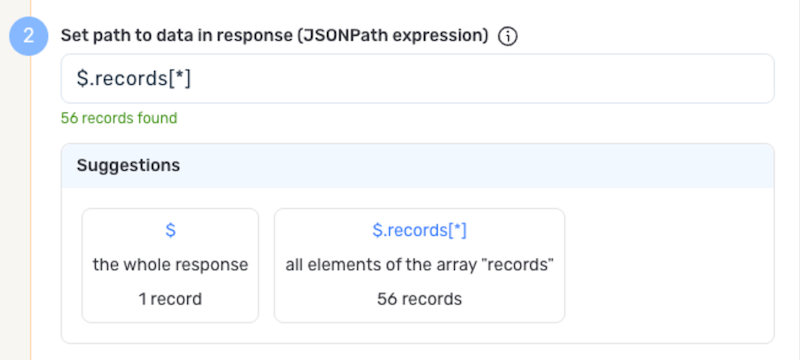
Nexla can also autogenerate data path suggestions based on the response from the API endpoint. These suggested paths can be used as-is or modified to exactly suit your needs.

  • To use this feature, click the Test button next to the Set API URL field to fetch a sample response from the API endpoint. Suggested data paths generated based on the content & format of the response will be displayed in the Suggestions box below the Set Path to Data in Response field.

  • Click on a suggestion to automatically populate the Set Path to Data in Response field with the corresponding path. The populated path can be modified directly within the field if further customization is needed.
    PathSuggestions.png

Metadata

If metadata is included in the response but is located outside of the defined path to relevant data, you can configure Nexla to include this data as common metadata in each record. This is useful when you want to preserve contextual information from Precoro API responses — such as total record counts or pagination details — that applies to all records but is not part of the main data array.

Metadata paths are particularly useful for preserving API response context like total record counts, pagination information, or summary statistics that apply to all records in the Precoro response.

  • To specify the location of metadata that should be included with each record, enter the path to the relevant metadata in the Path to Metadata in Response field.

    • For responses in JSON format, enter the JSON path to the object or array that contains the metadata.

Request Headers

Optional
  • If Nexla should include any additional request headers in API calls to this source, enter the headers & corresponding values as comma-separated pairs in the Request Headers field (e.g., header1:value1,header2:value2). Additional headers may be required for API versioning or custom request requirements.

    You do not need to include the X-AUTH-TOKEN or email authentication headers in this field — these are handled automatically by the Precoro credential configured for this source.

Endpoint Testing

After configuring all settings for the selected endpoint, Nexla can retrieve a sample of the data that will be fetched according to the current configuration. This allows users to verify that the source is configured correctly before saving.

  • To test the current endpoint configuration, click the Test button to the right of the endpoint selection menu. Sample data will be fetched & displayed in the Endpoint Test Result panel on the right.

  • If the sample data is not as expected, review the selected endpoint and associated settings, and make any necessary adjustments. Then, click the Test button again, and check the sample data to ensure that the correct information is displayed.

Save & Activate the Source

  1. Once all of the relevant steps in the above sections have been completed, click the Create button in the upper right corner of the screen to save and create the new Precoro data source. Nexla will now begin ingesting data from the configured endpoint and will organize any data that it finds into one or more Nexsets.